
Alabama Commercial Mold Inspections: Protect Property & Tenants


Most commercial property owners in Alabama assume that a mold problem means weeks of lab testing, stacks of reports, and a bill that rivals a small renovation. That assumption is wrong, and it costs people time and money every year. The reality is that most professional mold inspections rely primarily on visual evidence, moisture mapping, and targeted sampling only when truly needed. Alabama’s Gulf Coast climate creates real mold risk year-round, but the inspection process is more practical and straightforward than the industry sometimes makes it sound. This guide walks you through what a commercial mold inspection actually involves, what the law requires, and how to protect your tenants and your investment without overspending.
Key Takeaways
Point | Details |
Focus on safety | Alabama law centers on providing safe conditions, not mandatory mold tests. |
Prioritize moisture control | Fixing leaks and keeping humidity in check is crucial for prevention. |
Visual inspection comes first | Sampling is not routine—inspectors rely on visual evidence and moisture detection. |
Edge cases need action | HVAC contamination and Condition 2/3 results require professional remediation. |
Separate inspection and remediation | Hire different companies for unbiased findings and reduced liability risks. |
Why mold matters in Alabama commercial properties
Alabama sits in one of the most humid regions in the country. Average indoor relative humidity in coastal counties regularly climbs above 70 percent during summer months, and that is the exact environment mold needs to colonize building materials fast. A small roof leak after a Gulf storm can become a serious mold problem inside two weeks if no one catches it early.
Mold is not just a cosmetic issue. It can trigger respiratory problems, worsen asthma, and create legal exposure for property owners who ignore it. Tenants who develop health complaints tied to mold have successfully pursued landlords in civil court, even in states with minimal mold-specific statutes. Your commercial building inspection strategy needs to account for this risk proactively, not reactively.
Here is what Alabama property managers need to know about their obligations:
General duty: Alabama landlords must provide a safe, habitable environment. This obligation applies to commercial leases where tenants operate businesses and employ workers.
OSHA coverage: Worker areas fall under federal Occupational Safety and Health Administration (OSHA) standards. If mold creates an unsafe work environment, OSHA can get involved.
EPA guidance: The EPA guidance on mold does not set numeric spore limits, but it does establish best practices that courts and regulators reference.
No state-specific limits: Alabama has no numeric airborne spore thresholds. Compliance is judged against habitability standards and federal safety guidance.
“Fix moisture first, conduct annual checks, and perform post-remediation verification after any work. Alabama general duty flows through OSHA and EPA guidance, not a dedicated state mold statute.”
The bottom line is that you do not need a specific Alabama mold law to face real legal and financial consequences. Ignoring mold in a tenant space is a liability regardless of what the state code does or does not say.
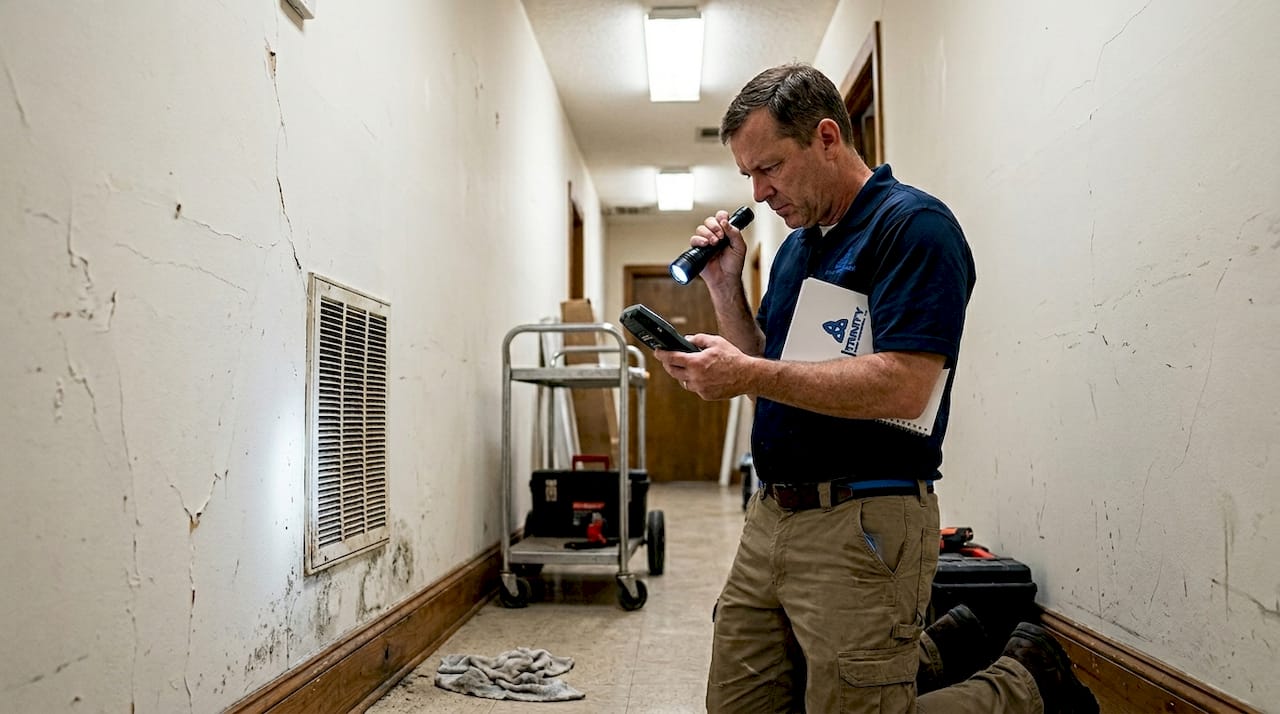
What a professional commercial mold inspection includes
A thorough commercial mold inspection is not a random walk-through with a flashlight. It follows a structured process designed to find moisture problems before they become mold problems, and to confirm mold presence when visual evidence is ambiguous. Commercial mold inspections involve visual assessment, moisture mapping with meters and infrared cameras, and targeted sampling only when needed.
Here is how a professional inspection unfolds step by step:
Initial interview: The inspector asks about tenant complaints, past water events, HVAC history, and any visible staining. This context shapes where the inspector focuses attention.
Visual inspection: Every accessible surface is examined, including walls, ceilings, crawl spaces, mechanical rooms, and roof penetrations. Visible mold growth is documented with photos.
Moisture mapping: A calibrated moisture meter measures moisture content in drywall, wood framing, and concrete. Readings above baseline flag areas for closer review.
Infrared thermal imaging: An infrared camera detects temperature differences that indicate hidden moisture behind walls or under flooring, without cutting into anything.
Targeted sampling: Air or surface swab samples are collected only when the inspector cannot determine the extent of growth visually, or when a tenant health complaint requires documentation.
Report delivery: Findings are organized by severity, with photos, moisture readings, and recommended next steps.
The inspection workflow is designed to give you actionable answers, not just data.
“Sampling is not a routine step. It is a tool used to answer a specific question when visual evidence alone is not enough.”
Pro Tip: If you can see mold, you do not need to test it first. The EPA is clear that visible mold should be remediated regardless of species. Spending money on lab tests before removing visible growth delays action and adds cost without changing the outcome.
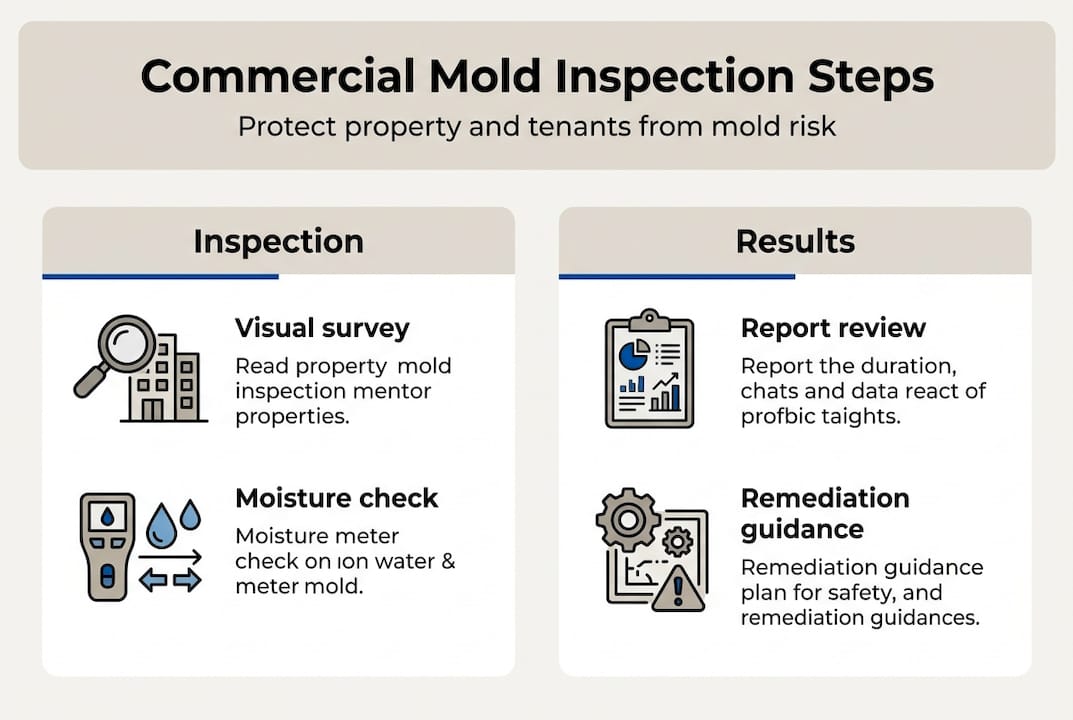
Interpreting inspection results: What really matters
Getting a report back is one thing. Knowing what to do with it is another. Inspectors and industrial hygienists generally classify mold contamination into three condition levels, and understanding these helps you prioritize your response.
Condition level | What it means | Typical action required |
Condition 1: Normal ecology | Indoor spore types and counts match outdoor baseline | No remediation needed; monitor moisture |
Condition 2: Settled spores | Elevated spores from adjacent contaminated areas | Identify and address moisture source; clean HVAC |
Condition 3: Active growth | Visible colonies or heavily elevated indoor counts | Full remediation required; PRV testing after |
There are no federal or state numeric spore limits. Inspectors compare indoor spore counts to outdoor baseline samples and look for indicator species like Stachybotrys (often called black mold) that signal serious water damage history. A high total spore count is not automatically alarming if the types match what is outside. Context matters.
Post-remediation verification (PRV) testing is one of the most skipped and most important steps in the process. PRV confirms that remediation actually worked before you allow tenants back into a space. Skipping it leaves you legally exposed if a tenant later claims ongoing health issues.
Key situations that require immediate escalation:
HVAC contamination: Mold inside ductwork or air handling units distributes spores throughout the entire building. This is a high-risk scenario that requires a broader remediation response.
Hidden moisture behind walls: Infrared findings that suggest moisture but show no visible mold still warrant investigation. Mold can be actively growing inside a wall cavity.
Tenant health complaints on record: Once a complaint is documented, you need a paper trail showing you investigated and acted. Inspection reports in Mobile and across Alabama serve as that documentation.
Review your mold test results with your inspector before making any remediation decisions. A good inspector explains what the numbers mean in plain language.
Alabama law, regulations, and your legal duties
Alabama does not have a dedicated commercial mold inspection law. There is no state licensing requirement for mold inspectors, no mandated reporting threshold, and no required tenant disclosure form specific to mold. That might sound like good news, but it cuts both ways.
Alabama lacks mold-specific laws for commercial buildings, so compliance falls under general habitability obligations and OSHA standards. Here is what that means practically:
Implied habitability: Courts have consistently held that landlords must maintain conditions safe enough for the intended use of the space. A tenant operating a business in a moldy building has grounds for a lease dispute or civil claim.
OSHA worker protection: If your tenants employ workers, OSHA’s General Duty Clause requires employers to provide a workplace free of recognized hazards. Mold qualifies. If OSHA investigates and finds mold, the building owner can be drawn into the complaint.
No required disclosure, but real liability: You are not legally required to disclose mold history in Alabama, but failing to address a known mold problem and renting the space anyway creates significant civil exposure.
EPA commercial property guidance is the practical standard courts and regulators reference when evaluating whether an owner acted reasonably.
Understanding the duties of inspectors and your own obligations as an owner helps you build a defensible record of responsible management.
Pro Tip: Always hire your inspector and your remediator separately. Using the same company for both creates a conflict of interest. An inspector who also sells remediation has a financial incentive to find problems. Separation protects you legally and ensures you get an honest assessment.
How often and how much: Scheduling and budgeting for inspections
Frequency and cost are the two questions every property manager asks. The answer depends on your building’s risk profile, but there are clear benchmarks to work from.
Annual inspections are the minimum for most commercial properties. High-humidity buildings, properties with older HVAC systems, or any building that experienced water intrusion in the past 12 months should move to quarterly checks. Gulf Coast Alabama properties near the water fall into the high-risk category almost by default.
Cost ranges for commercial mold services in 2026:
Service | Typical cost range | Notes |
Visual inspection only | $300 to $600 | Appropriate for routine checks |
Full inspection with moisture mapping | $600 to $1,500 | Recommended for most commercial buildings |
Inspection plus air sampling | $1,000 to $3,000 | Used when extent is unclear or complaints exist |
Full remediation (small area) | $1,000 to $4,000 | Under 100 square feet of affected material |
Full remediation (large area) | $4,000 to $8,000+ | Extensive growth or HVAC involvement |
Early detection consistently saves money. Catching mold early can reduce remediation costs by tens of thousands of dollars compared to addressing a problem that has spread through walls, flooring, and ductwork.
Here is a practical schedule to build into your property management program:
Move-in inspection: Document baseline conditions before a new tenant takes possession. This protects you from claims that mold predated their tenancy.
Annual inspection: Schedule every 12 months, ideally before peak humidity season in late spring.
Post-storm inspection: After any significant rain event, flooding, or roof damage, inspect within two weeks.
Tenant reporting program: Give tenants a simple process to report moisture or musty odors. Fast reporting is your best early warning system.
Use your inspection scheduling process to build a consistent record across all your properties.
Expert insights and common pitfalls
Even experienced property managers make mistakes that turn manageable mold issues into expensive ones. Here are the patterns we see most often, and how to avoid them.
Physical removal is the only real fix. Biocides and encapsulation are not substitutes for removing contaminated material. Spraying a chemical on mold and painting over it leaves dead spores in place, and those spores can still trigger allergic reactions. Proper remediation means removing the affected material and addressing the moisture source.
Common pitfalls to avoid:
Skipping PRV testing: Remediation without post-remediation verification is like surgery without a follow-up appointment. You have no confirmation the problem is resolved.
Hiring one company for both inspection and remediation: This is the most common conflict of interest in the industry. Keep these roles separate.
Ignoring tenant complaints: A documented complaint that goes unaddressed is a liability waiting to happen. Respond in writing and act quickly.
Treating HVAC as an afterthought: Mold inside an air handling unit spreads spores to every room the system serves. HVAC contamination requires a full-scale response, not a surface wipe-down.
Relying on smell alone: A musty odor is a signal, not a diagnosis. Some active mold growth has no odor, and some odors come from non-mold sources. Always verify with an inspection.
Building better indoor air quality starts with controlling moisture at the source, not masking symptoms.
Pro Tip: Invest in routine HVAC cleaning and coil inspections at least once a year. A contaminated air handling unit requires a full-scale remediation response that can shut down tenant operations for days. Prevention costs a fraction of that.
Get expert mold inspections for your Alabama property
You now have a clear picture of what commercial mold inspections involve, what Alabama law requires, and how to build a practical inspection schedule that protects your tenants and your investment. The next step is working with a certified inspector who knows Gulf Coast Alabama conditions and gives you straight answers, not upsells.

At Trinity Home Inspections, we provide mold inspection services in Alabama backed by InterNACHI certification, thermal imaging, moisture meters, and same-day reports. Matt Cameron and the Trinity team serve Mobile, Baldwin, Escambia, and surrounding counties with the kind of honest, thorough inspections you can build a legal and safety record on. If you need a Mobile AL mold inspector or coverage across the Gulf Coast region, we are ready to schedule around your tenants and your timeline. Reach out today for a tailored risk assessment.
Frequently asked questions
Are commercial mold inspections required by law in Alabama?
No Alabama law mandates mold inspections for commercial buildings, but owners must provide habitable, safe conditions under general landlord responsibilities and OSHA standards.
When is mold testing or sampling necessary for my property?
Testing is only needed when the visible mold’s extent or remediation success cannot be confirmed visually, as recommended by the EPA. If you can see it, remove it.
How often should Alabama commercial buildings be inspected for mold?
Annually at minimum for most properties, or quarterly for high-humidity buildings, older HVAC systems, or any property with a recent water intrusion history.
What qualifications should a mold inspector have in Alabama?
Alabama does not require inspector licensing, so look for certifications from InterNACHI, AIHA (American Industrial Hygiene Association), or inspectors with formal industrial hygiene training and verifiable credentials.
Can I use the same company for mold inspection and remediation?
It is best to separate these roles. Using one firm for both creates a financial conflict of interest and can undermine the credibility of your inspection results if a dispute ever reaches court.
Recommended

