
Does a Manufactured Home Need an Engineer Certificate to Sell or Refinance?

An engineer certificate for a manufactured home is a licensed engineer’s sealed report confirming the home’s foundation meets HUD permanent foundation standards, and most lenders require it before approving a mortgage, refinance, or government-backed loan. Without this document, your manufactured home is typically classified as personal property rather than real property, which severely limits your financing options and can stop a sale or refinance in its tracks. Whether you are selling a manufactured home in Mobile County, refinancing in Baldwin County, or buying one anywhere along the Gulf Coast, understanding this requirement upfront saves you time, money, and serious frustration.
Does a manufactured home need an engineer certificate to sell or refinance?
The short answer is: yes, in most cases. The longer answer depends on your loan type, your lender, and your home’s current foundation status. The engineer certificate, sometimes called a HUD foundation certification or an engineer letter, is a loan-file document that verifies the manufactured home is permanently installed and eligible to be treated as real property for mortgage underwriting purposes.
When a manufactured home is classified as real property, it qualifies for conventional, FHA, VA, and USDA mortgage products. When it is classified as personal property, it is limited to chattel loans, which carry higher interest rates and shorter repayment terms. That distinction alone can mean thousands of dollars in additional cost over the life of a loan.

For sellers, the certificate matters because most buyers financing through a traditional mortgage lender will need it to close. For homeowners refinancing, lenders require it to confirm the home qualifies as real property before issuing a new loan. Fannie Mae requires both a HUD Data Plate and permanent foundation evidence to qualify a manufactured home for real property mortgage financing. That means even if your home has been on the same lot for 20 years, the lender still needs a licensed engineer to confirm the foundation meets the standard.
Pro Tip: Order the engineer certificate before you list your home for sale or apply for refinancing. Waiting until you are under contract adds unnecessary pressure and can delay closing by weeks.
Here is a quick breakdown of how the certificate requirement plays out across common transaction types:
Conventional loans (Fannie Mae/Freddie Mac): Engineer certificate required to confirm permanent foundation and real property status.
FHA loans: Foundation certification required per HUD guidelines; the engineer must be licensed in the state where the home is located.
VA loans: Foundation certification required; VA appraisers will flag missing certification as a condition of loan approval.
USDA loans: Permanent foundation certification required for rural housing loan eligibility.
Cash sales: No lender requirement, but buyers may still request certification for their own peace of mind or future financing purposes.
How is an engineer certificate for a manufactured home obtained?
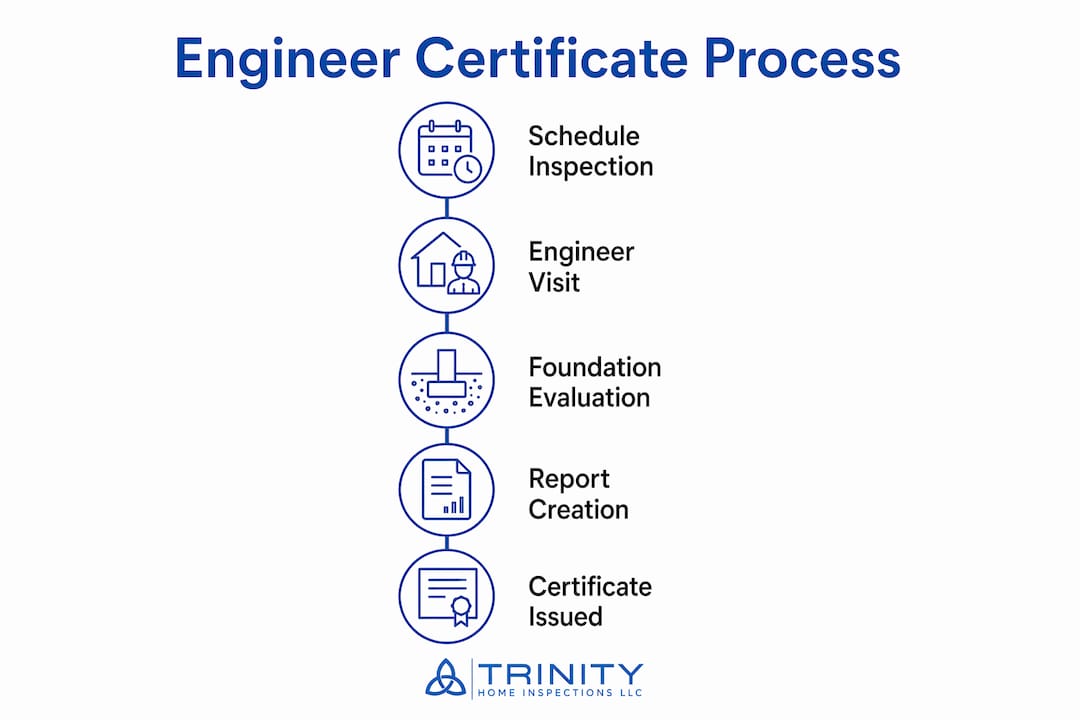
The certification process follows a defined workflow, and knowing each step helps you avoid surprises. Certification typically requires coordination between an on-site technician who collects detailed data and a licensed engineer who reviews that data and issues the official sealed report.
Here is how the process typically unfolds:
Hire a qualified engineering firm. Choose a firm with specific experience in HUD foundation standards. General structural engineers without manufactured housing experience can cause delays or produce reports that lenders reject.
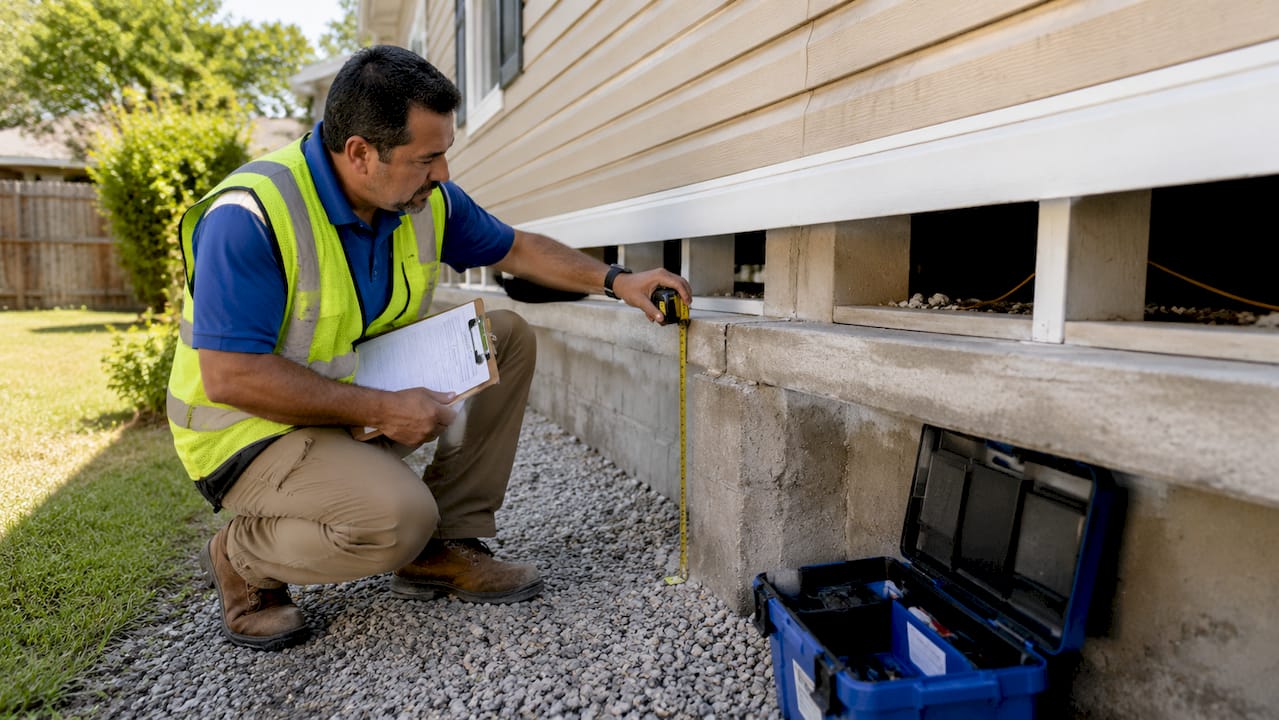
Schedule the on-site inspection. A technician visits the property to document the foundation type, anchorage system, pier spacing, soil conditions, and drainage. They photograph every relevant component.
Engineer review and analysis. The licensed engineer reviews the field data and evaluates compliance with HUD Guideline 4930.3G, which governs permanent foundation requirements for manufactured housing.
Sealed report issuance. If the foundation passes, the engineer issues a signed and sealed certification letter. This document goes into the loan file.
Deficiency correction (if needed). If the foundation does not meet standards, the engineer identifies what must be corrected. After repairs, a re-inspection is required before certification is issued.
The timeline from inspection to report delivery ranges from a few days to several weeks, depending on the engineer’s workload and the complexity of the foundation. Experienced engineers with HUD-specific expertise avoid the inspection hold-ups that less specialized firms create.
Certification fees typically range from $400 to $700, with variation based on home size and local soil or seismic conditions. Additional charges apply if remediation and re-inspection are needed. That cost is modest compared to the financing advantages it unlocks.
Pro Tip: Ask the engineering firm directly whether they have completed HUD 4930.3G certifications before. If they hesitate or are unfamiliar with that guideline number, keep looking.
What are the HUD permanent foundation standards and why do they matter?
HUD Guideline 4930.3G, titled “Permanent Foundations Guide for Manufactured Housing,” is the federal standard that defines what qualifies as a permanent foundation. Lenders use this guideline as the benchmark when deciding whether a manufactured home is eligible for real property financing. Understanding what it covers helps you know what an engineer is actually evaluating during the inspection.
The guideline addresses four core areas:
Foundation Element | What the Engineer Evaluates |
Soil and load transfer | Whether the foundation distributes the home’s weight to stable soil without settling or shifting |
Anchorage system | Whether the home is anchored to resist wind uplift and lateral loads from storms |
Drainage | Whether water is directed away from the foundation to prevent erosion and moisture damage |
Foundation type | Whether the foundation type (slab, perimeter wall, piers) meets permanence criteria |
The engineering analysis covers soil and load transfer, anchoring to resist uplift and lateral loads, and drainage effectiveness. This is far more involved than simply confirming concrete is present under the home. A home sitting on concrete blocks without proper anchorage, for example, does not meet the standard even though it appears to have a solid base.
Why does this matter for your transaction? Lenders use the permanent foundation classification to assess risk. A home that cannot be certified as permanently installed is harder to repossess and resell in a default scenario, which makes lenders unwilling to extend standard mortgage terms. The engineer certificate removes that uncertainty by providing a licensed professional’s documented confirmation that the home meets the required standard.
Non-compliance has real financial consequences. Without certification, homes qualify only for chattel loans with higher costs and shorter terms, which reduces the pool of qualified buyers and limits your refinancing options to less favorable products.
What nuances affect the necessity of an engineer certificate for different loan types?
Not every manufactured home transaction triggers the same certification requirements. Several factors shape whether and how the engineer certificate applies to your specific situation.
Loan type variations:
FHA loans follow HUD guidelines strictly and require a state-licensed engineer to sign the certification. Lender overlays sometimes add requirements beyond the baseline HUD standard.
VA loans require foundation certification and the VA appraiser independently verifies compliance. Missing documentation is flagged as a loan condition that must be resolved before closing.
USDA Rural Development loans require permanent foundation certification for all manufactured homes financed under their programs.
Conventional loans through Fannie Mae and Freddie Mac both require HUD Data Plate verification and permanent foundation evidence, though specific lender overlays vary.
Home-specific factors that affect certification:
Age of the home: Homes built before June 15, 1976, do not carry a HUD label and cannot be certified under HUD standards. These homes are generally ineligible for government-backed financing regardless of foundation condition.
Size and configuration: Multi-section homes have more complex foundation requirements than single-section homes, which can affect inspection scope and cost.
Permanent attachment status: If the home’s title has not been converted from personal property to real property, the certification alone is not sufficient. Title conversion must accompany the certification as part of the full documentation package.
Local building codes: Some Alabama counties have additional requirements beyond the federal HUD standard. Your engineer should be familiar with local codes in Mobile, Baldwin, and surrounding counties.
The full documentation package required for refinancing or selling includes HUD labels, permanent foundation evidence, and proper titling. The engineer certificate is one critical piece of that package, not a standalone solution.
How can manufactured home owners navigate the certification requirement efficiently?
Getting through the engineer certificate process without delays comes down to preparation and choosing the right professionals. Here is a practical checklist to keep your sale or refinance on track:
Start early. Order the certification at the beginning of the process, not after you are under contract. Delays in certification are one of the most common reasons manufactured home transactions fall apart at closing.
Gather your HUD documentation first. Locate your HUD Data Plate and HUD labels (the red tags on the exterior) before the engineer visits. Missing labels can require a separate verification process through the Institute for Building Technology and Safety (IBTS).
Confirm title status. Verify whether your home is titled as real property or personal property with your county. If it is still titled as personal property, begin the conversion process in parallel with the certification.
Choose an engineer with HUD experience. Ask specifically about HUD 4930.3G certifications and request references from lenders they have worked with previously.
Address known foundation issues before the inspection. If you know the home has pier spacing problems, missing tie-downs, or drainage issues, correct them before the engineer visits. Re-inspections add cost and time.
Coordinate with your lender early. Ask your lender exactly what their certification requirements are, including any overlays beyond the standard HUD guidelines. Different lenders sometimes have slightly different documentation formats they accept.
Here is a side-by-side comparison of what a prepared homeowner versus an unprepared homeowner typically experiences:
Scenario | Prepared Homeowner | Unprepared Homeowner |
Timeline | Certification complete before listing or loan application | Certification ordered after contract, causing closing delays |
Cost | Standard fee of $400 to $700 | Standard fee plus re-inspection charges for discovered deficiencies |
Loan outcome | Smooth underwriting with complete documentation | Loan conditions issued, potential deal fall-through |
Buyer confidence | Buyers see certified foundation, fewer objections | Buyers uncertain, may request price reduction or walk away |
A thorough pre-sale inspection of your manufactured home before the engineer visit gives you a clear picture of what the engineer will find. Knowing the condition of your foundation, anchorage, and drainage in advance lets you make corrections on your timeline rather than under contract pressure.
Key takeaways
An engineer certificate is a lender-required document confirming a manufactured home’s permanent foundation compliance with HUD standards, and without it, most mortgage financing for selling or refinancing is unavailable.
Point | Details |
Certificate is lender-driven | FHA, VA, USDA, and conventional lenders all require it to classify the home as real property. |
HUD 4930.3G is the standard | The engineer evaluates soil load transfer, anchorage, drainage, and foundation type against this guideline. |
Cost ranges from $400 to $700 | Additional re-inspection fees apply if foundation deficiencies require correction before certification. |
Start the process early | Ordering certification before listing or applying for refinancing prevents closing delays. |
Full documentation package required | The certificate works alongside HUD labels, title conversion, and permanent foundation evidence. |
What I have learned from manufactured home certifications on the Gulf Coast
By Matt Cameron, Trinity Home Inspections
After inspecting manufactured homes across Mobile, Baldwin, and surrounding counties, the pattern I see most often is this: homeowners are caught off guard by the engineer certificate requirement when they are already under contract. They assumed the home was “fine” because it had been sitting on the same foundation for years. But lenders do not care how long the home has been there. They care whether a licensed engineer has confirmed it meets HUD standards right now.
The most overlooked issue I encounter is anchorage. A home can have a solid concrete perimeter and still fail certification because the tie-down straps are corroded, missing, or improperly spaced. That is not visible from a casual walkthrough. It requires someone who knows what to look for and where to look.
My honest advice: do not wait for a lender to tell you there is a problem. Get a manufactured home inspection done before you list or apply. Know what your foundation looks like before an engineer shows up with a clipboard. The cost of fixing a tie-down issue on your own schedule is a fraction of what it costs when a closing deadline is looming.
The other thing I tell homeowners is to treat the engineer certificate as part of a broader documentation effort. Confirm your HUD labels are present, check your title status, and review your foundation certification options early. When all of that is in order before you go to market, transactions close faster and with far fewer surprises.
— Matt
Get your manufactured home inspection done right the first time
[

If you are preparing to sell or refinance a manufactured home in Mobile, Baldwin, Escambia, or surrounding Gulf Coast Alabama counties, Trinity Home Inspections gives you the clear, documented picture of your home’s condition before the engineer or lender ever gets involved. Our InterNACHI-certified inspections include free thermal imaging, same-day reports packed with photos and video, and post-inspection support so you know exactly what to address. We also help you locate property records and permits through our property and deed search service, which is one more piece of the documentation puzzle for a smooth transaction.
Call us at 251-210-7376 or visit TrinityInspectionsLLC.com to schedule your inspection today.
FAQ
Does every manufactured home sale require an engineer certificate?
Not every sale requires one, but any sale involving mortgage financing from FHA, VA, USDA, or conventional lenders will require it. Cash sales have no lender requirement, though buyers may still request certification.
How long does it take to get an engineer certificate?
The timeline ranges from a few days to several weeks depending on the engineering firm’s workload and the complexity of the foundation. Choosing a firm experienced with HUD 4930.3G certifications reduces the risk of delays.
What happens if my foundation fails the engineer inspection?
The engineer identifies specific deficiencies that must be corrected before certification is issued. After repairs are completed, a re-inspection is required, which adds cost and time to the process.
Can I sell a manufactured home without converting it to real property?
Yes, but buyers using traditional mortgage financing will require real property status. Homes still titled as personal property are limited to chattel loan financing, which reduces your buyer pool and typically results in a lower sale price.
Does a manufactured home need an inspection beyond the engineer certificate?
Yes. The engineer certificate addresses foundation compliance only. A full manufactured home inspection covers the roof, electrical, plumbing, HVAC, and structural components that the engineer does not evaluate, giving buyers and lenders a complete picture of the home’s condition.
Recommended

