
Porches Can Be An Issue For Manufactured Home Foundation Certifications

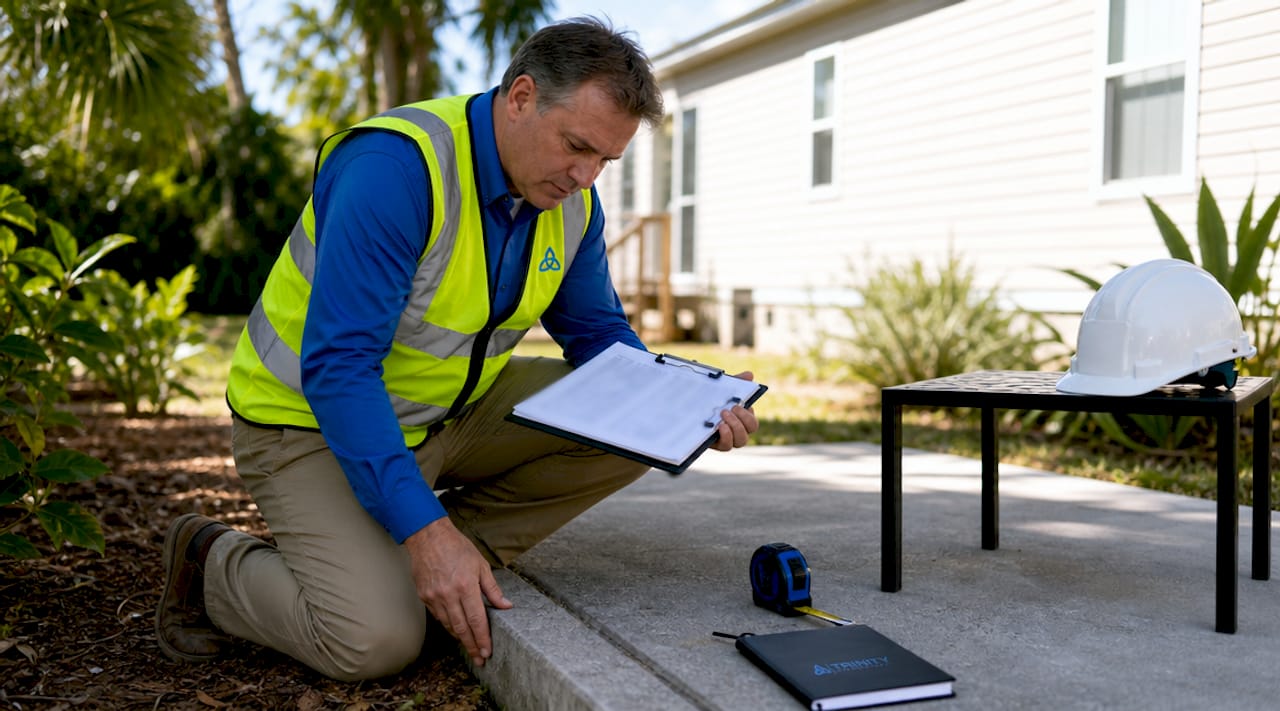
Porches are a leading cause of manufactured home foundation certification failures because HUD requires all permanent additions to be structurally independent from the home itself. That single rule catches more buyers and sellers off guard than almost any other regulation in manufactured housing. If you are buying, selling, or refinancing a manufactured home with a porch, understanding why porches can be a problem for manufactured home foundation certifications is not optional. It is the difference between a smooth closing and a deal that falls apart at the finish line. This guide explains the rules, the risks, and exactly what you can do to stay compliant.
Why porches can be a problem for manufactured home foundation certifications
A manufactured home foundation certification is an engineering document that confirms a home’s foundation meets HUD and FHA standards. Lenders require this certification before approving FHA, VA, or conventional loans on manufactured homes. Without it, financing is typically denied, and the home’s resale value takes a serious hit.
Here is what most homeowners do not realize: manufactured home engineering certifications intentionally exclude porches and other additions. The certification covers the home’s foundation only. Any porch, deck, or addition attached to the home requires its own separate engineering review. That distinction matters enormously when a lender orders an appraisal or a foundation inspection.
Common reasons foundation certifications fail include:
Load transfer from a porch to the home’s chassis or rim joists
Porches bolted directly to the manufactured home’s structure
Missing or improper weather seals between the porch and the home
Porch footings that are too shallow or not independently supported
Unpermitted additions that were never reviewed by an engineer
Drainage problems that cause moisture damage to the home’s foundation
Each of these issues can trigger a certification rejection, a zero-dollar appraisal on the addition, or an outright loan denial. The good news is that every one of them is preventable with the right knowledge and the right professionals involved early.
How do porches violate HUD foundation requirements?
HUD’s core rule is straightforward: additions must be free-standing and must not transfer any structural load to the manufactured home. That means the porch must support its own weight, its roof load, and any live loads like people and furniture entirely through its own foundation system. The manufactured home carries none of that weight.
The problem arises when contractors build porches the same way they would on a site-built house. On a traditional home, attaching a ledger board to the rim joist is standard practice. On a manufactured home, that same attachment invalidates the HUD certification and can result in an appraisal that values the porch at zero dollars. That is not a technicality. That is a financing disaster.
Here is how porch violations typically happen, step by step:
A contractor bolts the porch ledger board to the home’s rim joist or chassis. This transfers vertical and lateral loads directly into the manufactured home’s structure, which is not designed to handle them.
The porch roof is tied into the home’s roofline without a proper non-structural seal. This creates a rigid connection that prevents the home and porch from moving independently, as they must.
Porch footings are poured as a simple concrete slab without independent support. Slabs that are not on proper footings can settle, pulling the attached porch and stressing the home’s frame.
No engineering review is ordered for the addition. The homeowner assumes the porch is fine because it looks solid. The lender’s appraiser or engineer disagrees.
The certification engineer flags the load transfer during the foundation inspection. The certification is denied, the loan stalls, and the seller faces costly remediation.
A common misconception is that a “sturdy” attachment is a safe attachment. The opposite is true in manufactured housing. Separation and correct footing design are what keep a porch compliant. A non-structural, flexible weather seal between the porch and the home is mandatory. It allows the two structures to move independently without creating a gap that lets in water.
Pro Tip: If you see caulk or rigid flashing as the only connection between a porch roof and a manufactured home’s exterior wall, ask an engineer to evaluate it before closing. Rigid connections are a red flag for load transfer.
What are the technical code requirements for porch foundations?
Building a compliant porch on a manufactured home requires more than good carpentry. The foundation system must meet both local building codes and HUD’s structural independence standard.
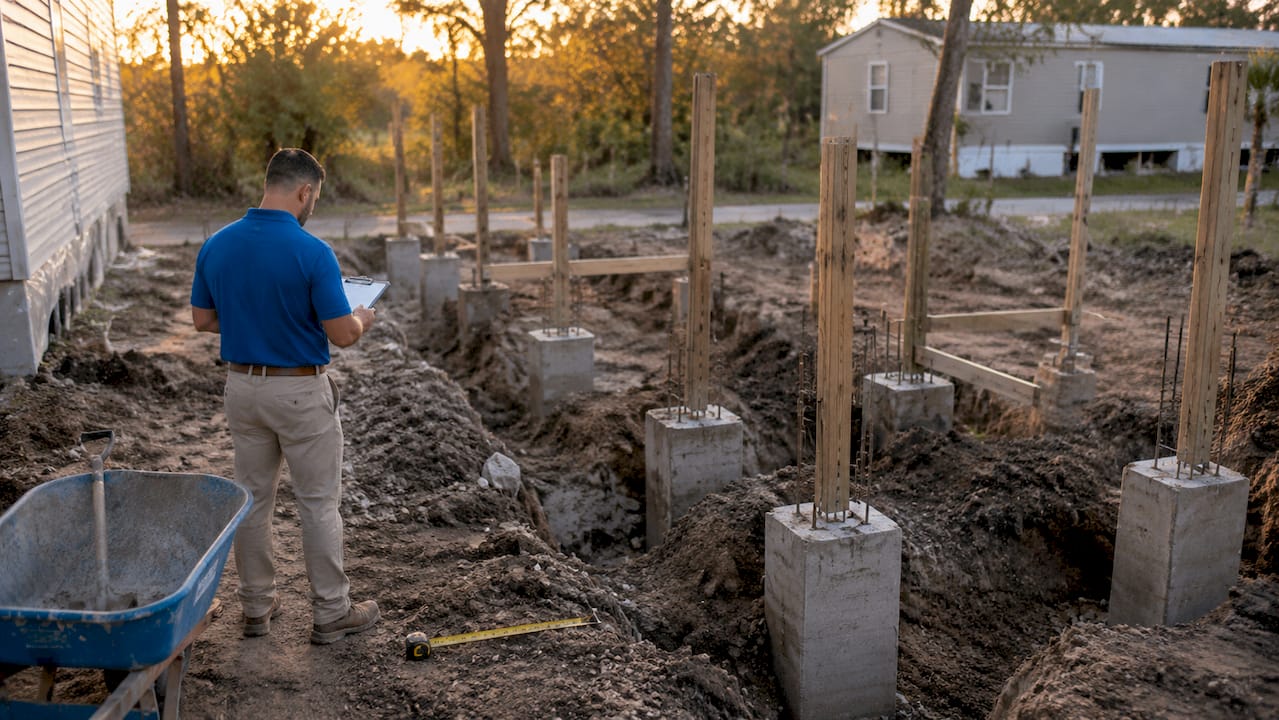
Porch foundations must extend below the frost line on independent footings. In most of the Gulf Coast Alabama region, frost depth is minimal, but soil bearing capacity and drainage are critical concerns. Footings must be sized for the load they carry, and porch slabs must be at least 4 inches thick, with thicker pours required for heavier structures. A simple patio slab poured on grade does not meet this standard for an enclosed or roofed porch.
Local building codes also specify post spacing, footing diameter, and anchorage requirements based on vertical and lateral loads, including wind. In coastal Alabama, wind load requirements are significant. A porch that meets the International Residential Code (IRC) for post sizing and footing depth but is still bolted to the manufactured home fails on the HUD independence standard regardless.
Feature | Compliant Porch Foundation | Non-Compliant Porch Foundation |
Footing type | Independent concrete footings below frost line | Poured slab attached to home’s perimeter |
Load path | Porch carries its own weight to its own footings | Load transfers to home’s chassis or rim joist |
Connection to home | Flexible, non-structural weather seal only | Ledger board, bolts, or rigid framing |
Drainage | Graded away from home, proper flashing | Traps water against home’s skirting or wall |
Engineering review | Separate additions certification letter | No engineering review obtained |
Moisture control is another technical requirement that gets overlooked. Porches alter water runoff patterns and can trap moisture against the home’s exterior if roof tie-ins, flashing, and grading are not properly designed. Rot and foundation deterioration can develop within a few years even when the porch is structurally independent. Proper drainage grading, drip-edge flashing, and a gap between the porch decking and the home’s skirting are all part of a compliant installation.
Pro Tip: Ask your contractor to show you the drainage plan before construction begins. Water that pools under a porch or against a manufactured home’s skirting causes damage that shows up years later and is expensive to fix.
How do you manage porch certification issues when buying or selling?
Porch-related foundation certification challenges are manageable when you address them early. The worst outcomes happen when buyers, sellers, or agents discover the problem at closing. Here is how to stay ahead of it.
Order a foundation inspection before listing. Sellers who know about porch compliance issues before going to market can fix them or price accordingly. A pre-listing inspection catches these problems when you still have time to act.
Request an additions certification letter. Lenders often require a separate engineering letter confirming the porch is structurally independent. Ordering this early prevents costly re-inspections and closing delays.
Verify permits on any existing porch. An unpermitted porch is an automatic red flag for lenders and appraisers. You can search permits and deed records for Baldwin, Mobile, and Escambia counties to confirm what was legally approved.
Consult a licensed engineer, not just a contractor. Contractors build to code. Engineers certify compliance with HUD standards. For manufactured home additions, you need both.
Check the FHA underwriting requirements. Non-compliant porches are among the FHA underwriting red flags that delay or deny loan approval. Knowing this before you apply saves weeks of frustration.
Do not assume an old porch is automatically a problem. Older porches are not automatically disqualifying if they are structurally independent. The key question is always whether load transfers to the home, not how old the porch is.
The process for obtaining an additions certification letter typically involves hiring a licensed structural engineer to inspect the porch, review the connection details, and issue a written statement confirming independence. That letter goes to the lender alongside the standard foundation certification. Together, they satisfy most FHA, VA, and conventional loan requirements.
Freestanding vs. attached porches: how do they compare?
The distinction between a freestanding porch and an attached porch is the single most important factor in manufactured home foundation certification outcomes. Understanding the difference protects your financing and your investment.
A freestanding porch stands entirely on its own foundation system. Its posts carry all loads to independent footings. The only contact with the manufactured home is a flexible weather seal that keeps out wind and rain without transferring any structural force. Decks, porches, and stairs that impose no load on the manufactured home do not invalidate the foundation certification, though they must be disclosed to the lender.
An attached porch uses the manufactured home as part of its structural system. Ledger boards, rim joist connections, or shared roof framing all create load transfer. That transfer is what triggers certification failure.
Factor | Freestanding Porch | Attached Porch |
Structural support | Independent footings and posts | Relies on home’s chassis or framing |
HUD compliance | Compliant when properly built | Violates HUD independence requirement |
Certification impact | Does not affect home certification | Can invalidate existing certification |
Lender reaction | Acceptable with disclosure | Often triggers loan denial or delay |
Resale value | Adds value when certified | May reduce appraised value to zero |
Remediation cost | Minimal if built correctly | Can require full reconstruction |

The practical takeaway is this: if you are planning a new porch on a manufactured home, design it as a freestanding structure from the start. Retrofitting an attached porch to meet HUD standards often costs more than building it correctly the first time. Working with contractors who understand HUD requirements for custom structures and manufactured home additions prevents the most expensive mistakes.
Key takeaways
Porches cause manufactured home foundation certification failures when they transfer structural loads to the home, violating HUD’s requirement for complete structural independence of all additions.
Point | Details |
HUD requires structural independence | All porches and additions must stand on their own foundation without transferring load to the home. |
Attached porches invalidate certifications | Ledger board or rim joist connections can result in a zero-dollar appraisal and loan denial. |
Separate engineering letters are required | Lenders typically require an additions certification letter in addition to the standard foundation certification. |
Freestanding design is the solution | Building a porch on independent footings with a flexible weather seal keeps the home fully certifiable. |
Early inspection prevents closing delays | Ordering a foundation and porch review before listing or applying for a loan avoids last-minute surprises. |
What i see in the field on porch compliance
I have inspected manufactured homes across Baldwin, Mobile, and Escambia counties where a porch was the only thing standing between a buyer and their closing date. The pattern is almost always the same. A previous owner added a nice-looking porch, a contractor bolted it to the home, and nobody thought twice about it for years. Then a buyer applies for an FHA loan, the lender orders a foundation certification, and the engineer flags the load transfer. Suddenly the seller is looking at tearing off a porch they paid good money for.
What surprises most people is how simple the fix sounds in theory. Disconnect the porch from the home, add independent footings, install a flexible seal, and get an engineer to certify it. In practice, that work can run several thousand dollars and take weeks to schedule, permit, and complete. When you are already under contract with a closing date, that timeline is brutal.
My honest advice is this: if you own a manufactured home with a porch and you are even thinking about selling or refinancing in the next few years, get a foundation evaluation now. Do not wait for a lender to find the problem. The manufactured home foundation certification process is not complicated when you have time on your side. It becomes complicated when you are racing a closing deadline.
One more thing worth saying: not every porch is a problem. I have inspected plenty of older porches that were built correctly, sit on their own footings, and have no structural connection to the home. Those pass without issue. The goal is not to fear porches. The goal is to know what you have before someone else finds out for you.
— Matt
Is your manufactured home porch putting your certification at risk?
Trinity Home Inspections provides InterNACHI-certified manufactured home inspections across Baldwin, Mobile, Escambia, and surrounding Gulf Coast Alabama counties. If you have a porch on your manufactured home and you are buying, selling, or refinancing, we can evaluate the porch connection, flag any load transfer issues, and help you understand exactly what a lender’s engineer will look for.
[

Our same-day reports include photos and video documentation of every concern, so you have clear evidence to share with your engineer or contractor. We also help you search permits and deed records to confirm whether existing additions were legally approved. Call us at 251-210-7376 or visit TrinityInspectionsLLC.com to schedule your inspection today.
FAQ
What makes a porch non-compliant for HUD certification?
A porch is non-compliant when it transfers structural load to the manufactured home through bolts, ledger boards, or rigid framing connections. HUD requires all additions to be fully free-standing on independent footings.
Can an old porch pass a foundation certification?
Yes. An older porch is not automatically disqualifying if it sits on independent footings and has no structural connection to the home. The engineer evaluates load transfer, not the age of the structure.
Do lenders always require a separate porch certification letter?
Most FHA and VA lenders require a separate additions certification letter confirming the porch is structurally independent. Ordering this letter early prevents closing delays and costly re-inspections.
How deep do porch footings need to be on a manufactured home?
Porch footings must extend below the local frost line, which is minimal in coastal Alabama but must still account for soil bearing capacity. Slabs must be at least 4 inches thick, with independent footings sized for the porch’s total load.
What happens if a porch fails the foundation certification review?
A failed review can result in the porch being appraised at zero dollars and the loan being denied or delayed. The seller typically must disconnect the porch from the home, add proper independent footings, and obtain a new engineering certification before closing can proceed.
Recommended

