
Where Do You Need AFCI Breakers in Your Home?


Under NEC Section 210.12, AFCI protection is required on all 120-volt, single-phase, 15- and 20-ampere branch circuits supplying outlets in these areas of a dwelling:
Bedrooms (the original requirement, added in 1999)
Living rooms, family rooms, parlors, libraries, dens, and sunrooms
Dining rooms and recreation rooms
Hallways and stairways
Closets and storage areas
Laundry areas
Kitchens (required under recent NEC editions)
Attics and crawl spaces where outlets are installed
Garages (under some NEC editions and local adoptions)
The short version: If a room is part of your living space and has a 120V outlet, switch, or lighting outlet on a 15/20A circuit, there is a strong chance the NEC requires AFCI protection on that circuit.
One important caveat: the NEC is a model code, not federal law. Your local building department decides which edition to enforce, and jurisdictions vary widely — some Alabama counties may still operate under the 2020 NEC while others have moved to 2023. Always verify with your local building department before planning any electrical work.
The U.S. Consumer Product Safety Commission and the USFA both point to electrical malfunction as a significant cause of residential structure fires, which is precisely why the NEC has expanded AFCI coverage edition by edition.
Key Takeaways
The NEC requires AFCI protection on 120V, 15/20A branch circuits supplying outlets in habitable rooms and several non-habitable areas, and that requirement is triggered by permitted work even in existing homes.
Point | Details |
Covered areas under NEC 210.12 | Bedrooms, living areas, dining rooms, hallways, closets, laundry, kitchens, attics, and crawl spaces with outlets. |
Retrofit trigger | Permitted work that extends, modifies, or replaces branch-circuit wiring in a covered area requires AFCI protection. |
6-foot exception | Extensions of 6 feet or less that add no new outlets are exempt; conductor length inside enclosures does not count toward the 6 feet. |
AFCI and GFCI overlap | Kitchens and laundry circuits often require both; a dual-function breaker or AFCI breaker plus GFCI receptacle satisfies both requirements. |
Trinity Home Inspections | Provides full panel and outlet inspection with same-day reports and thermal imaging across Gulf Coast Alabama. |
Where Do You Need AFCI Breakers? A Room-by-Room Breakdown
Understanding the list above is one thing. Knowing what it means for the actual circuits in your home is another.
What “habitable room” and “outlet” mean under the NEC
The NEC defines a habitable room as a space used for living, sleeping, eating, or cooking. Bathrooms, hallways, closets, and storage areas are technically not habitable rooms, yet the code still requires AFCI protection in many of them because they contain outlets. That distinction matters: AFCI coverage is tied to the circuit and the outlet, not just the room type.
An outlet under the NEC is broader than most homeowners expect. It includes receptacles (the plug-in kind), lighting outlets, and switch outlets. So a hallway with only a light switch and a ceiling fixture still has an outlet, and the circuit feeding it may require AFCI protection.
Room-by-room guidance
Bedrooms: The original AFCI zone. Every 15/20A circuit feeding a bedroom receptacle, lighting outlet, or switch falls under 210.12.
Living rooms, family rooms, dens, and dining rooms: Added in later NEC editions. A single circuit that feeds both a living room and an adjacent hallway light is covered in its entirety.
Hallways and stairways: Required under current NEC editions. A common point of confusion is the “10-foot hallway” reference that appears in some local interpretations — this refers to hallways of a certain length or more, though your local code may define this differently.
Closets: Yes, even a bedroom closet with a single light fixture. The circuit feeding that light is covered.
Laundry areas: The 20A laundry branch circuit is included under recent NEC editions.
Kitchens: Small appliance branch circuits in kitchens are now covered under the 2023 and 2026 NEC. This one surprises many homeowners because kitchens already require GFCI protection at countertop outlets.
Attics and crawl spaces: Only when outlets are present. An attic with no wiring is not a concern; one with a light fixture or receptacle for a fan or equipment is.
Real-world scenario: A bedroom circuit that loops through the hallway to feed a hall light is a single branch circuit. The entire circuit needs AFCI protection, not just the bedroom portion.
Pro Tip: Label your panel clearly. If you are not sure which breaker feeds which room, use an inexpensive circuit tracer tool or ask your electrician to label each breaker during any permitted work. Knowing your circuit map makes AFCI compliance checks much faster.
Which Circuits Are Usually Exempt from AFCI Requirements?
Not every circuit in your home falls under the AFCI requirement. Knowing the common exceptions saves you from unnecessary upgrades and helps you ask the right questions when getting quotes.
Circuits typically not required to have AFCI protection:
Bathrooms: Bathroom branch circuits are generally exempt from AFCI requirements, though they do require GFCI protection.
Dedicated 240V circuits: Circuits for electric ranges, dryers, water heaters, and similar large appliances operate at 240 volts and are outside the 120V, single-phase scope of 210.12.
Dedicated appliance circuits for arc welding outlets: The NEC includes a specific exception for these.
Detached garages and accessory buildings: Coverage depends on the NEC edition your jurisdiction enforces. Some editions include garages; others do not. Verify locally.
Outdoor circuits: Exterior receptacle circuits are not universally covered, though they do require GFCI protection.
Existing circuits with no permitted work: An existing circuit that has not been modified, extended, or replaced does not retroactively require AFCI protection simply because a new NEC edition was adopted.
The 6-foot extension exception is worth understanding. Under the NEC, if permitted work extends a branch circuit by 6 feet or less and adds no new outlets or devices, AFCI protection is not triggered. Conductor length inside enclosures, cabinets, or junction boxes does not count toward that 6 feet.
Local adoption warning: States and counties can amend the NEC or delay adoption. A circuit that is exempt under the 2020 NEC may be covered under the 2023 NEC. Your local building department is the only authoritative source for what applies to your home right now.
Pro Tip: If you are buying a home built before 2000, do not assume any AFCI protection exists. Bedrooms were the first area added to the requirement, and many older homes have none at all. A pre-purchase electrical inspection will document exactly what is present.
When Does Permitted Electrical Work Require AFCI Upgrades?
This is where many homeowners get caught off guard during a remodel. The NEC does not require you to retrofit AFCI protection in an existing home simply because time has passed. But the moment you pull a permit for electrical work, the rules change.
Identify the scope of your permit. Any extension, modification, or replacement of branch-circuit wiring in an AFCI-covered area triggers the requirement. Adding an outlet to a bedroom circuit? That circuit now needs AFCI protection.
Confirm the local NEC edition. Ask your building department which edition they enforce. The 2026 NEC FAQ from the Minnesota Department of Labor and Industry clarifies that installing an outlet branch-circuit AFCI (OBCAFCI) at the first receptacle or switch of an existing branch circuit is an accepted compliance method — a useful option when replacing a full panel is not practical.
Include AFCI work in your contractor quotes. Ask every electrician to specify AFCI breaker or device costs as a line item. Some contractors omit this, and the surprise shows up on the final invoice.
Request permit and inspector notes before installation. Knowing what the inspector will look for prevents rework. Some jurisdictions accept receptacle-based AFCI devices; others require breaker-level protection.
Pro Tip: Before any permitted electrical work begins, call your local building department and ask two questions: “Which NEC edition do you enforce?” and “Do you accept outlet branch-circuit AFCI devices as a compliance method for existing circuits?” Write down the answers and share them with your electrician.
How Do AFCI and GFCI Protections Differ, and Where Do You Need Both?
AFCI and GFCI devices protect against completely different hazards, and confusing them is one of the most common mistakes homeowners make.
Feature | AFCI | GFCI |
Protects against | Electrical arcing that can cause fires | Ground faults that can cause shock |
Primary hazard | Fire | Electrocution |
Typical locations | Bedrooms, living areas, hallways, kitchens | Bathrooms, kitchens, garages, outdoors |
Device types | Breaker, receptacle, combination | Receptacle, breaker |
NEC section | 210.12 | 210.8 |
Some circuits require both protections. Kitchen countertop circuits are a clear example: they need GFCI protection under 210.8 and, under recent NEC editions, AFCI protection under 210.12. Laundry circuits and garage circuits (depending on local adoption) can fall into the same overlap zone.
For circuits that need both, you have three practical options:
A dual-function AFCI/GFCI breaker at the panel, which covers the entire circuit
An AFCI breaker at the panel combined with a GFCI receptacle at the first outlet
A combination AFCI receptacle with GFCI function built in, installed at the first outlet on the circuit
The NFPA notes that both types of circuit interrupters play distinct roles in residential fire and shock prevention. For Gulf Coast homeowners with older wiring, the GFCI requirements guide is worth reading alongside this article to map out where both protections apply in your specific home.
What Types of AFCI Devices Are Available and How Are They Installed?
Breaker-based AFCI is the most common approach. The AFCI breaker replaces a standard breaker in your panel and monitors the entire circuit for arc signatures. It protects every outlet, switch, and fixture on that circuit.
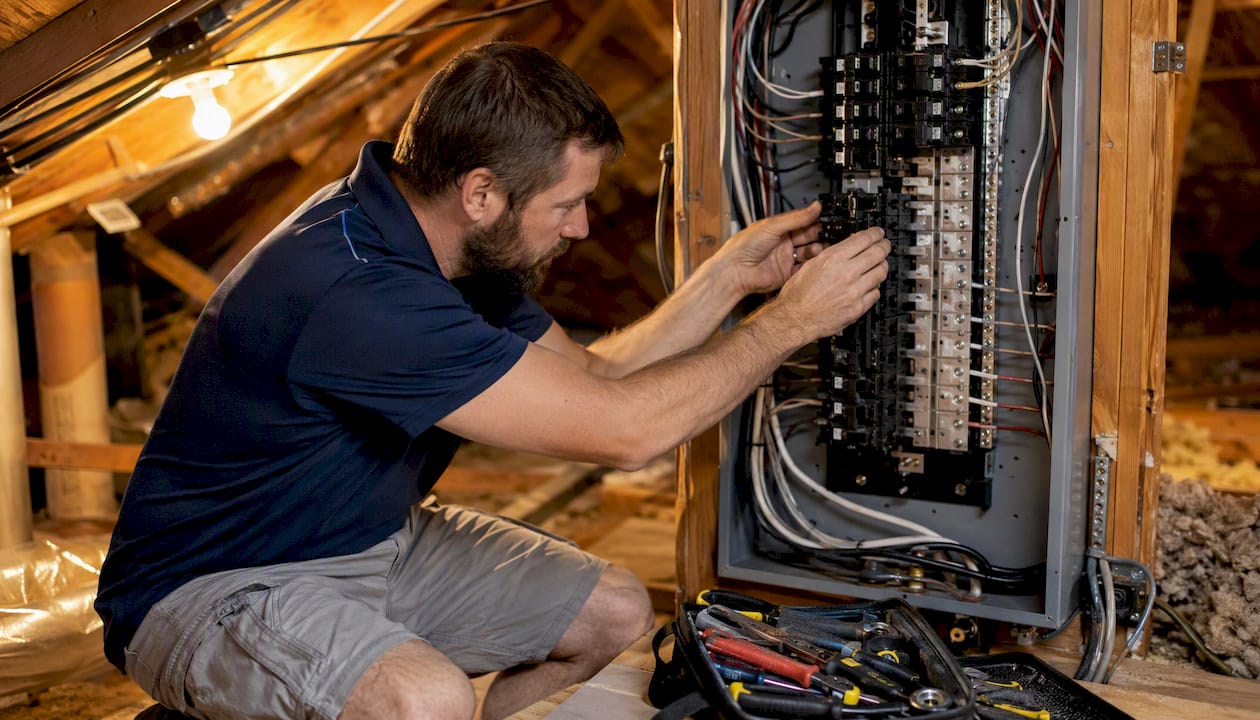
Receptacle-based AFCI (outlet branch-circuit AFCI) installs at the first outlet on a circuit and protects all downstream devices. This is particularly useful in retrofit situations where the panel cannot accommodate a new AFCI breaker or where a dual-function device is needed at a specific location.
Combination AFCI devices detect both parallel arcs (line-to-neutral or line-to-ground) and series arcs (within a single conductor). Current NEC editions require combination-type protection, not just branch/feeder type.
What an electrician will do during installation
Identify all circuits in AFCI-covered areas using the panel directory and a circuit tracer.
Check for shared neutrals (multiwire branch circuits). These require a two-pole AFCI breaker, not two single-pole breakers, to function correctly.
Perform a diagnostic check for neutral-to-ground voltage and insulation resistance before installing, which significantly reduces nuisance trips after installation.
Label each breaker clearly after installation.
Test each AFCI device using the built-in test button to confirm it trips and resets correctly.
As a homeowner, you can test your AFCI breakers monthly: press the TEST button on the breaker face. The breaker should trip immediately. Reset it by switching it fully off, then back on. If it does not trip, the device may be faulty and needs replacement.
Pro Tip: If an AFCI trips only when you run a specific appliance, that appliance’s electrical signature may be triggering a false arc detection. Before replacing the breaker, try the appliance on a different circuit. If it trips there too, the appliance itself may have a wiring issue.
How Local Code Adoption Affects Your AFCI Requirements
The NEC is updated on a three-year cycle, but states and counties adopt new editions on their own schedules. Right now, local jurisdictions vary widely — for example, a homeowner in one Alabama county may be governed by the 2020 NEC while a neighbor in the next county falls under 2023 provisions. The AFCI room list differs between those editions.
Common nuisance-tripping causes to know:
Shared neutrals on multiwire branch circuits wired to separate single-pole breakers
Loose wire connections at outlets, switches, or the panel
Motorized appliances (vacuum cleaners, older refrigerators, treadmills) with electrical signatures that resemble arc patterns
Long runs of older wiring with degraded insulation
Leviton’s guidance on nuisance tripping notes that some manufacturers now offer firmware-updateable AFCI devices, which allow field updates when new appliance signatures are identified. If you are experiencing repeated nuisance trips on a specific circuit, ask your electrician whether a firmware update is available for your installed device before replacing it.
When to call a licensed electrician or inspector: If an AFCI trips repeatedly with no obvious cause, or if it trips immediately upon reset, do not simply reset and ignore it. Repeated tripping can indicate a real arc condition, a loose connection, or a wiring defect. A licensed electrician can perform megger insulation resistance testing and neutral-to-ground checks to isolate the cause.
A home inspection that documents wiring conditions, panel labeling, and outlet function gives you a clear picture of which circuits are likely candidates for nuisance trips before you invest in new AFCI devices. The double-tapped breaker guide covers another common panel issue that can complicate AFCI installation.
Pro Tip: Ask your building department for a written confirmation of the currently adopted NEC edition. Keep that document with your home’s permit file. It becomes useful if you sell the home and a buyer’s inspector questions the electrical work.
An Inspector’s Perspective on AFCI Requirements
The most practical thing you can do right now is this: pull your panel cover (or have an inspector do it) and count how many breakers are standard versus AFCI-labeled. In most Gulf Coast Alabama homes built before 2008, the answer is zero AFCI breakers, even in bedrooms.
That does not mean your home is dangerous today. Existing circuits are not retroactively required to be upgraded. But if you are buying a home, remodeling, or pulling any permit for electrical work, the AFCI question will come up, and you want to be prepared rather than surprised.
My suggestion: start with sleeping areas. Bedrooms have been in the AFCI requirement since 1999, and they are where electrical fires most often cause harm while people are asleep. From there, expand to living areas and kitchens as your local code and budget allow. Get a written scope from your electrician that specifies which circuits are being upgraded and which NEC edition the work is permitted under. That documentation protects you at resale.
Buyers should request AFCI testing as part of any pre-purchase inspection. Sellers benefit from knowing the status before listing, because a buyer’s inspector will flag missing AFCI protection in covered areas, and it is better to address it on your terms than to negotiate under pressure.
Schedule an Inspection That Covers Your Electrical Panel and Outlets
Trinity Home Inspections provides InterNACHI-certified home inspections across Baldwin, Mobile, Escambia, Washington, Monroe, and Clarke counties, including Daphne, Fairhope, Gulf Shores, Orange Beach, Foley, Spanish Fort, and Mobile.
[

What’s included in every electrical inspection:
Full panel inspection with photo documentation of breaker types, labeling, and visible defects
Testing of all accessible outlets and switches (not just a representative sample)
Thermal imaging at no extra charge to help identify overheated components
Same-day report with color-coded findings, photos, and video where applicable
Post-inspection walkthrough by phone or in person to explain every finding
Whether you are buying, selling, or planning a remodel, a pre-listing inspection gives you a documented baseline of your electrical system’s current condition, including AFCI status, before a buyer’s inspector finds it first. You can also use the permit and deed search tool to verify whether prior electrical work was permitted in your area.
Call 251-210-7376 or visit TrinityInspectionsLLC.com to schedule your inspection.
Sources
The sources below are the primary references for AFCI requirements, fire statistics, and manufacturer guidance.
FAQ
Where are AFCI breakers required in a residential home?
Under NEC Section 210.12, AFCI protection is required on 120V, 15/20A branch circuits supplying outlets in bedrooms, living rooms, dining rooms, dens, hallways, stairways, closets, laundry areas, kitchens, and attics or crawl spaces where outlets are installed. Your local building department determines which NEC edition applies to your home.
Where should you not use AFCI breakers?
AFCI protection is generally not required on bathroom circuits, dedicated 240V appliance circuits (ranges, dryers), outdoor circuits, or existing circuits that have not been modified under a permit. Bathrooms require GFCI protection instead.
Do I need both GFCI and AFCI protection on the same circuit?
Yes, in some cases. Kitchen countertop circuits, laundry circuits, and garage circuits (depending on local code adoption) often require both. A dual-function AFCI/GFCI breaker at the panel satisfies both requirements on a single device. You can also read the GFCI requirements guide for more detail on where GFCI applies.
Does an older home need AFCI breakers added retroactively?
No. Existing circuits are not required to be upgraded simply because a new NEC edition was adopted. However, if you pull a permit for electrical work that extends, modifies, or replaces branch-circuit wiring in a covered area, AFCI protection is required on that circuit at that time.
What should I do if my AFCI breaker keeps tripping?
First, identify whether the trip happens only with a specific appliance. If so, that appliance’s electrical signature may be causing a false detection. Check for loose connections at outlets and the panel, and ask your electrician whether a firmware update is available for your device. Repeated tripping with no clear cause warrants a professional diagnostic, including insulation resistance testing.
Recommended
