
Best Bathroom Exhaust Vent Covers for Humid Climates

Updated: May 2
TL;DR:
Proper exterior vent covers with dampers and pest screens are essential for Gulf Coast homes.
Vents must terminate outdoors, not into attics or soffits, to prevent mold and damage.
Extended fan operation and humidity sensors improve moisture control in high-humidity coastal environments.
Most Gulf Coast homeowners assume any vent cover from the hardware store will protect their bathroom. That assumption is quietly behind thousands of dollars in mold remediation and wood rot repairs every year across Mobile, Baldwin, and Escambia counties. Alabama’s coastal humidity is not the same challenge you find in drier climates, and your bathroom exhaust system deserves more thought than a five-minute aisle decision. Effective moisture control depends on the entire exhaust duct system terminating outdoors through a weatherproof hood with a working backdraft damper. This guide walks you through exactly what to look for, which cover types actually perform, and how to avoid the mistakes we see on nearly every other inspection.
Key Takeaways
Point | Details |
Proper outdoor venting | Your bathroom exhaust must always terminate outside with a weatherproof cover, never into the attic or soffit. |
Backdraft prevention | A quality vent cover with a backdraft damper and pest screen is essential to block humid air and pests from re-entering. |
Ductwork matters | Keep ducts short, straight, sealed, and insulated for reliable, efficient ventilation in humid climates. |
Longer fan operation | Run exhaust fans longer or use humidity controls to manage Gulf Coast moisture. |
Routine maintenance | Check and clean covers annually to ensure airflow and prevent buildup or pest issues. |
Understanding the unique Gulf Coast challenge
Living along the Alabama Gulf Coast means living with some of the highest average relative humidity levels in the country. Fairhope, Gulf Shores, Orange Beach, and the communities surrounding Mobile Bay regularly see outdoor humidity climb above 85 percent for weeks at a time. That outdoor air does not stay outside. It works its way into your home through every gap, crack, and poorly sealed duct connection it can find.
Your bathroom makes the problem worse. Every shower sends warm, saturated air into an already-humid space. If that air does not have a clear, reliable path to the outdoors, it finds another one, usually into wall cavities, ceiling framing, and attic spaces where mold grows fast and stays hidden for months.
Recommended indoor humidity for Alabama Gulf Coast homes: 30 to 50 percent. Staying within this range limits mold growth, protects wood framing, and keeps your air quality healthy year-round.
One of the most common mistakes we see is a bathroom exhaust fan that vents into the attic or through a soffit cavity rather than directly outside. Homeowners often do not even know this is happening because the fan turns on, sounds like it is working, and that feels like enough. It is not. Dumping warm, moist bathroom air into your attic is one of the fastest ways to destroy roof decking and insulation. Check out these humidity control tips specifically written for Gulf Coast homeowners if you want a deeper look at the bigger picture.
Here is where it gets especially important for homes on the Gulf Coast. Because outdoor humidity is already high, simply running your fan for a few minutes after a shower may not be enough. Gulf Coast ventilation guidance recommends running the fan longer and using timer controls or humidity-sensing switches to make sure the fan runs until moisture levels actually drop. A humidity-sensing switch is one of the best low-cost upgrades any coastal homeowner can make.
Common mistakes Gulf Coast homeowners make with bathroom ventilation:
Venting the exhaust duct into the attic instead of through an exterior wall or roof cap
Using flexible plastic duct that sags and collects condensation
Skipping insulation on duct runs that pass through unconditioned attic space
Installing a vent cover without a working backdraft damper
Running the fan for only two or three minutes after a shower
Neglecting to clean the vent grille and cover annually
These are not rare situations. We see them regularly across bathroom ventilation tips we publish and across real homes we inspect every week. The good news is that all of these problems are fixable, often without calling a contractor.
Core features of the best bathroom exhaust vent covers
Now that you understand why the Gulf Coast climate demands more from your ventilation system, let’s talk about what specifically to look for in an exhaust vent cover. Not all vent covers are created equal, and the differences matter more here than they would in a drier climate like Phoenix or Denver.
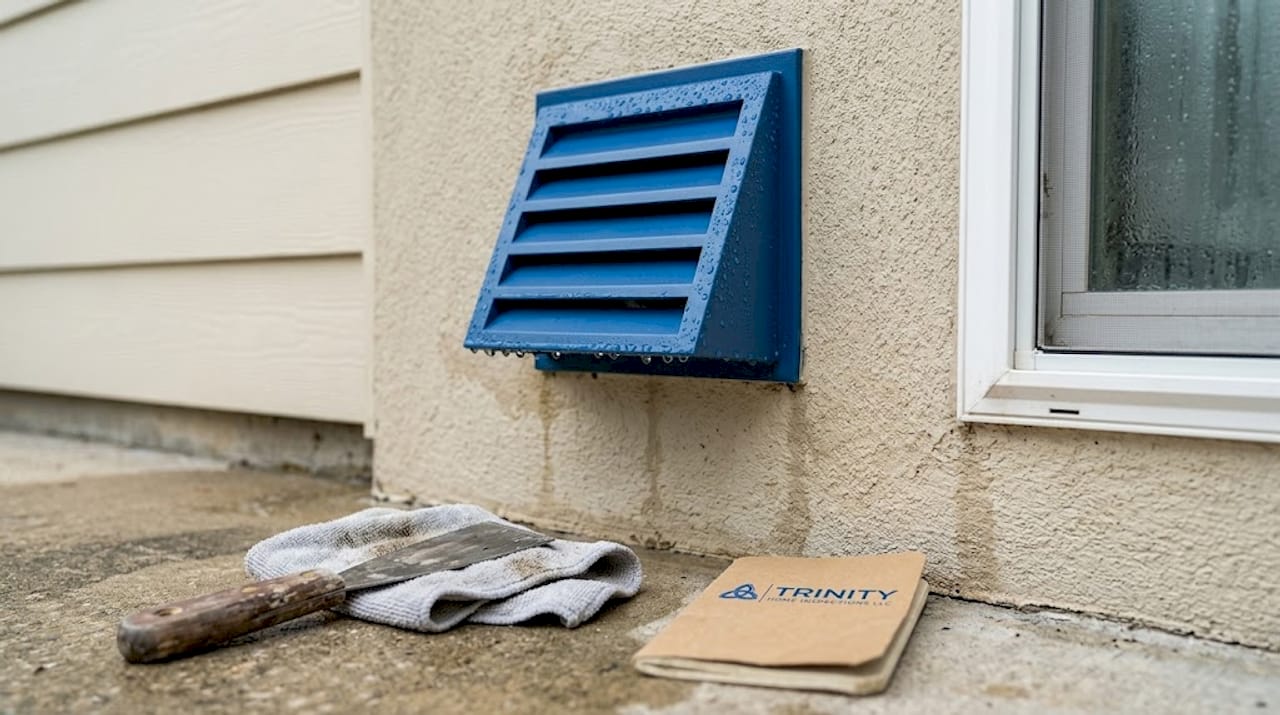
The single most important rule, backed by building codes for bathrooms, is that all bathroom exhaust must terminate outdoors. Not into a wall cavity. Not into a soffit. Not into the attic. Outdoors. If your vent cover is not attached to an exterior surface that leads directly outside, you do not actually have a working ventilation system regardless of how good the fan motor is.
Here are the core features every Gulf Coast homeowner should require in a vent cover:
Weatherproof hood or cap: The cover must be rated for exterior use and built to handle rain, wind, and sun exposure. UV-degraded plastic louvers that fall off or crack open are a direct entry point for wind-driven rain and insects.
Backdraft damper: This is a flap or valve inside the cap that allows air to flow out but snaps shut when the fan is off. Without it, humid Gulf Coast air and insects can travel back into your duct and into your home. Vent caps with dampers are a standard feature in quality covers, but lower-cost generic covers often omit them.
Pest screen: A fine mesh or screen prevents birds, wasps, roaches, and other pests from nesting in your duct. This is especially important in coastal Alabama where insects are active year-round.
Adequate opening size: The cover must match your duct diameter, typically 3 or 4 inches for most residential bathroom fans. An undersized opening restricts airflow and reduces fan performance.
Durable material: Look for heavy-gauge metal or UV-stabilized heavy-duty plastic. Thin plastic covers crack and fade quickly under Alabama’s intense sun and heat.
Pro Tip: If you are replacing an old cover, confirm your duct diameter before purchasing. A cover that is too small creates backpressure that makes even a powerful fan ineffective. Rigid metal duct transitions also help maintain that diameter all the way from the fan housing to the exterior cap.
The ventilation for mold prevention connection is direct. A vent cover without a damper lets humid air back in at night. A cover without a pest screen allows nesting that blocks airflow entirely. A cover without a proper weatherproof seal lets rain work into the duct joint. Every one of these failure points becomes a mold risk in a Gulf Coast home.
Comparing common vent cover options
With the key features established, it helps to see how the most common vent cover types actually stack up for Gulf Coast bathrooms. Some options that work fine in moderate climates are genuinely problematic here.
Cover type | How it works | Gulf Coast suitable | Key concern |
Exterior wall hood | Horizontal discharge through exterior wall with a hinged flap | Yes, with damper | Must include damper; verify flap seals fully |
Roof cap with damper | Vertical discharge through roof deck with weighted or spring damper | Yes, with insulated duct | Duct must be insulated and sloped to avoid condensation |
Louvered wall cap | Horizontal discharge with multiple fixed louver slats | Marginal | Louvers can stick open; no positive seal against backdraft |
Soffit termination cap | Discharge into or near soffit overhang | Not recommended | Soffit venting risks include recirculation of moist air back into attic vents |
Interior flush grille only | Decorative cover over fan inside bathroom | Not applicable | Not a vent cap; only covers fan opening from interior |
The soffit option deserves extra attention. Some contractors route exhaust ducts out through the soffit because it is faster and cheaper than running duct to a proper wall or roof termination. The problem is that soffit areas are ventilated to pull air into the attic. Exhausting your bathroom moisture directly into or near that intake area means some of that humid air gets pulled right back into the attic space you were trying to protect. This is a code issue in many jurisdictions and a practical problem in every climate. Prioritize a clear outdoor termination every time.
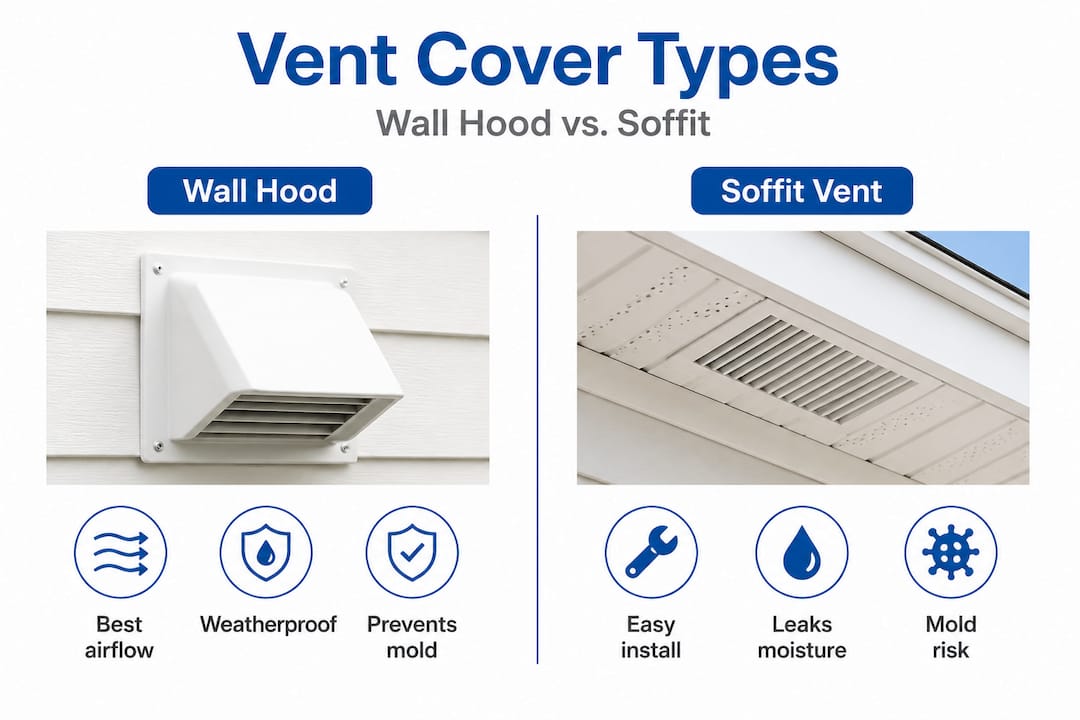
For coastal HVAC tips, the same principle applies. Any duct that terminates near an air intake point, whether for HVAC or attic ventilation, creates a recirculation problem that defeats the purpose of the exhaust system entirely.
Here are simple steps to check and replace your current vent cover if needed:
Go outside and locate where your bathroom exhaust actually terminates. Look on exterior walls, the roof, and unfortunately in many homes, inside the attic.
Check the existing cover for cracked or missing louvers, stuck damper flaps, pest nesting, or visible deterioration.
Turn on the bathroom fan and hold a tissue or thin piece of paper near the interior grille. It should pull toward the fan. Then go outside and confirm you can feel airflow at the exterior cap.
If the exterior cap shows no airflow, check for blocked duct runs, detached flex duct in the attic, or a stuck damper.
Purchase a replacement cap that matches your duct diameter and includes a backdraft damper and pest screen.
Seal the new cap to the exterior wall or roof deck with exterior-grade caulk rated for your surface material.
Confirm airflow again after installation to verify the system is actually working end to end.
Optimizing installation and long-term performance
Choosing the right vent cover is only part of the equation. The duct that connects your bathroom fan to that cover plays an enormous role in whether your ventilation system actually protects your home. We see plenty of homes with a decent exterior cap that still have serious moisture problems because the duct run itself is poorly executed.
According to best ducting practices, the most effective duct runs are short, straight, and made from smooth rigid metal duct. Every bend in a flex duct run reduces airflow. A 90-degree bend can reduce effective fan performance by the equivalent of adding several additional feet of duct length. In a Gulf Coast attic where duct runs can get long, this adds up quickly.
Here is a summary of common installation mistakes compared to better solutions:
Installation mistake | Why it causes problems | Upgraded solution |
Long flex duct with multiple bends | Reduces airflow; sags and collects water | Use rigid metal duct with minimal bends |
Unsealed duct joints | Humid air leaks into attic space | Seal all joints with foil-backed HVAC tape |
Uninsulated duct in attic | Cold duct surface causes condensation inside | Wrap duct with insulation rated for your climate zone |
Duct sloping toward fan | Condensation pools and breeds mold | Slope duct slightly toward exterior cap |
Flex duct compressed or kinked | Severe airflow restriction | Run duct fully extended and supported every four feet |
The condensation issue deserves more explanation. When warm, humid bathroom air travels through a cool, uninsulated duct in the attic, the duct surface acts like a glass of ice water on a hot day. Moisture condenses on the inside of the duct, collects in low spots, and eventually drips back into the fan housing or soaks into surrounding materials. Coastal installation guidance specifically identifies uninsulated duct runs as a leading cause of ventilation system failure in humid climates.
Pro Tip: When upgrading your duct run, use rigid galvanized metal duct instead of flexible plastic duct wherever the path allows it. Connect sections with metal sleeve fittings and seal every joint with foil-backed HVAC tape, not standard duct tape which dries out and peels within a year or two. Then wrap the entire run with R-6 or higher duct insulation before closing up the attic access.
Annual maintenance keeps your system performing the way it should. Make these tasks part of your spring checklist each year:
Remove and wash the interior grille cover to clear dust and debris that restricts airflow
Inspect the exterior cap for cracked material, pest nesting, or stuck damper flaps
Confirm airflow from inside by running the fan and checking that the exterior cap shows outward air movement
Check visible duct runs in the attic for sagging, disconnected joints, or condensation stains
Test your humidity-sensing switch or timer if you have one installed
Verify that the duct insulation wrap has not shifted or deteriorated
Staying on top of these small tasks every spring means you catch small problems before they become expensive ones. For more on protecting your crawlspace ventilation tips, the same routine inspection mindset applies throughout your home.
The common mistakes most homeowners make (and what actually works)
Here is a straight-talking perspective after years of inspecting Gulf Coast homes: the single most common bathroom ventilation failure we find is not a broken fan or a missing grille. It is improper vent termination combined with a cover that was never designed for exterior use.
We walk into attics across Mobile and Baldwin counties and find flexible duct that ends mid-air, or a piece of plastic sheeting taped over a hole that was never properly finished. Sometimes we find a decorative interior cover plate that was installed on what was supposed to be an exterior wall cap location. These situations are not edge cases. They are frequent enough that we built them into our standard inspection checklist.
The counterintuitive part is that most of these installations look fine from inside the bathroom. The fan runs. The grille looks normal. Nothing triggers concern until the inspector gets into the attic with a moisture meter and a thermal camera.
“Every season, we see more damage from venting to attics and soffits than from any other bathroom renovation shortcut. The cost difference between doing it right and doing it wrong at installation is often less than fifty dollars and two hours of effort. The cost of the mold remediation that follows doing it wrong can easily reach five to ten thousand dollars.”
The ventilation code requirement is clear and it exists for good reason. Exterior termination with a proper weatherproof cap and working backdraft damper is not optional guidance. It is the baseline standard that protects your home’s structure and your family’s air quality.
What actually works, based on what we see in the field, is this combination: a rigid or smooth-wall metal duct run kept as short and straight as possible, insulated where it passes through unconditioned space, sealed at every joint, and terminated at a quality exterior cap that includes a positive-sealing backdraft damper and a pest screen. Pair that with a humidity-sensing switch and you have a system that genuinely protects your home in Alabama’s coastal climate.
The best exhaust fans matter too, but a great fan with a poor duct run and a cheap cover will fail just as surely as a weak fan with perfect installation. Start from the exterior cap and work your way in, because that is where your system either succeeds or leaks.
Get expert help and peace of mind
Understanding vent cover requirements is a great first step, but seeing your system evaluated by trained eyes gives you certainty that good reading material cannot. Moisture issues in Gulf Coast bathrooms often stay hidden in duct runs, wall cavities, and attic spaces that are difficult to inspect without thermal imaging and moisture meters.
[

At Trinity Home Inspections, we inspect bathroom ventilation as part of every standard home inspection across Mobile, Baldwin, Escambia, Washington, Monroe, and surrounding counties. Our free thermal imaging helps us spot condensation and moisture where it hides, not just where it has already shown up as a stain. If you are buying, selling, or just want to know what your current system is actually doing, schedule your home inspection and get a same-day report with photos, video, and plain-English priorities. You can also use our property permit search tool to research your home’s history before your inspection appointment.
Frequently asked questions
Can I vent my bathroom exhaust fan into the attic if I use a vent cover?
No. Building codes require all bathroom exhaust ducts to terminate directly outdoors, and attic or soffit venting is non-compliant regardless of what cover you use inside.
What is a backdraft damper and why is it important?
A backdraft damper is a spring-loaded or weighted flap inside the vent cap that allows air to exit but closes when the fan is off. Quality vent caps include dampers to block reverse airflow and prevent insects and outside humidity from re-entering your duct system.
Do I need to insulate my bathroom exhaust duct in the attic?
Yes, always. Ducts in unconditioned attic spaces must be insulated to prevent the warm exhaust air from condensing on the cool duct surface, which leads directly to mold growth inside the duct and fan housing.
How long should I run my bathroom exhaust fan in Alabama’s climate?
Run the fan for at least 20 minutes after every shower, or install a humidity-sensing switch that keeps the fan running until moisture levels actually drop. Gulf Coast ventilation guidance specifically recommends extended run times and smart controls for high-humidity coastal homes.
What is the ideal interior humidity range for Gulf Coast homes?
Keep your indoor humidity between 30 and 50 percent. Alabama moisture control targets this range as the sweet spot for protecting home materials, preventing mold, and maintaining healthy air quality in coastal climates.
Recommended