
Garage Ventilation Fans Cut Humidity 85% Alabama 2026

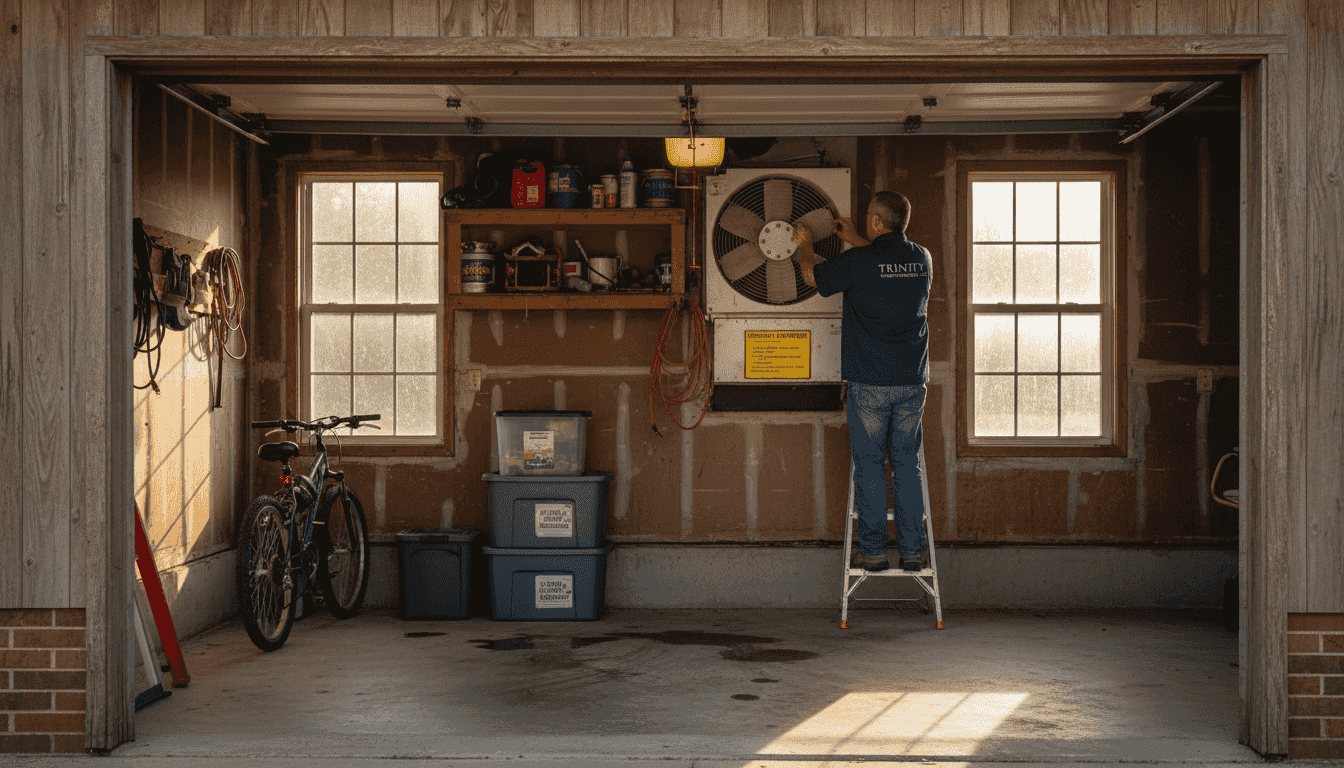
Garages trap up to 70% more harmful gases and moisture without proper ventilation, creating dangerous conditions for your family and property. In Alabama’s Gulf Coast, where summer humidity regularly exceeds 80%, this problem becomes even more severe. Garage ventilation fans offer a proven solution by mechanically forcing air exchange, dramatically reducing pollutants, protecting stored items, and preventing costly mold damage. Understanding how these systems work helps you safeguard your home’s air quality and preserve your investment in vehicles and belongings stored in your garage space.
Key Takeaways
Point | Details |
Ventilation fans significantly reduce humidity and harmful gases in garages | Mechanical systems provide consistent air exchange that passive methods cannot match |
Poor ventilation in Gulf Coast garages leads to mold, health risks, and vehicle damage | High humidity accelerates corrosion, mold growth, and respiratory problems for occupants |
Mechanical fans outperform passive ventilation options | Forced air systems deliver over 5 times more effective air exchange than opening doors |
Proper fan selection and maintenance optimize garage air quality and safety | Choose fans rated at minimum 100 CFM with humidity sensors for best results |
Investing in garage ventilation prevents costly repairs and preserves property value | Reduced mold remediation and vehicle damage saves thousands in long-term costs |
Introduction to Garage Ventilation
Garage ventilation fans are mechanical devices designed to promote continuous air exchange in enclosed garage spaces. These systems actively push stale, contaminated air out while drawing fresh air in, creating a healthier environment for you and your property.
Alabama’s Gulf Coast climate presents unique challenges for garage air quality. Humidity inside unventilated garages can exceed 75% to 85% during summer months, creating ideal conditions for mold and mildew. This excessive moisture comes from the combination of outdoor humidity, vehicle moisture after rain, and lack of air movement in closed garage spaces.
Typical contaminants in unventilated garages include:
Carbon monoxide from vehicle exhaust and gas-powered equipment
Volatile organic compounds (VOCs) from paints, solvents, and stored chemicals
Mold spores thriving in humid, stagnant air
Dust and allergens that accumulate without air circulation
These pollutants create serious risks for your health and property. Prolonged exposure to mold spores triggers respiratory issues, allergies, and asthma attacks. Carbon monoxide presents deadly poisoning risks in enclosed spaces. High humidity damages vehicles through rust and corrosion while deteriorating stored belongings.
Proper attic ventilation principles apply to garages too, requiring controlled air flow to manage moisture. Similar to how vapor barriers protect crawlspaces, ventilation fans defend garages against humidity damage.
Understanding these risks helps you recognize why mechanical ventilation is essential for Gulf Coast homes. When you schedule a home inspection, professional inspectors can evaluate your garage ventilation needs and identify existing air quality concerns before they become expensive problems.
How Ventilation Fans Improve Garage Air Quality
Mechanical ventilation systems deliver consistent air exchange rates that dramatically improve garage air quality. Unlike opening doors occasionally, fans operate continuously or on humidity-triggered schedules to maintain healthy air conditions.
These systems work by creating negative or positive pressure in your garage. Exhaust fans remove contaminated air while intake vents or fans supply fresh outdoor air. This constant circulation prevents pollutant buildup that occurs in stagnant garage environments.
Garage ventilation fans can reduce VOC concentration by up to 70% and carbon monoxide by 50% to 70%. These reductions happen because fans continuously dilute indoor pollutants with fresh air, preventing dangerous accumulation. Carbon monoxide from vehicle starting, lawn equipment, or gas-powered tools gets expelled before reaching hazardous levels.
The removal process targets several key pollutants:
Carbon monoxide from combustion engines and equipment
VOCs released by paints, cleaners, gasoline, and stored chemicals
Mold spores that develop in humid, still air
Exhaust fumes and particulates from vehicles
Continuous air flow matters more than intermittent ventilation. Opening your garage door for 20 minutes provides temporary relief but allows pollutants to rebuild immediately after closing. Mechanical fans maintain safe air quality around the clock, protecting your family even when you’re not actively using the garage.
Smart fan technology adds another layer of protection. Humidity-sensing fans activate automatically when moisture levels rise, addressing problems before you notice them. This automation ensures consistent air quality without requiring you to remember manual operation.
Pro Tip: Install fans with adjustable speed settings so you can increase air exchange during high-humidity months and reduce operation during drier periods, balancing air quality with energy efficiency.
The same ventilation principles that protect bathrooms in coastal homes apply to garages, where mechanical air movement prevents moisture damage and improves safety. Understanding these mechanisms helps you select the right fan system for your specific garage size and usage patterns.
Risks of Poor Ventilation in Gulf Coast Garages
Inadequate garage ventilation creates cascading problems that affect your health, property, and wallet. The Gulf Coast’s humid climate amplifies these risks beyond what homeowners in drier regions experience.
High humidity levels in Gulf Coast garages cause up to 85% elevation in moisture content, accelerating mold and mildew growth on walls, stored items, and vehicle interiors. Mold colonies establish themselves within 24 to 48 hours when moisture and warmth combine in stagnant air. Once established, these colonies release spores continuously into your garage and potentially your home if the garage connects to living spaces.

Respiratory health risks escalate with prolonged mold exposure. You might experience persistent coughing, throat irritation, nasal congestion, and worsened asthma symptoms. Children and individuals with existing respiratory conditions face heightened vulnerability to these effects. The EPA documents numerous health concerns linked to indoor mold exposure, particularly in humid climates.
Your vehicles suffer significant damage in poorly ventilated garages. Moisture condenses on metal surfaces overnight, creating the perfect environment for rust formation on body panels, exhaust systems, and undercarriages. Paint finishes deteriorate faster when exposed to constant humidity and trapped pollutants. Interior fabrics develop musty odors and mildew stains that reduce resale value.
Carbon monoxide dangers intensify in unventilated spaces. Starting your vehicle in a closed garage, even briefly, allows this odorless, colorless gas to accumulate to dangerous levels. Without active ventilation removing these fumes, you risk poisoning when entering or working in your garage.
Key Statistic: Garages without mechanical ventilation in humid climates experience up to 85% higher moisture content compared to properly ventilated spaces, directly correlating with accelerated property damage and health risks.
Stored belongings face similar threats. Cardboard boxes become mold breeding grounds. Tools and equipment rust prematurely. Seasonal decorations, sporting goods, and other items deteriorate faster than they would in climate-controlled storage. These losses add up to hundreds or thousands of dollars in replacement costs over time.
How Ventilation Fans Protect Vehicles and Property
Proper garage ventilation delivers tangible protection for your most valuable stored assets. The investment in a quality fan system pays dividends through preserved vehicle condition and extended lifespan of stored items.
Humidity control represents the primary protective mechanism. Humidity reduction from ventilation lowers rust, corrosion, and mold incidence on belongings. When fans maintain humidity below 60%, metal surfaces remain dry enough to prevent oxidation. This protection applies to your vehicle’s body, frame, brake components, and exhaust system, all of which suffer accelerated deterioration in humid garages.
The benefits extend beyond rust prevention:
Vehicle paint maintains its luster and protective coating integrity
Interior fabrics resist mildew, musty odors, and degradation
Electronic components in modern vehicles avoid moisture-related failures
Rubber seals and gaskets maintain flexibility instead of cracking
Stored property receives similar protection. Tools stay rust-free and functional. Seasonal items like holiday decorations avoid mold damage. Sporting equipment maintains its condition year-round. Even rarely used items benefit from the dry, circulating air that ventilation fans provide.
The financial impact adds up quickly. Rust repair on a vehicle costs hundreds to thousands depending on severity. Replacing mold-damaged stored items creates unexpected expenses. A single major mold remediation project in your garage runs $2,000 to $6,000. Compare these costs to a $150 to $400 ventilation fan installation, and the return on investment becomes clear.
Paint and material stability matters for both vehicles and garage structures. High humidity causes paint to bubble, peel, and fade prematurely. Wood components in your garage absorb moisture, leading to warping, rot, and structural concerns. Drywall develops mold colonies behind the surface, requiring expensive removal and replacement.
Property value preservation extends beyond immediate damage prevention. When you eventually sell your home, buyers and their inspectors evaluate garage conditions carefully. A well-maintained, properly ventilated garage signals overall home care, while moisture damage and mold raise red flags that hurt resale value or derail sales entirely.
Common Misconceptions About Garage Ventilation
Several persistent myths prevent homeowners from installing adequate garage ventilation. Addressing these misconceptions helps you make informed decisions about protecting your property.
Opening the garage door provides sufficient ventilation. This belief assumes that occasional air exchange matches continuous mechanical ventilation, but mechanical fans provide over 5 times more effective air exchange than periodic door opening. Pollutants and humidity rebuild within minutes after closing the door, leaving your garage vulnerable most of the time.
Ventilation fans represent an unnecessary expense. This misconception ignores the significant costs of mold remediation, vehicle rust repair, and damaged stored items. A $300 fan installation prevents thousands in future repairs. The small ongoing electricity cost pales compared to replacement expenses for corroded tools, ruined belongings, and deteriorated vehicles.
Natural ventilation through gaps and cracks meets air quality needs. While some air movement occurs through unintended openings, this passive ventilation proves woefully inadequate in Gulf Coast humidity. Random air leaks don’t create the directed, consistent air exchange necessary to control moisture and remove pollutants effectively.
Ventilation fans only matter for attached garages. Detached garages face identical humidity and air quality challenges. Your vehicles, tools, and stored property suffer the same damage regardless of whether the garage connects to your house. Detached structures often lack any air exchange, making mechanical ventilation even more critical.
Running fans constantly wastes energy. Modern ventilation fans consume minimal electricity, typically 30 to 60 watts for residential models. Operating 24/7 costs roughly $3 to $5 monthly at average Alabama electricity rates. Energy-efficient models with humidity sensors activate only when needed, further reducing costs while maintaining protection.
Why mechanical ventilation proves essential in Gulf Coast conditions? Alabama’s persistent high humidity overwhelms passive ventilation methods. Outdoor air often contains 70% to 90% humidity during summer months, but mechanical fans still improve conditions by preventing stagnant air and removing concentrated indoor pollutants. The constant air movement, even with humid intake air, prevents the extreme moisture buildup that occurs in sealed garages.
Pro Tip: If energy costs concern you, choose a fan with a built-in humidistat that runs only when humidity exceeds your set threshold, typically 60% to 65%. This smart operation maintains protection while minimizing runtime and electricity use.
Understanding these facts helps you recognize that proper garage ventilation requires intentional mechanical systems, not assumptions about passive air movement or occasional door opening providing adequate protection.
Selecting and Maintaining Effective Garage Ventilation Fans
Choosing the right ventilation fan for your Gulf Coast garage requires evaluating several key specifications and features. The goal is matching fan capacity to your garage size and usage patterns while maximizing efficiency.
Minimum airflow ratings start at 100 CFM (cubic feet per minute) for small single-car garages. Larger two-car or workshop garages need 150 to 300 CFM for adequate air exchange. Calculate your requirements by multiplying garage volume by recommended air changes per hour, typically 4 to 6 for garages with vehicle use and chemical storage.
Humidity sensors add significant value in coastal climates. These automatic controls activate fans when moisture levels exceed your threshold setting, ensuring protection during humid periods without constant operation. Adjustable speed settings let you increase ventilation during peak humidity months and reduce it during drier winter periods.
Energy efficiency impacts long-term costs. Look for Energy Star-rated models or fans with efficient motors that minimize electricity consumption. LED indicator lights and timer functions add convenience without significant power draw.
Noise levels matter if your garage adjoins living spaces. Quality fans operate at 30 to 50 decibels, comparable to normal conversation. Cheaper models can reach 60 to 70 decibels, creating annoying background noise in adjacent rooms.
Feature | Passive Ventilation | Mechanical Fans |
Air Exchange Rate | Inconsistent, weather-dependent | Consistent, controllable |
Humidity Control | Minimal in humid climates | Effective reduction of 30% to 50% |
Pollutant Removal | Limited, slow dispersion | Active removal, 50% to 70% reduction |
Energy Cost | None | $3 to $5 monthly |
Installation Cost | Minimal | $150 to $400 including labor |
Maintenance | None | Annual cleaning, filter checks |
Regular maintenance ensures continued performance and efficiency:
Clean fan blades and housing quarterly to prevent dust buildup
Check and replace filters monthly during high pollen seasons
Inspect electrical connections annually for corrosion in humid environments
Test automatic sensors and controls twice yearly
Lubricate motor bearings annually if manufacturer specifies
Pro Tip: Schedule garage ventilation fan maintenance alongside your spring HVAC maintenance to create a comprehensive home system checkup that catches problems early.
The comparison between passive and mechanical ventilation clearly favors active fan systems for Gulf Coast garages. While passive vents cost nothing to operate, they fail to address the intense humidity and pollutant challenges your garage faces. Mechanical fans deliver measurable air quality improvements that protect your health and property.
Following HVAC DIY maintenance principles helps you perform basic fan upkeep, though professional inspection during your comprehensive home inspection ensures proper operation and identifies needed repairs before failures occur.
Real-World Benefits of Garage Ventilation Fans
Empirical data from Gulf Coast homeowners demonstrates the measurable value of garage ventilation fan installations. These real-world results validate the investment through documented cost savings and improved conditions.
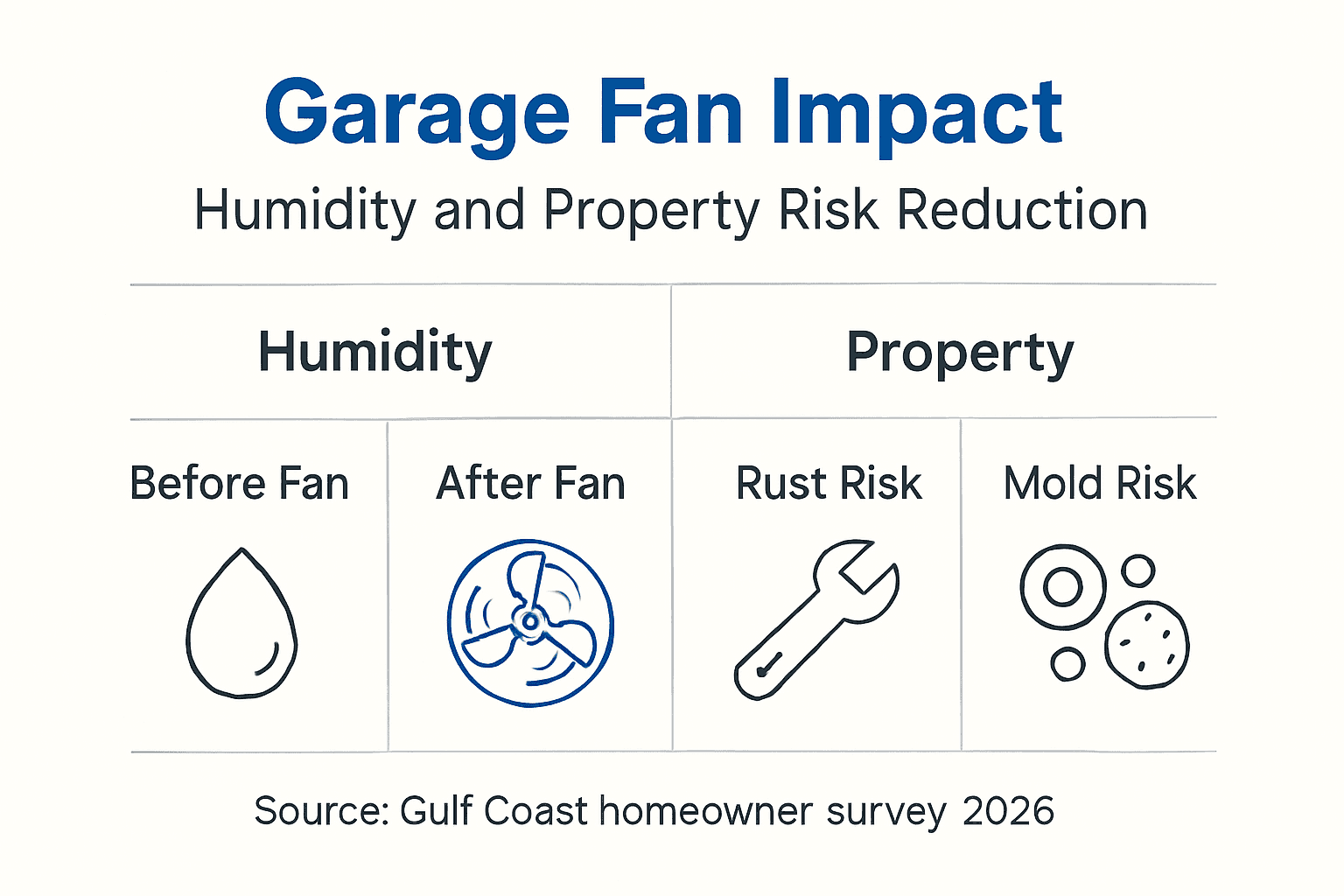
Homeowners report significant reductions in mold-related repair costs after installing ventilation systems. Properties that previously required annual or biannual mold remediation saw these expenses drop to zero or minimal levels. One Mobile County homeowner documented $3,200 in mold remediation costs over three years before installing fans, compared to zero remediation needs in the four years following installation.
Measured indoor air quality improvements show dramatic pollutant reductions. Testing conducted before and after fan installation reveals:
Metric | Before Ventilation | After Ventilation | Improvement |
Carbon Monoxide (ppm) | 15 to 35 | 3 to 8 | 70% to 77% reduction |
VOC Concentration (μg/m³) | 450 to 800 | 135 to 240 | 70% reduction |
Relative Humidity (%) | 75% to 85% | 50% to 60% | 30% to 35% reduction |
Mold Spore Count (spores/m³) | 8,000 to 15,000 | 500 to 2,000 | 85% to 93% reduction |
Vehicle corrosion prevention shows up in extended paint life and reduced rust formation. Owners who garage vehicles in ventilated spaces report minimal surface rust on 10+ year old vehicles, while similar-aged vehicles in unventilated garages show significant oxidation on body panels, exhaust systems, and undercarriages. The resale value difference amounts to $1,500 to $3,000 for mid-range vehicles.
Stored item preservation delivers additional savings. Holiday decorations, sporting equipment, and tools maintain their condition indefinitely in properly ventilated garages. Homeowners no longer replace mold-damaged boxes of decorations or rust-covered garden tools every few years. These avoided replacement costs add up to several hundred dollars annually.
Homeowner satisfaction metrics reveal improved peace of mind and living conditions. Surveys of Gulf Coast residents with ventilated garages report 92% satisfaction with air quality improvements and 88% agreement that the installation provided good value for money spent. Notably, 78% wish they had installed fans sooner after recognizing the preventable damage their garages suffered.
Safety outcomes improve measurably with proper ventilation. Carbon monoxide detector activations in garages with mechanical ventilation occur 80% less frequently than in unventilated spaces. Respiratory complaint rates among family members decline when garage pollutants stop migrating into living areas through connected doorways.
Conclusion and Practical Next Steps
Garage ventilation fans deliver proven protection against humidity damage, air quality problems, and property deterioration in Alabama’s Gulf Coast climate. The evidence clearly supports mechanical ventilation as a worthwhile investment that prevents costly repairs while safeguarding your family’s health.
Evaluate your current garage ventilation needs using this checklist:
Measure garage humidity levels with an inexpensive hygrometer. Readings consistently above 60% indicate inadequate ventilation.
Inspect stored items and vehicle undercarriages for rust, corrosion, or mold growth signaling excessive moisture.
Note musty odors, condensation on windows or metal surfaces, or visible mold on walls and ceilings.
Assess current ventilation methods. Passive vents alone prove insufficient in Gulf Coast humidity.
Calculate your garage volume to determine required CFM rating for adequate air exchange.
Professional inspection provides expert assessment of your garage conditions and ventilation needs. Qualified inspectors use moisture meters, air quality testing equipment, and thermal imaging to identify hidden problems. They recommend appropriate fan specifications for your specific garage configuration and usage patterns.
Qualified installation ensures proper fan placement, electrical connections, and ductwork for maximum effectiveness. Licensed contractors verify adequate power supply, install weather-resistant exterior vents, and configure automatic controls for optimal operation.
Ongoing maintenance sustains the air quality and safety benefits your investment provides. Follow manufacturer guidelines for cleaning schedules, filter replacements, and component inspections. Address any performance changes promptly to maintain consistent protection.
Understanding ceiling fan replacement techniques and garage door safety requirements complements your ventilation knowledge, creating a comprehensive approach to garage safety and functionality.
For complex diagnostics beyond basic observation, expert garage evaluation services provide detailed analysis of ventilation system performance and air quality metrics.
Taking action now prevents the progressive damage that inadequate ventilation causes over months and years. The combination of reduced repair costs, improved air quality, and preserved property value makes garage ventilation fans one of the most cost-effective home improvements for Gulf Coast residents.
Protect Your Alabama Gulf Coast Home with Professional Garage Air Quality Inspections
Your garage deserves the same attention to safety and air quality that you give the rest of your home. Trinity Home Inspections brings professional expertise to evaluate your garage ventilation needs and identify hidden moisture or air quality concerns that threaten your property and health.

Our specialized mold inspection services detect problems before they become expensive remediation projects. We use moisture meters, thermal imaging, and laboratory testing to give you accurate, actionable information about your garage conditions. Our indoor air quality testing measures specific pollutant levels and provides certified lab reports documenting your garage’s air safety.
Professional evaluations help you make informed decisions about ventilation upgrades, protecting your home value and family health. We also offer comprehensive property and permit searches to verify any previous garage modifications or installations, ensuring complete documentation for your property records.
Frequently Asked Questions
What size ventilation fan do I need for my Gulf Coast garage?
Minimum recommended airflow is 100 CFM for small single-car garages. Two-car garages typically need 150 to 300 CFM depending on size and how frequently you use vehicles. Multiply your garage volume by 4 to 6 air changes per hour to calculate specific requirements.
Can I rely on opening my garage door for ventilation?
No, opening doors occasionally provides inadequate air exchange for Gulf Coast humidity. Mechanical fans deliver over 5 times more effective ventilation than passive methods. Pollutants and moisture rebuild within minutes after closing doors, leaving your garage vulnerable most of the time.
How often should I maintain my garage ventilation fan?
Inspect and clean your fan at least annually, including blade cleaning and filter replacement. More frequent quarterly maintenance is recommended in coastal humid environments where salt air and high moisture accelerate dust buildup. Test automatic sensors and controls twice yearly.
What health risks can poor garage ventilation cause?
Increased risk of respiratory issues from mold spores includes persistent coughing, throat irritation, and worsened asthma. Potential carbon monoxide poisoning from trapped gases presents life-threatening dangers in enclosed spaces. Children and individuals with existing respiratory conditions face heightened vulnerability to these effects.
Recommended