Common Insurance Gaps for Gulf Coast Homes
- Matt Cameron
- 5 hours ago
- 8 min read

If I own a home on the Gulf Coast, I can have a standard homeowners policy and still face big out-of-pocket costs after a storm. The main gaps are usually flood and storm surge, hurricane or named-storm deductibles, roof payout limits, and small add-ons like water backup, code upgrade coverage, and living expense limits.
Here’s the short version I’d want in front of me before hurricane season:
Flood damage is usually not covered by a standard homeowners policy.
Storm deductibles can be a percentage of the home limit, not a flat amount.
Older roofs may be paid at depreciated value, not full replacement cost.
Detached structures, sewer backup, mold, and code fixes can have low limits or no coverage.
Once a named storm enters the Gulf, changes may be blocked for a period of time.
A lender’s flood requirement may not match rebuild cost, which can leave a gap.
A few numbers make the risk plain. On a $400,000 home, a 2% hurricane deductible means $8,000 out of pocket. At 5%, that becomes $20,000. Coverage for detached structures may be only 5% to 10% of the dwelling limit, or $20,000 to $40,000 on that same home, even though building costs have climbed by more than 55% since 2019.
Gap | What I’d Check First | Why It Matters |
Flood & storm surge | Separate flood policy, limits, deductible | Standard home insurance usually excludes flood |
Wind deductible | Named-storm or hurricane percentage | Out-of-pocket cost can be high |
Roof settlement | ACV vs. RCV, 4-point inspection roof age limits | Older roofs may be underpaid |
Other structures | Coverage B amount | Garages, sheds, and fences add up fast |
Water backup | Endorsement and sewer line terms | Backup and line repair are often split |
Living expenses & code | ALE and ordinance/law limits | Flood may not pay living costs; repairs can trigger code work |
I’d use this article as a plain-language checklist to spot the policy holes that show up most often for Gulf Coast homes and fix them before June 1 or before the next storm watch starts. If you are buying a new property, scheduling a home inspection in Mobile, AL can help identify these structural risks early.
Gap 1: Flood And Storm Surge Are Usually Not Covered
The first gap to fix is flood coverage. Standard homeowners insurance usually does not cover water that enters from outside and rises into the home. So if wind tears off shingles, a standard HO-3 policy will often pay for that. But if water comes up from the ground and moves into the house, that loss is usually excluded.
What Counts As Flood Damage During A Gulf Coast Storm
Flood damage means rising water entering from outside the structure. That includes storm surge, surface water, drainage overflow, and flash flooding.
How To Close The Flood Coverage Gap Before Hurricane Season
Flood insurance is separate from standard homeowners coverage. You can buy it through FEMA's National Flood Insurance Program (NFIP) or through private flood insurers.
There’s also a timing issue many homeowners miss. Carriers may stop binding new or changed coverage once a named storm enters the Gulf, which can block you from putting coverage in place or making updates until the threat passes.
Flood premiums go up as risk goes up. Zone X is the lowest-risk tier, Zone AE costs more, and Zone VE is the highest.
Your building and contents limits should match current replacement costs. Older limits may fall short now, especially after price increases for labor and materials. Lender-required limits can be a trap here too, because they may track the mortgage balance rather than what it would cost to rebuild the home.
Keep your flood declarations page, coverage limits, deductible, and any elevation documents together in one file.
After flood coverage, the next issue is how wind deductibles and roof limits affect storm claims.
sbb-itb-3aaca89
Gap 2: Wind Deductibles and Roof Claim Limits
Once flood coverage is handled, the next big exposure is wind. And even when a policy includes wind, two gaps show up again and again: percentage deductibles and roof payout limits.
How Named Storm and Hurricane Deductibles Raise Out-of-Pocket Costs
Named storm and hurricane deductibles are often set as a percentage of Coverage A, not a flat dollar amount. That can change the math fast.
A 2% deductible on a $400,000 home means $8,000 out of pocket before the insurer pays anything. At 5%, that jumps to $20,000.
Check your declarations page for terms such as "named storm deductible" or "hurricane deductible". Then confirm the percentage tied to your Coverage A limit. Some policies also leave out wind coverage for certain roofs or limit it based on age, condition, or construction type.
Even if the deductible looks manageable, the way the roof claim is settled can still leave you short.
Where Actual Cash Value Roof Terms Create Gaps
Roof claims often settle at Actual Cash Value (ACV), which subtracts depreciation and can leave an older roof underpaid. If your roof is near the back end of its life, that difference can sting.
Replacement Cost Value (RCV) coverage helps close that gap, but not every policy offers it for older roofs.
Roofs with only a few years of life left can lead to tighter underwriting review, renewal limits, or even replacement demands. Unpermitted roof work can also complicate both underwriting and claims.
It’s one of those details people don’t think about until a storm hits. By then, the numbers on paper matter a lot more than expected.
How Inspections and Maintenance Records Support Better Coverage Decisions
The best time to document roof condition is before hurricane season starts. A pre-storm inspection from Trinity Home Inspections can document roof condition, roof-to-wall connections, attic access, and permit history before a claim or renewal.
Documented wind-mitigation features can also help with underwriting decisions. Keep permit records for any roof work. If repairs were done without permits, that can create problems during underwriting and claims.
Gap 3: Other Structures, Water Backup, Living Expenses, and Code Upgrades
After flood and wind, the next trouble spots are often the smaller limits and add-ons that don’t get much attention until a claim is filed. Once flood and wind are dealt with, many of the losses that remain come from sublimits and endorsements.
When Coverage B Is Too Low for Garages, Sheds, Fences, and Other Detached Structures
Coverage B (Other Structures) pays for detached garages, workshops, sheds, fences, pool houses, and carports. Standard HO-3 policies usually limit this coverage to 5% to 10% of your dwelling coverage.
On a $400,000 home, that leaves only $20,000 to $40,000 for all detached structures combined. That may sound like enough at first glance, but building costs have gone up by more than 55% since 2019. A detached garage or similar outbuilding can burn through that limit faster than most homeowners think.
Pull out your declarations page and check the Coverage B amount against what it would cost to rebuild those structures today at local rates. That one comparison can tell you a lot.
Water Backup and Sewer Line Repair Gaps That Leave Homeowners Paying Out of Pocket
Heavy rain can overwhelm drains and sewer lines, and that creates a different kind of coverage issue. If drains or sewers back up, the claim is usually handled through a water-backup endorsement, not a flood policy.
Standard policies also usually don’t pay to fix a failed sewer line unless you have a separate endorsement. In plain terms, you could end up paying for the repair yourself even if the damage inside the home is covered under a water-backup add-on.
A sewer scope inspection from Trinity Home Inspections can help spot line wear before it turns into a claim. It’s the kind of issue many people don’t think about until wastewater ends up where it definitely shouldn’t be.
Loss of Use, Ordinance or Law, and Mold Limits After a Storm
Loss of use, also called Additional Living Expenses, helps pay for temporary housing and other extra costs when a covered loss makes your home unlivable. The key thing to check is whether the limit can handle months of hotel stays, short-term rent, meals, and other added costs.
Flood policies typically do not include additional living expenses. So if flood damage forces you out of the house, those living costs may land squarely on you.
Then there’s the code issue. Once repairs begin, older homes often reveal work that must be brought up to current code. Along the Gulf Coast, that can mean electrical, plumbing, or structural upgrades after a covered loss. If your ordinance or law coverage isn’t high enough, you pay the difference out of pocket.
Mold is another area worth checking after a storm. Standard policies often place tight limits on mold claims, and some don’t cover it at all unless you add a specific endorsement.
Certified mold swab testing from Trinity Home Inspections can document preexisting moisture before hurricane season.
Conclusion: A Pre-Hurricane Insurance Checklist for Gulf Coast Homeowners
Use this final pass to check the coverage gaps that matter most before June 1.
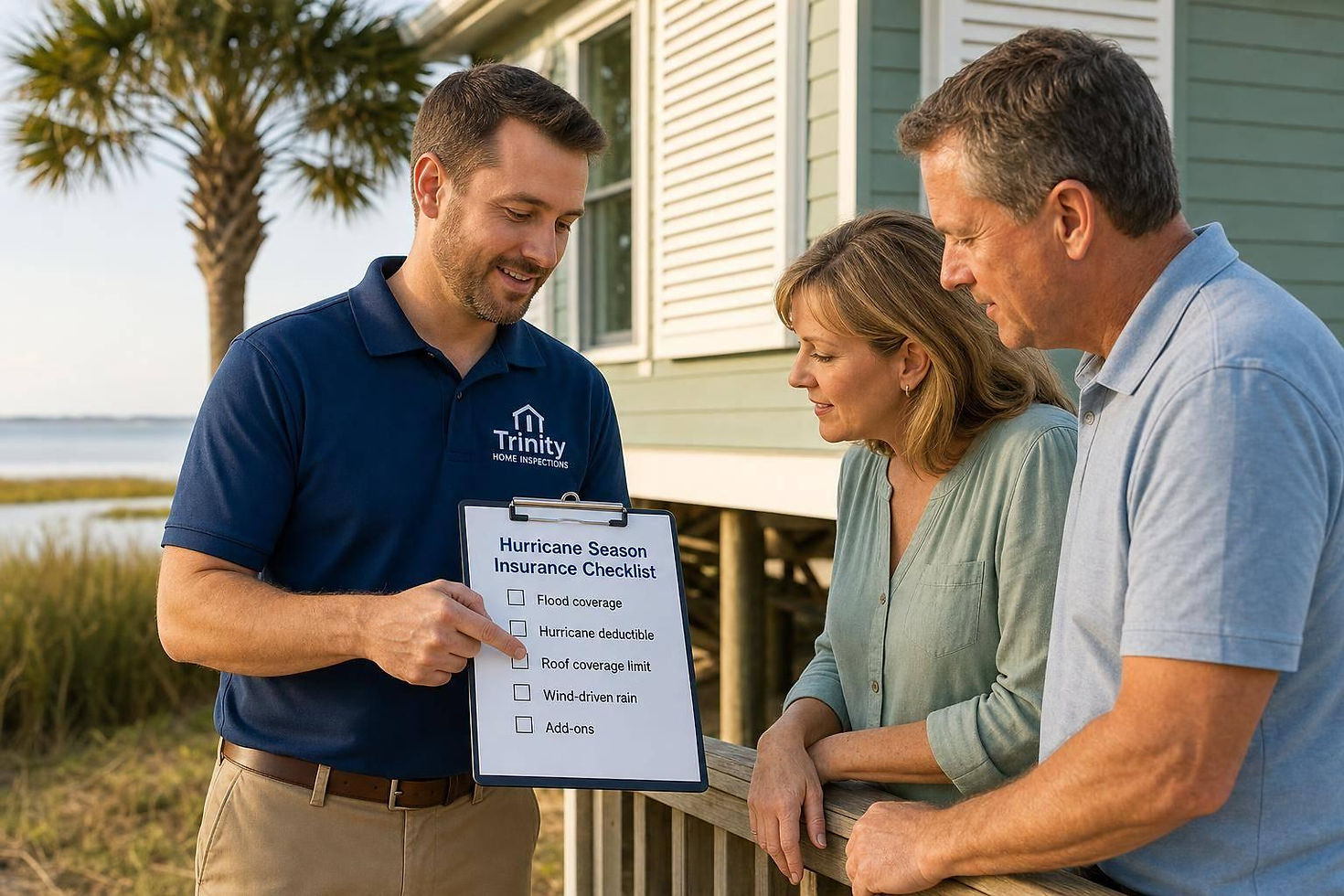
Pull out your declarations page and go through it line by line. Start by making sure a separate flood policy is active. Then check your hurricane or named-storm deductible, since that number can shape what you pay out of pocket after a storm.
Next, look at wind and roof terms. Review your wind coverage, then check how your policy handles roof age and condition. It’s also smart to confirm that your dwelling limit still matches today’s replacement cost, not what the home might have cost to rebuild a few years ago.
After that, review the smaller endorsements that often make a big difference when a claim is paid. Confirm water backup, ordinance or law, and additional living expenses coverage. These parts of the policy often decide how much you recover and how much comes straight from your own pocket after a storm.
A recent inspection can help back up that review. A current inspection from Trinity Home Inspections can document roof condition, detached structures, and drainage before hurricane season.
FAQs
Do I need flood insurance if I’m not in a high-risk zone?
Yes. Standard homeowners insurance usually does not cover flood damage, even though flooding plays a part in 90% of U.S. natural disasters.
That catches a lot of people off guard. Many homeowners assume their policy covers water damage from any source, but flood damage is usually a separate issue.
Even places labeled lower risk, like Zone X, can still get hit by heavy rain or flash flooding. It doesn’t take a major coastal storm to cause a mess. A stalled storm system or fast downpour can do plenty of damage on its own.
Most flood policies also come with a 30-day waiting period. That means you can’t wait until a storm is already on the radar and expect coverage to kick in right away. It makes sense to lock in a policy well before hurricane season starts.
How do I know if my roof is covered at replacement cost?
Check your homeowners insurance declarations page, or ask your insurance provider if your roof is covered at replacement cost or actual cash value.
Since Gulf Coast rebuilding costs have gone up since 2019, it’s smart to confirm that your policy pays the full amount needed to replace the roof, not a depreciated payout.
A roof inspection from Trinity Home Inspections can help document the roof’s condition, age, and estimated remaining life for your records.
When should I review or update my coverage before hurricane season?
Review and update your insurance coverage well before hurricane season starts. Some policies, like flood insurance, can come with a 30-day waiting period, so it’s smart to lock in coverage before any storm gets a name.
Starting in March or April gives you breathing room to make changes, gather paperwork, and look over your policy each year for wind damage, flood protection, and current construction costs.