
5 ft Surface, 10 ft Buried: Inspector Backed Downspout Distances

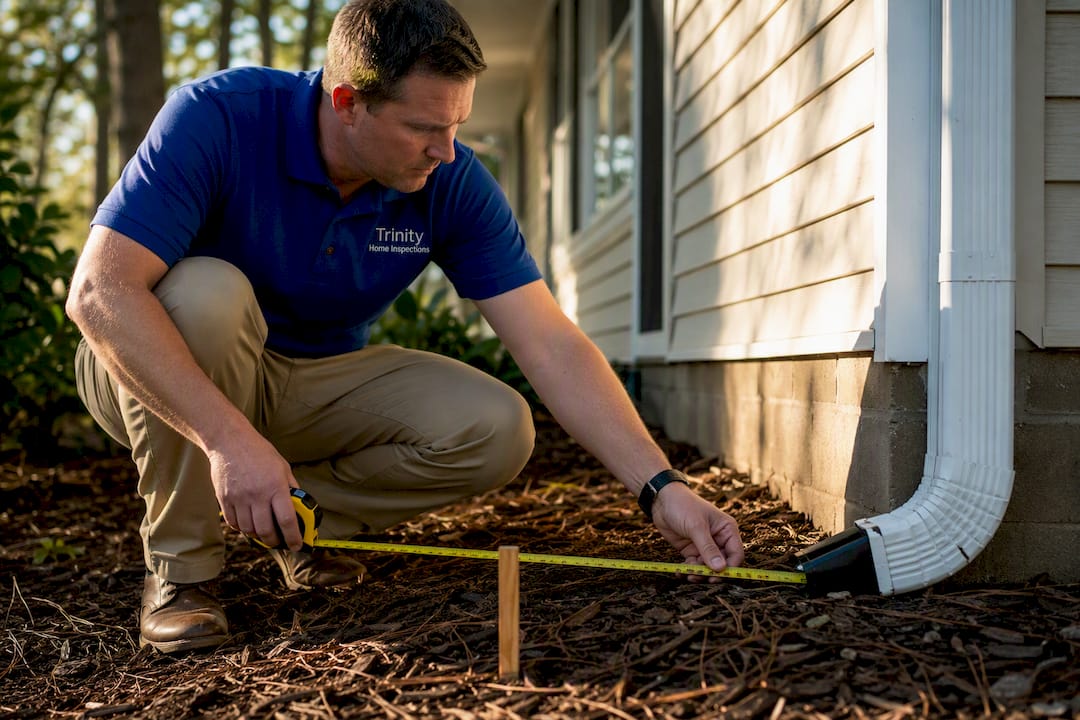
Downspouts should discharge water at least 5 feet from the foundation for surface extensions, and 10 feet or more for buried pipes or dry wells, according to Department of Energy Building America guidance. Basements and clay soils need extra distance, often 6 to 10 feet, while slabs and crawlspaces on well-graded lots can sometimes get by with less. Check your current setup: if water discharges under 5 feet with no slope carrying it away, extend it this weekend.
TL;DR:
For proper drainage, downspouts should discharge at least 5 feet from the foundation for surface extensions and 10 feet or more for buried pipes or dry wells, especially on clay soils or basement foundations.
Buried systems require a longer minimum distance of 10 feet or more to ensure effective water flow and prevent backpressure against the foundation.
Signs of inadequate discharge distance include damp basement floors after rain, foundation cracking, settling soil near the outlet, and efflorescence on basement walls.
Yard grading must fall away from the foundation at a slope of 5% or roughly 6 inches over 10 feet, with flat or reversing slopes requiring longer downspout runs or buried pipe solutions.
Regular inspection, debris removal, and testing are essential to maintain drainage effectiveness, and professional assessments can identify hidden issues or soil-related risks.
Recommended Downspout Discharge Distances By Situation
The right distance depends on what’s under your house and what your yard does with water once it lands. A one-size-fits-all answer doesn’t hold up across foundation types, so here’s how the numbers break down.
For a standard surface extension, the widely cited baseline is 4 to 6 feet, with the Department of Energy’s Building America program setting the floor at 5 feet minimum. That’s the distance most homes need just to get water past the disturbed soil around the foundation footing, where backfill tends to be looser and more prone to settling.
Buried systems change the math. Because underground pipe hides the run and doesn’t rely on visible slope to keep working, aim for 10 feet or more whenever your yard allows it. This Old House’s guidance on extending downspouts backs this up, recommending dry wells sit 10 to 15 feet from the foundation when space permits.
Foundation type matters just as much as the discharge method:
Basements: target 6 to 10 feet. Basements sit deepest in the ground and take the most hydrostatic pressure from saturated soil, so give yourself the longer end of the range.
Slab foundations: 2 to 5 feet often works fine if the finish grade genuinely slopes away and the slab has no history of moisture intrusion.
Crawlspaces: similar to slabs, 2 to 5 feet is workable with good grading, but tighten that up if the crawlspace has ever flooded or smelled musty.
Poor-draining or clay-heavy soils: push toward 8 to 10 feet regardless of foundation type, since clay soaks up water slowly and holds it against the wall longer.
When your lot is too tight for a 10-foot surface run, using buried pipe to a dry well or daylight outlet can be an effective solution. A short yard doesn’t mean you’re stuck with inadequate drainage. It means the pipe needs to go underground instead of across the lawn.
Why Distance From the Foundation Actually Matters
Water sitting against a foundation wall isn’t just an aesthetic problem. It builds hydrostatic pressure, and that pressure is what actually breaks things.
Here’s the mechanism: soil next to the foundation gets saturated, and saturated soil pushes against basement or crawlspace walls with real force. That pressure finds the weakest point, whether it’s a hairline crack, a form tie hole, or a joint where the wall meets the footing, and forces water through. Building Science’s research on bulk water control points to this exact dynamic: managing roof runoff only works when it’s paired with grading that keeps soil near the foundation from saturating in the first place.
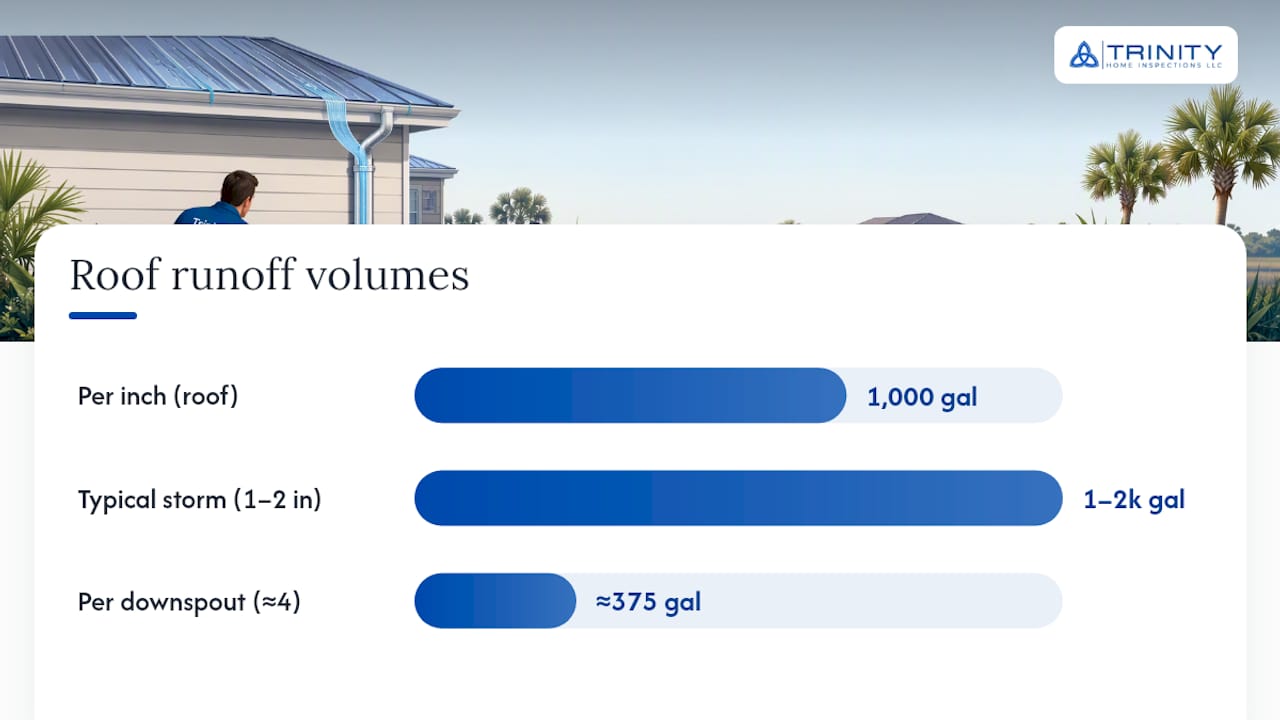
A typical 1,600 square foot roof sheds roughly 1,000 gallons of water for every inch of rain, according to Building Advisor’s site drainage research. During a normal Gulf Coast thunderstorm dropping an inch or two, that’s 1,000 to 2,000 gallons funneling off your roof and out four or so downspouts. A splash block that moves water two feet simply isn’t built to handle that volume without some of it working its way back toward the wall.
Watch for these signs that discharge distance is failing:
A damp or wet basement floor showing up specifically after storms, not during dry stretches
New cracks in the foundation wall, or existing cracks that seem to be widening
Soil that’s visibly sinking or settling near the downspout outlet
Efflorescence (white, chalky mineral deposits) on basement walls
If you’re noticing any of these, our guide on signs of foundation problems walks through what’s worth watching and what needs a closer look.
How Grading and Soil Type Change the Right Distance
Distance alone doesn’t solve drainage. Where that water lands relative to your yard’s slope determines whether it stays away or eventually finds its way back.
The building code baseline here is IRC R401.3, which requires finish grade to fall away from the foundation at 5%, or roughly a 6-inch drop over the first 10 feet. That’s not an arbitrary number. It’s the minimum slope needed to keep gravity working in your favor instead of against you.
If your yard already meets or beats that grade, a shorter downspout extension can still perform well, since the ground itself is doing a lot of the work. If your yard is flat, or worse, slopes back toward the house (a surprisingly common issue after landscaping or mulch buildup over the years), you need a longer run regardless of what the baseline distance chart says.
Measuring your own slope takes about ten minutes:
Place a 4 foot level at the foundation wall and extend a tape measure 10 feet out along the yard.
Hold the level flush at the wall end and check how many inches of drop you have at the 10 foot mark using the tape and a straightedge.
Look for low spots, especially where patios, walkways, or old flower beds create a dip that funnels water back toward the house.
Repeat at each downspout location, since grading often varies around a single home.
Clay soil compounds the problem because it drains slowly and holds saturation longer than sandy or loamy soil, so wet-climate homes on clay should default to the longer end of every distance range. Our post on foundation moisture risks from poor drainage goes deeper into how soil composition interacts with grading over a full season of Gulf Coast rain.
Pro Tip: Do this slope check right after a heavy rain, not on a dry day. Standing water reveals low spots that a dry, flat-looking yard hides completely.
Splash Blocks, Extenders, and Buried Pipe: What Actually Works
Not every discharge method delivers the same distance, and picking the wrong one is how homeowners end up with water back at the wall despite doing “everything right.”
Splash blocks are the cheapest and fastest fix, but they typically only move water 1 to 3 feet, according to Bob Vila’s downspout length guidance. That’s rarely enough distance on its own, especially for basements or clay soil. Think of a splash block as a starting point, not a finish line.
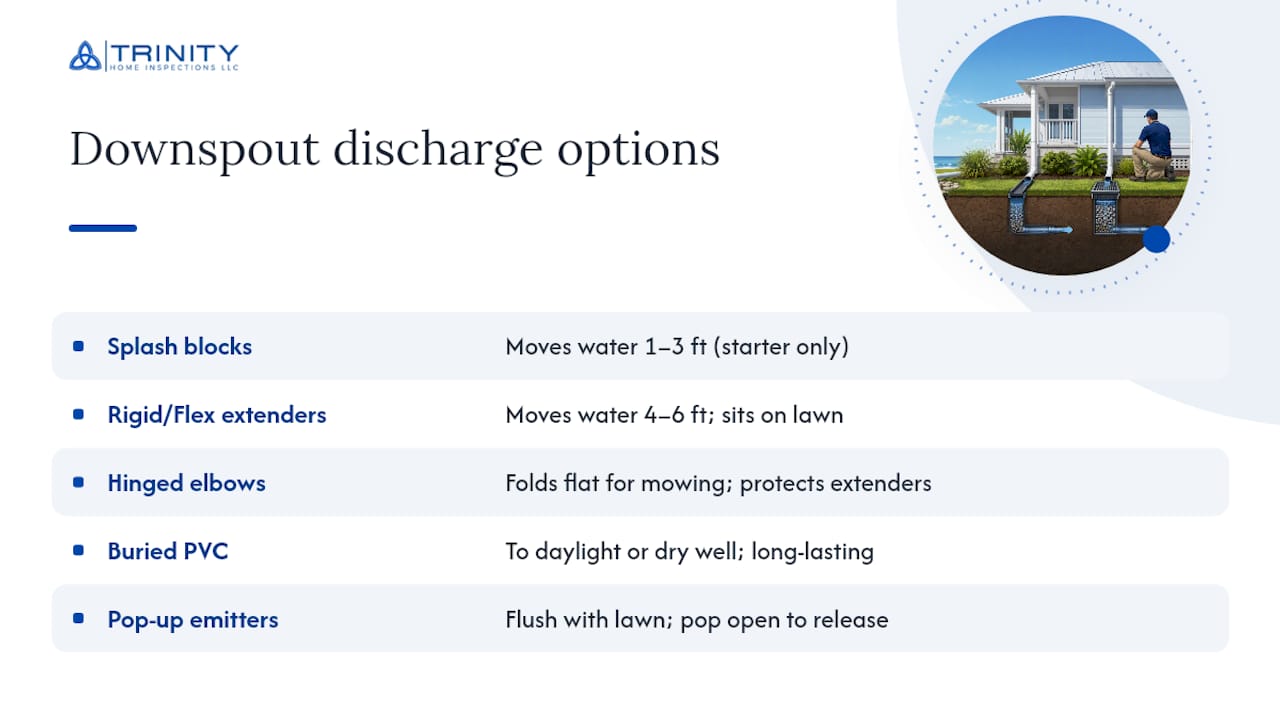
Rigid or flexible extenders get you to the 4 to 6 foot range most homes need, and they’re affordable and easy to install without tools beyond a hacksaw. The tradeoff is that they sit on top of the lawn, which means lawn mowers, kids, and dogs all interact with them regularly.
Hinged or flip up elbows solve that exact problem. They fold flat when you mow and pop back into place afterward, which Building Science’s research notes cuts down on the mower damage that eventually cracks rigid extenders.
Buried PVC to daylight or a dry well is the strongest option when yard space won’t allow a 10 foot surface run, or when you want the discharge point completely out of sight. This route requires more upfront work, digging a trench with proper fall and terminating into gravel or a percolation pit, but it holds up long term and doesn’t create a tripping hazard across the lawn.
Pop-up emitters offer a middle ground: they sit flush with the grass, stay hidden, and pop open underwater pressure to release the flow at distance. They’re worth considering if your buried run terminates somewhere visible near a patio or walkway.
One more consideration: where the water actually lands matters beyond your own yard. If a downspout route sends runoff toward a neighbor’s property line or under a deck, check local drainage ordinances first, and look at options like the drainage strategies covered in Cactus Decking’s under-deck drainage guide if the discharge point sits near a covered structure.
DIY Installation Steps for Downspout Extensions
Installing an extension yourself is entirely doable for a confident homeowner with a weekend and basic tools. Here’s how to do it right the first time.
Before you dig or attach anything, plan the full route. Trace where water will travel from the downspout to its final discharge point, and make sure that path doesn’t cross a neighbor’s property line, run over a septic field, or sit near buried utility lines. Call 811 before any digging deeper than a few inches.
You’ll need: a downspout extender or PVC pipe, pipe couplers if extending a run, gravel and geotextile fabric for a buried termination, a 4 foot level, a shovel, and basic safety gear like gloves and eye protection.
For a surface installation:
Measure the distance from your downspout outlet to your target discharge point (5 to 6 feet minimum in most cases).
Attach the extender to the downspout’s existing elbow, angling it slightly downward so water doesn’t pool at the joint.
Secure a kick-out elbow or splash guard at the discharge end to disperse flow instead of letting it drill a single channel into the soil.
Test it. Run a garden hose into the gutter for a few minutes and watch where the water actually ends up.
For a buried installation:
Dig a trench roughly 12 to 18 inches deep, maintaining a consistent downward fall of about 1 inch per 10 feet toward the outlet.
Lay PVC pipe with solvent-welded joints, and wrap the trench in geotextile fabric before backfilling to prevent silt buildup.
Terminate into a gravel bed or dry well. This Old House recommends a pit roughly 16 inches deep and 36 inches wide, filled with rock, placed 10 to 15 feet from the foundation.
Backfill in layers, tamping as you go, and reseed or resod the disturbed area.
One hard rule: never tie a downspout into a footing or perimeter drain. DOE Building America warns that gutter debris can clog and overload that system, turning a working foundation drain into a liability. If your grading is complex, or the route runs anywhere near a septic system or sewer line, that’s the point to bring in a professional instead of guessing.
Pro Tip: Run the hose test again a few weeks after installation. Soil settles, extenders shift, and a run that worked perfectly on install day can drift out of alignment by fall.
Maintaining and Inspecting Your Downspout Extensions
A downspout extension is only as good as its last cleaning. Systems that worked great in spring can fail completely by the time storm season peaks if nobody’s checked them since.
Clear gutters and downspouts at least twice a year, and always after a major storm drops branches or heavy debris. While you’re up there, check the joints and straps holding downspouts to the house, since loose brackets let sections separate right where you need a tight seal most.
At ground level, walk the discharge points after any heavy rain and look for:
Ponding or standing water right at the outlet, which usually means the ground has settled and lost its slope
Erosion channels or bare dirt where water has been cutting the same path repeatedly
Extenders that have shifted, popped loose, or gotten buried under mulch and lawn debris
If a buried run seems sluggish, run a hose through it and watch the outlet end for flow. A weak trickle usually means a clog or a settled low spot in the pipe. For homeowners who’ve dealt with repeat moisture issues, a periodic check with a moisture meter or thermal imaging can catch problems before they show up as visible damage. Our gutter cleaning maintenance guide covers the seasonal routine in more detail.
Pro Tip: Mark your buried discharge points with a small flag or stake before winter. It’s a lot easier to find a dry well under snow or dead leaves when you know exactly where to look.
What a Home Inspector Checks About Downspout Drainage
When we walk a property, drainage around the foundation gets just as much attention as the roof or the electrical panel, because water is the most common cause of long-term structural trouble we see across coastal Alabama.
A thorough inspection looks at:
Overall site grading and whether it slopes away from the foundation per the standards outlined in IRC R401.3
Downspout routing and discharge distance at every corner of the house, not just the ones visible from the driveway
Evidence of past water intrusion: staining, efflorescence, or musty odors in basements and crawlspaces
Moisture meter readings at suspect walls, and thermal imaging where hidden moisture might not show up to the naked eye
What’s included when Trinity Home Inspections handles this for you: a same-day photo and video report covering grading and drainage observations, free thermal imaging where conditions allow, moisture meter verification on any suspect areas, and a color-coded priority list so you know what’s urgent versus what can wait. If your home sits in a region with historically wet soil, our post on why Gulf Coast homes need better drainage explains why local conditions push these numbers toward the higher end of every range.
Not Sure If Your Drainage Setup Is Enough? Get a Second Look
DIY distance checks and a level get most homeowners most of the way there, but if you’ve already seen dampness, cracking, or settling soil near your foundation, a visual inspection alone can miss what’s happening beneath the surface. That’s where Trinity Home Inspections comes in as your next step, using tools your eyes alone can’t match, like moisture meters and free thermal imaging, to confirm whether your grading and downspout setup are actually protecting your home.
[

What’s included with a Trinity Home Inspections drainage and moisture evaluation:
Same-day digital report with photos and video, not a wait of several days
Free thermal imaging to spot hidden moisture patterns behind walls
Moisture meter verification at any area showing signs of past water intrusion
Plain-English priority list so you know what needs attention now versus later
If you’re buying a home and want the fuller picture before closing, our pre-listing and seller inspection services cover drainage alongside the rest of the property’s condition. Call 251-210-7376 or visit Trinityinspectionsllc to schedule an inspection and get real answers about what’s happening around your foundation.
A Local Note From Matt
Coastal Alabama doesn’t get gentle rain. It gets downpours, and clay soil that holds onto every drop longer than homeowners expect. I’ve walked enough crawlspaces around Baldwin and Mobile counties to know that a downspout extension someone installed five years ago rarely still works the way it did on day one. Soil settles. Grading shifts. What matters is checking it, not just installing it once and forgetting it.
If your gut says something’s off with drainage around your home, trust that instinct enough to get a second opinion. Call Trinity Home Inspections at 251-210-7376 or visit Trinityinspectionsllc.
— Matt
Sources
These recommendations rest on established code and building science, not guesswork:
FAQ
How far should water be from your foundation?
Surface discharge should land at least 5 feet from the foundation, and basements or clay soils generally need 6 to 10 feet for reliable protection.
Is it a good idea to bury downspouts underground?
Yes, burying downspouts works well when yard space limits a surface run, as long as the pipe terminates at least 10 feet away and never ties into a footing or perimeter drain.
How can I redirect downspout water away from my house?
Use a rigid or flexible extender for a quick fix, or bury PVC pipe to a dry well or daylight outlet when you need a longer, permanent run that stays out of the way.
How far should a pop-up drain be from the house?
A pop-up emitter should sit at the end of a buried run that’s at least 10 feet from the foundation, matching the same distance guidance as any other buried discharge point.
Recommended