
Why Gulf Coast Homes Need Better Drainage Around Foundations

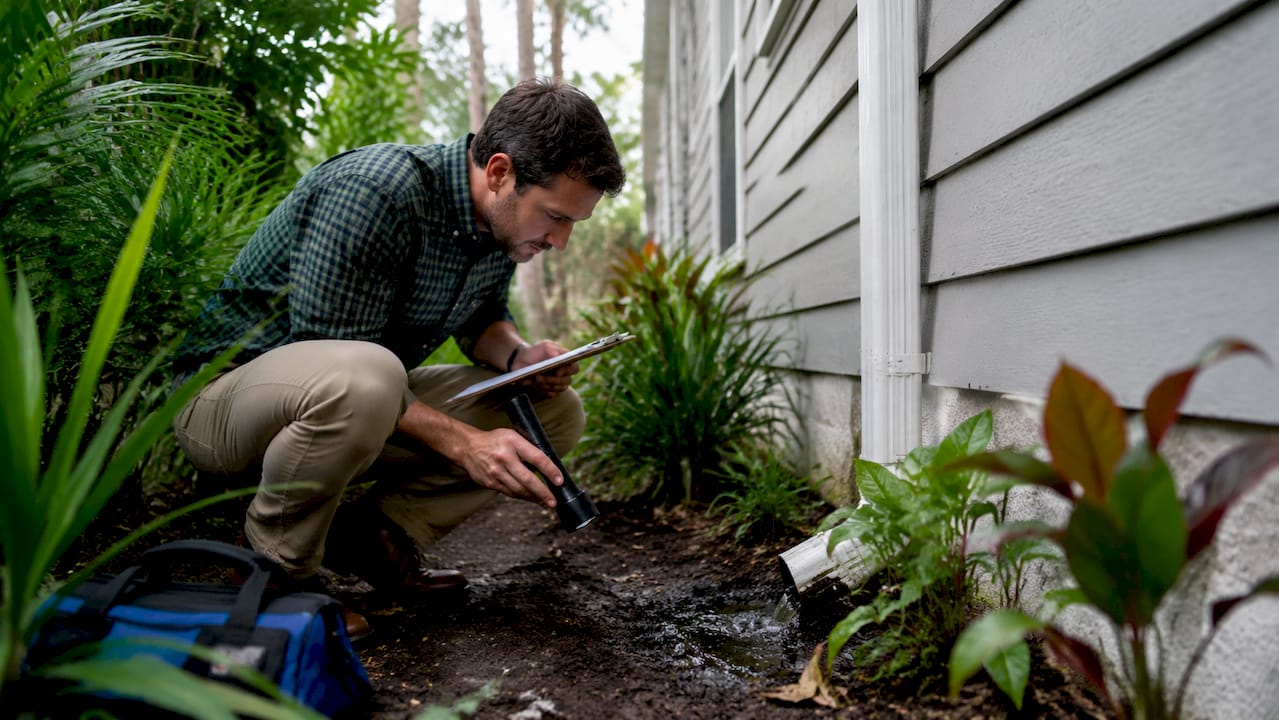
Proper drainage around a Gulf Coast home’s foundation is the single most effective defense against water-driven structural damage. The Gulf Coast’s combination of heavy clay soils, high groundwater tables, and intense seasonal rainfall creates conditions that standard drainage advice simply does not address. Expansive clay soils absorb water slowly, swell against foundation walls, and shrink back during dry spells, repeating a cycle that cracks slabs and bows walls over time. Homeowners in Mobile, Baldwin, and surrounding counties face these risks every year, and understanding them is the first step toward protecting your investment.
Why Gulf Coast homes need better drainage around foundations than inland homes
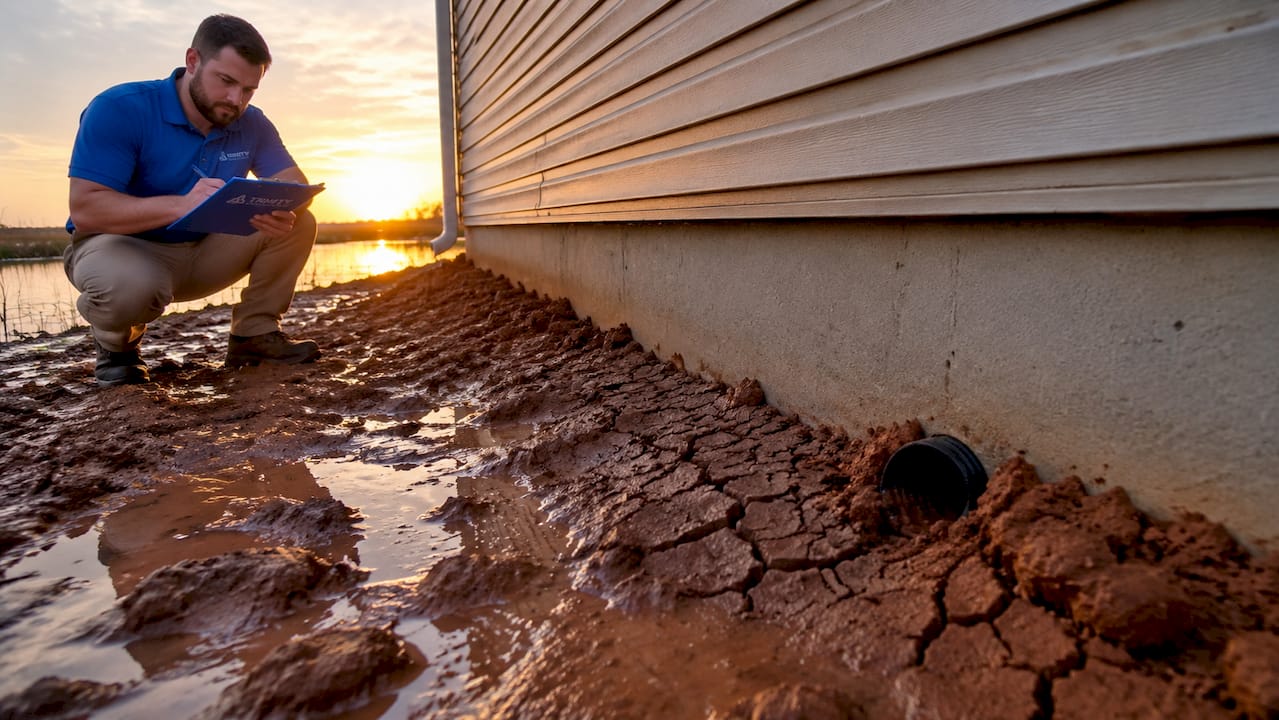
Gulf Coast homes sit on soil that behaves differently from almost anywhere else in the country. Clay soil permeability in coastal plains can drop as low as 0.06 inches per hour. That means water from a typical Gulf Coast thunderstorm sits on and around your foundation for hours, sometimes days, before the ground absorbs it.
That standing water does not just look bad. It builds hydrostatic pressure against your foundation walls. Hydrostatic pressure is the force that water exerts when it has nowhere to go. Over months and years, that pressure bows basement walls inward, widens hairline cracks in slabs, and pushes moisture through concrete pores into your living space.
The Gulf Coast adds another layer that inland homeowners never deal with: tidal influence on groundwater. Tidal fluctuations in coastal Gulf areas raise and lower the water table beneath your yard on a daily basis. During storm surge events, that table rises fast. Standard drainage systems designed for inland conditions cannot handle a water table that moves with the tides.
The core problem: Gulf Coast clay soils drain at a fraction of the rate that inland sandy or loamy soils drain. Combine that with a tidal groundwater table and seasonal rainfall that regularly exceeds 60 inches per year across much of coastal Alabama, and you have conditions that demand active, purpose-built drainage systems rather than simple grading alone.
The shrink-swell cycle is the most damaging long-term force at work here. When clay soil absorbs water, it expands and pushes against your foundation. When it dries out, it contracts and pulls away, leaving gaps where water channels directly down to your footing. This cycle repeats with every rain event. Over five to ten years, it produces settlement, cracking, and uneven floors that cost tens of thousands of dollars to repair. You can read more about how these coastal Alabama foundation issues develop and compound over time.
The contrast with inland homes is worth stating clearly. Inland Alabama soils tend to drain faster and experience less groundwater fluctuation. Drainage advice written for those conditions, such as simple downspout extensions and basic grading, falls short for Gulf Coast properties. Your home needs solutions built for your specific soil and water table.
What do local building codes require for foundation drainage?
The 2026 International Residential Code (IRC) Section R401.3 sets the minimum standard: ground must slope away from the foundation at a rate of 6 inches over the first 10 feet. That slope prevents surface water from pooling at your slab perimeter or crawlspace wall. If your yard is flat or slopes toward the house, you are out of compliance and actively directing water toward your foundation.
Grading is the starting point, but it is not the complete solution for Gulf Coast conditions. Here are the key drainage design requirements that go beyond basic slope:
Downspout extensions. Downspouts must discharge water 6–10 feet from the foundation, or connect to subsurface pipes that carry water off the property entirely. Dropping water at the foundation wall defeats the purpose of gutters.
Subsurface pipe connections. In clay-heavy Gulf Coast soils, extending downspouts alone is often insufficient. Connecting them to underground pipes that route water to the street or a drainage easement keeps foundation perimeter soil moisture stable.
French drains with filter fabric. A French drain is a gravel-filled trench with a perforated pipe that collects and redirects groundwater. Filter fabric wrapped around the gravel prevents clay particles from clogging the pipe over time. This is a critical detail in Gulf Coast installations because clay migration destroys unprotected French drains within a few years.
Interceptor drains. If your lot sits downhill from neighboring properties, lateral water flows toward your foundation regardless of how well you grade your own yard. Interceptor drains capture that water before it reaches your perimeter.
Sump pump systems. Interior French drains paired with a sump pump provide reliable moisture protection when full exterior excavation is not practical. Interior systems typically cost $5,000–$15,000, compared to $15,000–$50,000 for full exterior excavation systems.
Drainage method | Best use case | Approximate cost range |
Regrading and surface slope | Flat yards, minor pooling | $1,500–$5,000 |
French drain with filter fabric | Lateral groundwater, clay soils | $3,000–$10,000 |
Interior French drain and sump pump | Limited exterior access | $5,000–$15,000 |
Full exterior excavation system | Severe hydrostatic pressure | $15,000–$50,000 |
Pro Tip: Before spending money on any drainage system, have a structural engineer assess the root cause of your water intrusion. A professional diagnosis costs approximately $300–$700 and can prevent you from installing the wrong system for your specific soil and water pathway conditions.
How does your foundation type change the drainage strategy?
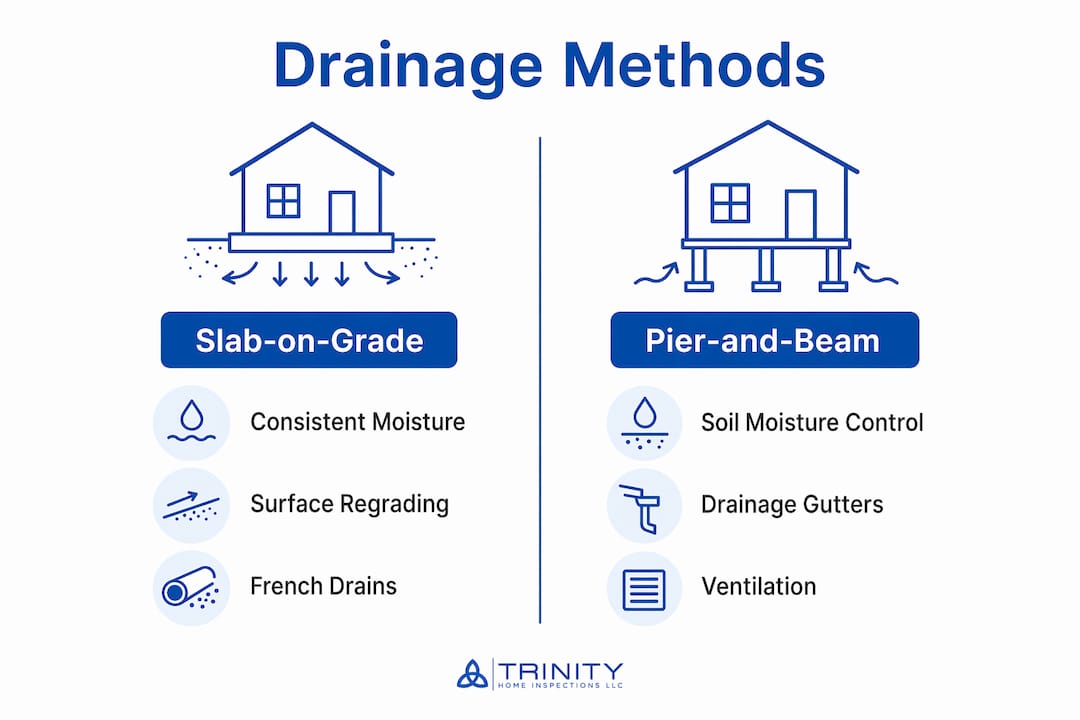
Not every Gulf Coast home has the same foundation, and using the wrong drainage approach for your foundation type can cause new problems while failing to solve the original ones. Pier-and-beam and slab-on-grade foundations require fundamentally different drainage strategies.
Slab-on-grade foundations
Slab-on-grade is the most common foundation type in newer Gulf Coast construction. The concrete slab sits directly on the soil, which means soil moisture changes directly affect the slab. The goal for slab drainage is moisture uniformity, not complete dryness.
Keeping soil consistently moist prevents the shrink-swell cycle that cracks slabs.
Perimeter grading and downspout extensions prevent localized saturation spikes after heavy rain.
Soaker hoses placed around the foundation perimeter during dry spells help maintain that uniform moisture level.
Avoid directing all water away from the slab during drought conditions. Completely dry clay soil shrinks and drops, causing settlement just as surely as oversaturation causes heave.
Pro Tip: Maintaining consistent moisture around a slab-on-grade foundation is more effective than trying to keep the soil completely dry. The goal is stability, not elimination of all moisture.
Pier-and-beam foundations
Pier-and-beam homes, common in older Gulf Coast neighborhoods and elevated coastal areas, have a crawlspace beneath the living area. The drainage priority here is completely different: total water exclusion from the crawlspace.
Standing water in a crawlspace accelerates wood rot on floor joists and beams within months.
Moisture without standing water still creates conditions for mold growth and structural wood decay.
Crawlspace vapor barriers combined with perimeter drainage direct water away before it enters the space.
Crawlspace vents must be positioned and sized correctly. Improper venting in Gulf Coast humidity can pull moist air in rather than push it out.
Sump pumps inside the crawlspace provide a last line of defense when perimeter drainage is overwhelmed during heavy rain events.
Using the same drainage measures for pier-and-beam and slab-on-grade homes can cause unintended structural damage. A drainage plan that works perfectly for a slab can leave a crawlspace wet and vulnerable. Know your foundation type before choosing a solution.
How can Gulf Coast homeowners improve foundation drainage right now?
You do not need to spend $20,000 to make meaningful progress on foundation drainage. Several improvements are low cost, and a few are free. Start with the basics and work up to more advanced solutions only if problems persist.
Clean gutters every six months. Clogged gutters overflow at the roofline and dump water directly against your foundation wall. Gulf Coast pine trees and seasonal storms fill gutters fast. Check out these gutter maintenance tips specific to Gulf Coast Alabama homes.
Extend downspouts immediately. If your downspouts discharge within 3 feet of the foundation, add plastic extensions to push water at least 6 feet out. This is a $10–$20 fix that reduces localized soil saturation right away.
Regrade low spots in your yard. Add topsoil to areas where water pools near the house and slope it away at the IRC-required rate of 6 inches over 10 feet. This is a weekend project for most homeowners.
Install a French drain if lateral water is the problem. If water flows toward your foundation from a neighbor’s yard or a slope, a French drain along the uphill side of your property intercepts it before it reaches your perimeter.
Consider a sump pump for persistent interior moisture. If water enters your crawlspace or basement regularly, a sump pump paired with an interior drainage channel is the most reliable long-term solution for Gulf Coast conditions.
Get a professional assessment before major work. Diagnosing the root cause with an expert assessment ensures your drainage solution addresses actual water pathways rather than symptoms. A structural engineer or qualified home inspector can identify whether your problem is surface water, lateral groundwater, or rising tidal water table.
Pro Tip: Check your foundation perimeter after the next heavy rain. Walk the full perimeter within 30 minutes of the storm stopping and note exactly where water pools, where it flows, and how long it takes to drain. That observation tells you more about your drainage needs than any general guide can.
Regular maintenance matters as much as the initial installation. Foundation moisture risks compound quietly over years. A French drain that worked perfectly when installed can fail within five years if filter fabric clogs with clay. Schedule a drainage inspection every two to three years, especially after major storm seasons.
Key takeaways
Gulf Coast homes face drainage challenges that standard inland solutions cannot solve, making foundation-specific, soil-aware drainage systems the only reliable protection against long-term structural damage.
Point | Details |
Clay soil is the root problem | Gulf Coast clay drains as slowly as 0.06 inches per hour, keeping water against foundations for days. |
IRC slope requirement is the baseline | The 2026 IRC requires a 6-inch drop over 10 feet away from the foundation as the minimum standard. |
Foundation type dictates strategy | Slab-on-grade needs moisture uniformity; pier-and-beam needs complete crawlspace water exclusion. |
Downspouts need subsurface connections | Extending downspouts alone is insufficient in clay soils; subsurface pipes are often necessary. |
Diagnose before you spend | A $300–$700 structural engineer assessment prevents costly installation of the wrong drainage system. |
What I’ve learned inspecting Gulf Coast foundations that most guides miss
I have walked through hundreds of homes across Mobile, Baldwin, and Escambia counties, and the pattern I see most often is not dramatic foundation failure. It is slow, quiet damage that homeowners did not know was happening until it became expensive.
The most common mistake I see is treating Gulf Coast drainage like a one-time fix. A homeowner installs a French drain, feels confident, and never checks it again. Five years later, clay has migrated through degraded filter fabric and the drain is completely blocked. The water problem returns, but now the homeowner assumes the drain is still working and looks for other explanations.
The second mistake is ignoring tidal groundwater. Many Gulf Coast residents use drainage advice written for inland conditions. That advice does not account for a water table that rises and falls with the tides. I have inspected homes where the perimeter grading was textbook perfect, downspouts extended correctly, and the crawlspace was still wet after every high tide cycle. The water was not coming over the surface. It was coming up from below.
The third mistake is skipping the diagnosis step. Homeowners see water in the crawlspace and immediately call for a sump pump installation. Sometimes that is the right call. But sometimes the real problem is a single disconnected downspout that is saturating one corner of the yard. A $20 fix gets missed because no one looked carefully before spending $8,000.
My honest advice: walk your property after every significant rain. Look at where water goes. Look at where it stays. That observation, combined with a professional inspection before you buy or before you spend serious money on repairs, gives you the clearest picture of what your home actually needs. The Gulf Coast is a beautiful place to own a home. Protecting that investment starts with understanding what the soil and water are doing beneath your feet.
— Matt
Trinity Home Inspections can help you assess your foundation drainage
If you are buying a home in Mobile, Daphne, Fairhope, Gulf Shores, or anywhere across coastal Alabama, foundation drainage is one of the first things Trinity Home Inspections evaluates. Our InterNACHI-certified inspectors use moisture meters and thermal imaging to identify hidden water intrusion and drainage problems that a visual walkthrough alone will miss.
[

Every inspection includes a same-day report with photos, videos, and plain-English priorities so you know exactly what needs attention before closing. If moisture or mold concerns come up during the inspection, our mold inspection services and pre-listing inspection options give you the full picture. Call us at 251-210-7376 or visit TrinityInspectionsLLC.com to schedule your inspection today.
FAQ
Why does Gulf Coast drainage differ from other regions?
Gulf Coast clay soils drain as slowly as 0.06 inches per hour and sit above a groundwater table influenced by tidal fluctuations, conditions that standard inland drainage systems are not designed to handle.
What is the minimum slope required away from a foundation?
The 2026 IRC Section R401.3 requires the ground to drop at least 6 inches over the first 10 feet away from the foundation to prevent water from pooling at the perimeter.
How far should downspouts extend from the foundation?
Downspouts should extend at least 6–10 feet from the foundation, or connect to subsurface pipes that carry water off the property, to prevent localized soil saturation in clay-heavy Gulf Coast soils.
What is the difference in drainage needs for slab vs pier-and-beam homes?
Slab-on-grade foundations need consistent soil moisture to prevent heave and settlement, while pier-and-beam foundations require complete water exclusion from the crawlspace to prevent wood rot and mold.
When should I call a professional about foundation drainage?
Call a structural engineer or qualified home inspector if you see water pooling near your foundation after rain, notice cracks in your slab or walls, or find moisture in your crawlspace. A professional assessment costs approximately $300–$700 and identifies the root cause before you spend money on repairs.
Recommended

