
Vacation Rental Inspection Checklist for Gulf Shores Owners


A vacation rental inspection checklist for Gulf Shores and Orange Beach owners is a structured property review covering local licensing, life safety devices, coastal structural integrity, and guest-ready compliance. Gulf Shores and Orange Beach sit in Baldwin County, Alabama, where salt air, hurricane exposure, and a booming short-term rental market create inspection demands that go well beyond a standard home walkthrough. Missing even one item on this checklist can delay your rental license, void your insurance coverage, or put guests at risk. This guide walks you through every critical checkpoint so your property stays compliant, protected, and profitable through every rental season.
1. What are the mandatory licensing and safety inspections vacation rentals must pass?
The rental license application in Gulf Shores follows a specific sequence you cannot skip or reorder. You must complete zoning verification first, then apply for a city business license, then submit your rental license application, and finally pass a Fire Marshal inspection before your license is issued. Skipping a step means starting over, which costs you time and booking revenue.
Here is what the licensing process looks like in practice:
Zoning verification: Confirm your property is in a zone that permits short-term rentals. Some residential zones and condo associations have restricted or banned them entirely.
City business license: Required before any rental license application is accepted.
Rental license application: Submitted to the city with proof of business license and property ownership.
Fire Marshal inspection: Scheduled after your application is submitted. Licenses must be renewed annually, with Fire Marshal inspections required every three years.
The initial license application fee is $500, with a $300 annual renewal. Budget an additional $200–$500 for remediation if the Fire Marshal finds deficiencies. That remediation window typically covers replacing smoke detectors, adding a CO detector, mounting a fire extinguisher, or correcting egress issues.
The Fire Marshal inspection is a legal regulatory checkpoint, not a general property condition review. It focuses exclusively on life safety features: working smoke detectors in every bedroom and hallway, at least one carbon monoxide detector per floor, a properly rated and mounted fire extinguisher, and clear egress from all sleeping areas. Passing this inspection is a condition of license issuance, not optional.
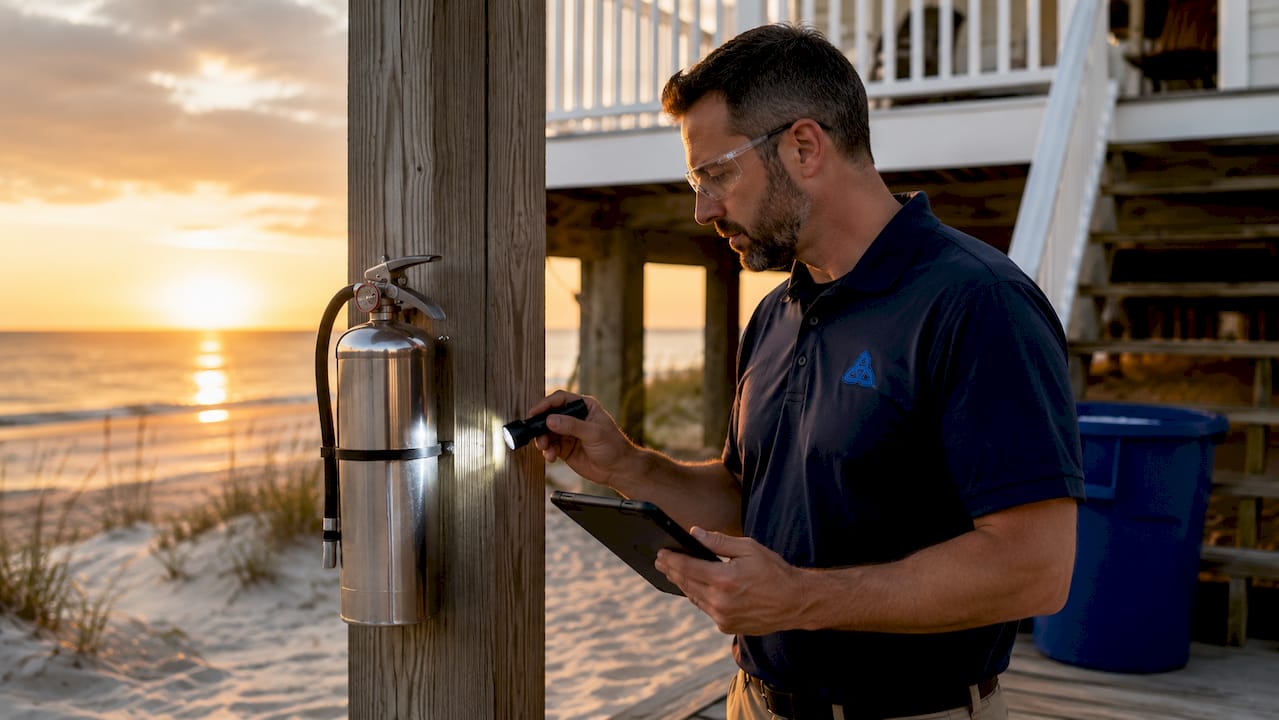
Pro Tip: Schedule your Fire Marshal inspection as early as January or February. Peak season demand in Gulf Shores and Orange Beach creates scheduling backlogs, and a delayed inspection means a delayed license, which means lost bookings.
2. How do Gulf Shores and Orange Beach rental requirements compare?
Both cities require a business license and a rental license, but Orange Beach adds a separate layer. Orange Beach implements a Vacation Rental Certificate process that is distinct from the city business license. You need both documents before you can legally rent.
Requirement | Gulf Shores | Orange Beach |
Business license | Required | Required |
Rental license | Required | Required |
Vacation Rental Certificate | Not required | Required (separate process) |
Fire Marshal inspection | Every 3 years | Every 3 years |
Zoning verification | Required before application | Required before application |
HOA restrictions | Vary by community | Vary by community; condo-level amendments common |
License renewal | Annual | Annual |
HOA rules add another layer that neither city government controls. In Orange Beach especially, condo associations have passed unit-level amendments that restrict or prohibit short-term rentals regardless of city zoning. Verify both the city rules and the HOA documents before you invest or list a property.
3. Which coastal-specific structural features should vacation rental owners inspect?
Standard home inspections do not cover coastal-specific risks like hurricane strapping, roof-to-wall connections, and saltwater corrosion. These are the items that determine whether your property survives a major storm and whether your insurance company pays out when it does not.
A coastal-aware inspector checks the following structural features:
Hurricane strapping and clips: Metal connectors that tie roof rafters or trusses to wall framing. Missing or corroded straps are a major insurance red flag.
Roof-to-wall connections: The physical attachment points between your roof system and the exterior walls. Inspectors look for proper nailing patterns and connector hardware.
Saltwater corrosion on HVAC components: Outdoor condenser units on Gulf Coast properties corrode faster than inland units. Corroded coil fins and refrigerant lines reduce efficiency and shorten equipment life significantly.
Exterior fasteners and hardware: Deck screws, railing bolts, and window hardware all corrode in salt air. Inspect these annually, not just at license renewal.
Foundation and pier conditions: Elevated homes on pilings are common in Gulf Shores and Orange Beach. Check pilings for rot, corrosion at base plates, and proper cross-bracing.
A wind mitigation report can save hundreds of dollars on homeowners insurance annually in Orange Beach. This report documents hurricane-resistant features your inspector identifies, and you submit it directly to your insurance carrier for a premium discount.
Pro Tip: Ask your inspector specifically whether they have experience with coastal Alabama properties. An inspector trained in InterNACHI standards who also understands Gulf Coast construction methods will catch corrosion and connection issues that a general inspector may walk past.
Inspectors with coastal expertise identify issues that directly affect both insurance eligibility and long-term property health. This is not a minor distinction. An undetected failed hurricane strap or a corroded electrical panel in a salt-air environment can result in a denied insurance claim after a storm.
4. What specific property areas and amenities require focused inspection?
Vacation rentals in Gulf Shores and Orange Beach often include amenities that standard single-family homes do not have. Each one carries its own compliance and safety requirements.
Docks, boat slips, and lifts
Waterfront properties require separate verification of dock structures, slip dimensions, lift capacity, and insurance requirements. Standard home inspections do not cover docks or lifts. You need to review HOA documents and management records to confirm slip size, whether electric and water utilities are available at the dock, and what the hurricane protocols are for the lift. Lift capacity ratings matter if you plan to market the property to boaters. A lift rated for a 25-foot boat will not safely handle a 35-foot vessel, and the liability falls on you.
Pool safety and fencing compliance
Pool fencing and emergency signage are standard vacation rental compliance checkpoints during safety inspections. Alabama requires pool barriers that meet specific height and latch requirements. Your inspector should verify that the fence height meets code, that self-closing and self-latching gates function correctly, and that no gaps exist that a child could pass through.
Bedroom egress and emergency preparedness
Every sleeping area must have a window or door that meets egress standards. Egress windows must open wide enough for an adult to exit and a firefighter to enter. In older Gulf Shores and Orange Beach condos, this is a common deficiency. Beyond egress, your property must have posted exit routes, local emergency contact numbers, and the property address clearly displayed so guests can communicate their location to emergency services.
Amenity | Key inspection points |
Dock and boat lift | Structural condition, lift capacity rating, HOA hurricane protocol |
Pool | Fence height, self-latching gates, barrier gaps, posted rules |
Bedroom egress | Window opening dimensions, unobstructed path, signage |
Emergency signage | Exit routes posted, local emergency numbers, property address displayed |
Balconies and railings | Railing height, fastener corrosion, load capacity |
5. How can owners maintain rental properties year-round to ensure inspection readiness?
Year-round maintenance is the difference between a property that passes its Fire Marshal inspection on the first visit and one that requires two or three return trips. The Gulf Coast climate accelerates wear on nearly every building system, and deferred maintenance compounds quickly in a salt-air environment.
Follow this maintenance schedule to stay ahead of inspection requirements:
January through March: Submit license renewal applications and schedule Fire Marshal inspections before peak season demand creates backlogs. Applying early in the year prevents scheduling delays that cost you bookings.
April: Test all smoke detectors and CO detectors. Replace batteries and units that are more than 10 years old. Confirm fire extinguisher charge and inspection tag date.
May: Inspect HVAC condenser units for saltwater corrosion before the cooling season begins. Clean coil fins and check refrigerant lines for corrosion damage.
June through August: Conduct a mid-season walkthrough between guest stays. Check for moisture intrusion around windows and doors, which is common during Gulf Coast storm season.
September: Post-storm inspection after any named storm or tropical system. Check roof, exterior fasteners, and any elevated structural connections for damage.
October through November: Full interior inspection. Test all outlets, switches, windows, and doors. Check under sinks and around water heaters for moisture or mold growth.
December: Review your insurance policy for coverage gaps. Confirm your wind mitigation report is current and on file with your carrier.
Pro Tip: If you work with a property manager, coordinate your annual inspection with their turnover schedule. A professional inspection conducted during a low-occupancy window gives you time to address findings before the next busy season without disrupting guest stays.
Coastal rentals need moisture inspections as a regular part of their maintenance cycle, not just at license renewal. Humidity, storm-driven rain, and condensation from HVAC systems create conditions where mold can establish itself inside walls and under flooring before you see any visible signs.
6. What are the most commonly overlooked items on a beach rental inspection checklist?
Most owners focus on the obvious items: smoke detectors, fire extinguishers, and pool fencing. The items below are the ones that show up as deficiencies during Fire Marshal inspections and professional property reviews, yet they rarely appear on basic checklists.
Thermal imaging for hidden moisture: Standard visual inspections miss moisture trapped inside walls, under flooring, and above ceilings. Thermal imaging cameras detect temperature differentials that indicate wet insulation or active leaks. Trinity Home Inspections includes thermal imaging at no extra charge, which is not standard practice across the industry.
Electrical panel condition: Salt air accelerates corrosion inside electrical panels. Corroded breakers and bus bars are a fire risk that a visual inspection from across the room will not catch. An inspector should open the panel and examine connections directly.
Balcony railing integrity: Railings on Gulf Coast properties corrode at the base fasteners first, where the post meets the deck surface. The railing can look solid from a distance while the anchor point is failing. Test every railing by applying lateral pressure.
Water heater age and condition: Vacation rentals cycle through more hot water than primary residences. Water heaters in high-use rentals often fail earlier than their rated lifespan. Check the manufacture date on the label and inspect the anode rod if accessible.
Carbon monoxide detector placement: CO detectors must be placed on each floor and within 10 feet of sleeping areas. A single detector in the living room does not satisfy Fire Marshal requirements in most cases. Verify placement against current code requirements.
Dryer vent condition: Lint buildup in dryer vents is one of the leading causes of residential fires. In vacation rentals with high laundry turnover, vents clog faster. Inspect and clean dryer vents at least twice per year.
Exterior lighting: Adequate exterior lighting is a guest safety issue and a compliance point. Stairways, walkways, and parking areas must be lit. Burned-out fixtures are a quick fix that owners often overlook between guest stays.
Key takeaways
A complete vacation rental inspection checklist for Gulf Shores and Orange Beach owners covers licensing, life safety devices, coastal structural risks, and property-specific amenities before every rental season.
Point | Details |
Follow the licensing sequence | Complete zoning, business license, rental license, and Fire Marshal inspection in order before listing. |
Budget for remediation | Set aside $200–$500 beyond license fees to correct safety deficiencies found during inspection. |
Hire a coastal-aware inspector | Standard inspectors miss hurricane strapping, saltwater corrosion, and wind mitigation features that affect insurance. |
Inspect docks and lifts separately | HOA documents and management records must verify slip dimensions, lift capacity, and hurricane protocols. |
Schedule inspections in January or February | Early scheduling prevents peak-season backlogs that delay licenses and cost you bookings. |
What I have learned inspecting Gulf Coast vacation rentals
I have walked through a lot of vacation rentals along the Gulf Coast, and the pattern I see most often is owners who treat the Fire Marshal inspection as the finish line. Pass the Fire Marshal check, get the license, move on. That approach works until it does not.
The Fire Marshal inspection is a regulatory threshold. It tells you whether your property meets the minimum life safety standard required by law. It does not tell you whether your HVAC condenser is two seasons away from failure, whether moisture is building up behind your bathroom tile, or whether the hurricane straps on your roof were ever installed correctly. Those are the findings that protect your investment and your guests.
What I have found is that owners who schedule a full professional inspection every two to three years, not just at license renewal, catch problems while they are still minor. A corroded electrical connection costs a few hundred dollars to fix. The same connection left alone for another two years can mean a panel replacement or worse. The math is straightforward.
I also want to say this directly: choosing an inspector with real coastal experience matters more than most owners realize. Gulf Shores and Orange Beach properties face conditions that inland homes simply do not. Salt air, hurricane loads, and elevated construction all require a trained eye that knows what to look for. At Trinity Home Inspections, we use thermal imaging, moisture meters, and FAA-licensed drone access on every inspection where conditions allow. That is not a sales point. It is what the job requires on the Gulf Coast.
If you are buying a vacation rental or reviewing a property you already own, do not wait for a problem to show up on a guest review. Get ahead of it.
— Matt
Get your Gulf Coast vacation rental inspection right the first time
Trinity Home Inspections serves Gulf Shores, Orange Beach, and the surrounding Baldwin County area with InterNACHI-certified inspections built for coastal properties. Whether you need a full property review before listing, a pre-listing inspection to identify issues before buyers do, or a mold inspection for a property with moisture concerns, we deliver same-day photo and video reports with thermal imaging included at no extra charge.
Call us at 251-210-7376 or visit TrinityInspectionsLLC.com to schedule your inspection. We are a local, family-owned business led by Matt Cameron, and we treat every property with the same care we would want for our own home.
FAQ
What does a vacation rental inspection checklist cover in Gulf Shores?
A vacation rental inspection checklist in Gulf Shores covers licensing compliance, Fire Marshal safety requirements, coastal structural features, and property-specific amenities like pools and docks. It goes beyond a standard home inspection to address local regulatory and coastal risk factors.
How often is a Fire Marshal inspection required for Gulf Shores rentals?
Gulf Shores requires a Fire Marshal inspection every three years as a condition of rental license issuance and renewal. The annual license renewal does not require a new inspection unless deficiencies were noted.
Does Orange Beach require anything different from Gulf Shores for rental licensing?
Orange Beach requires a Vacation Rental Certificate in addition to the standard city business license and rental license. This is a separate process that Gulf Shores does not require, so confirm both documents are in place before listing your Orange Beach property.
Are docks and boat lifts included in a standard home inspection?
Standard home inspections do not cover docks or boat lifts. These require separate verification through HOA documents and property management records to confirm structural condition, lift capacity, and hurricane protocols.
When is the best time to schedule a vacation rental inspection in Gulf Shores or Orange Beach?
Schedule inspections between January and March to avoid peak-season scheduling backlogs. Early scheduling gives you time to address any findings and receive your license before the summer rental season begins.
Recommended