
Gutter Maintenance Tips for Gulf Coast Alabama Homes


Gutter maintenance is defined as the regular practice of cleaning, inspecting, and repairing your home’s rainwater drainage system to protect the roof, fascia, foundation, and siding from water damage. For homeowners in Gulf Coast Alabama, this is not optional upkeep. The combination of heavy seasonal rainfall, hurricane-season storms, and dense tree canopy across Baldwin and Mobile counties means your gutters work harder than almost anywhere else in the country. Applying the right gutter maintenance tips twice a year, and after major storms, is the single most cost-effective thing you can do to protect your home’s structural integrity. The good news is that most of this work is straightforward, safe, and well within reach for any motivated DIY homeowner.
1. Gutter maintenance tips: how often Gulf Coast homeowners should clean
Cleaning frequency is the foundation of every effective gutter upkeep plan. For most Gulf Coast Alabama homeowners, twice-yearly cleanings are the baseline. Late spring and late fall are the two best windows, timed to clear debris after peak pollen and seed drop in spring and after leaf fall in autumn.
That schedule assumes moderate tree coverage. If your home in Daphne, Fairhope, or Foley sits under a heavy canopy of live oaks or pine trees, plan for three to four cleanings per year. Pine needles are particularly problematic because they slip through standard gutter guards and compact into dense mats that block water flow quickly.
After any named storm or significant rain event, do a quick visual check from the ground. Overflowing gutters during a rainstorm are a clear sign of a clog. Alabama’s rainy season runs roughly from late winter through early summer, which means a pre-season cleaning in February or March is worth adding to your calendar.
Late spring (April to May): Clear pollen, seed pods, and winter debris before peak rain season
Late fall (October to November): Remove leaf accumulation before winter rains
Post-storm: Visual check after any storm with high winds or heavy rainfall
Heavy tree coverage: Add one to two additional cleanings per year
2. Essential tools and safety tips for DIY gutter cleaning
The right tools make gutter cleaning faster, safer, and more thorough. Recommended equipment includes work gloves, safety goggles, a sturdy extendable ladder with a stabilizer, a gutter scoop or trowel, and a garden hose fitted with a spray nozzle. Each item serves a specific purpose, and skipping any one of them increases both risk and the chance of an incomplete job.
Here is the full tool list with notes on why each matters:
Work gloves: Gutter debris contains decomposing organic matter, bird droppings, and sometimes sharp metal edges. Thick rubber-coated gloves protect your hands and improve grip.
Safety goggles: Flushing gutters with a hose sends debris and water backward. Eye protection is non-negotiable.
Extendable ladder with a stabilizer: A ladder stabilizer, sometimes called a stand-off, keeps the ladder away from the gutter itself so you do not crush or dent the channel. Place the ladder on level ground and never lean it directly against the gutter.
Gutter scoop or trowel: A plastic scoop removes wet debris without scratching aluminum or vinyl gutters. Metal tools can gouge the gutter channel and create rust points over time.
Garden hose with spray nozzle: A pistol-grip nozzle gives you control over water pressure and direction. A standard thumb-over-the-end technique works but is harder to control for extended periods.
Bucket or tarp: Catching debris in a bucket hung from the ladder saves cleanup time on the ground.
Safety rules to follow every time:
Keep your hips between the ladder rails at all times. Leaning out to reach farther is the leading cause of ladder falls during gutter cleaning.
Work with a partner whenever possible. A spotter on the ground can stabilize the ladder and hand up tools.
Never work on a wet ladder or in wet conditions. Gulf Coast Alabama afternoons can turn rainy fast, so check the forecast before you start.
Wear rubber-soled shoes with good grip.
Pro Tip: Cut the bottom off a clean plastic milk jug at an angle to create a free DIY gutter scoop. The angled cut fits the gutter channel perfectly and the handle gives you a secure grip without bending awkwardly.
3. Step-by-step gutter cleaning technique that actually works
Technique matters as much as frequency. Many homeowners clean their gutters but still end up with water damage because they skip the downspout verification step or flush in the wrong direction. This sequence, drawn from This Old House guidance, produces a fully clear system every time.
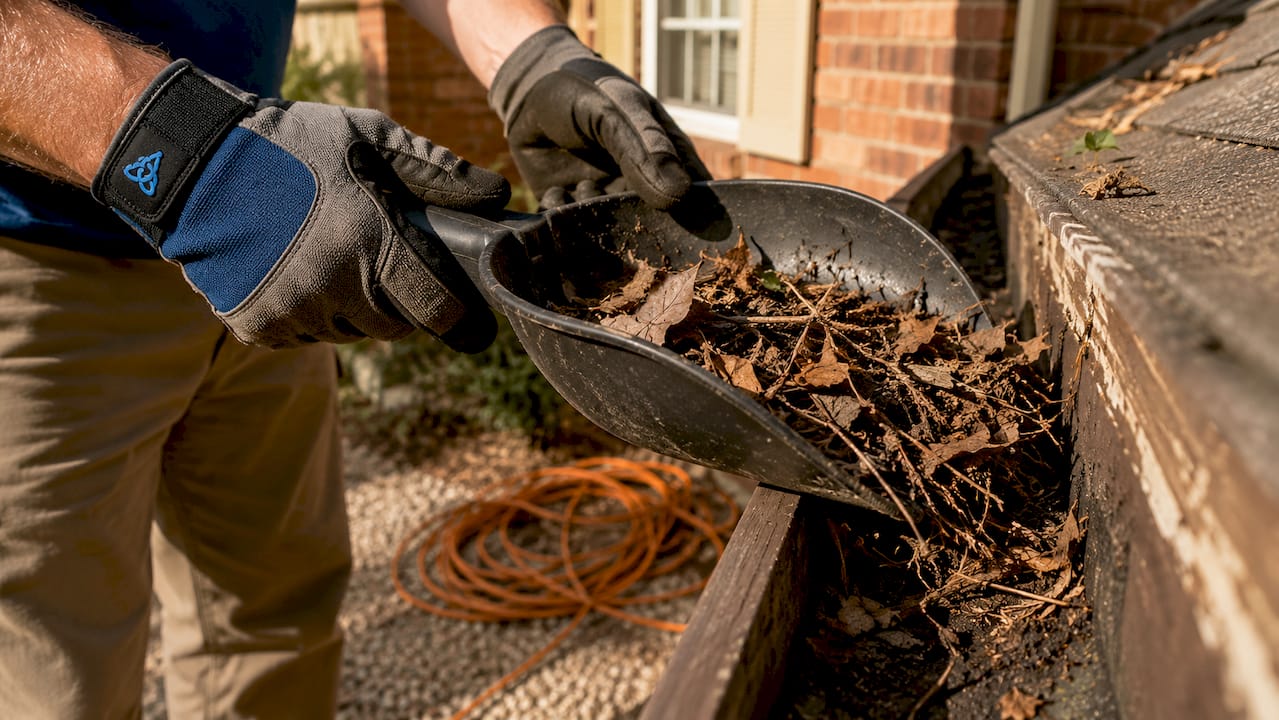
Step 1: Remove large debris by hand first
Start near the downspout and corners, where debris compacts most heavily. Use your scoop or gloved hands to pull out leaves, twigs, and sediment. Work toward the middle of each gutter run, dropping debris into your bucket. Do not push debris toward the downspout opening at this stage because you risk packing it deeper into the drain.
Step 2: Flush from the far end toward the downspout
Once large debris is cleared, connect your garden hose and start rinsing at the end of the gutter farthest from the downspout. This forces remaining loose material toward the downspout rather than spreading it back along the channel. Work at moderate pressure. High pressure can loosen gutter hangers or force water under roof shingles.
Step 3: Verify downspout flow
This is the step most DIYers skip, and it is the most important one. Clogged downspouts cause overflow that deteriorates fascia boards, soffit panels, and eventually the foundation. After flushing, watch the bottom of the downspout. Water should flow freely and steadily within a few seconds of turning on the hose. A slow trickle or no flow means a blockage is present.
Step 4: Clear stubborn downspout clogs
If the downspout is blocked, insert a plumber’s snake from the top and work it down with a rotating motion. Alternatively, direct your hose nozzle straight down into the downspout opening at full pressure. For underground downspout extensions, a plumber’s snake is the safer option to avoid disconnecting buried sections.
Pro Tip: After clearing a downspout clog, flush the entire gutter run one more time from the far end. Debris dislodged from the downspout can settle back into the channel if you skip this second flush.
Step 5: Inspect for damage while you are up there
Once the system is clean and flowing, look for these specific issues before you come down:
Sagging sections where hangers have pulled away from the fascia
Rust spots, holes, or cracks in the gutter channel
Separated joints where two gutter sections meet
Peeling paint or staining on the fascia directly behind the gutter, which signals chronic overflow
Step 6: Dispose of debris properly
Gutter debris is excellent compost material. Add it to a compost bin or bag it for yard waste pickup. Do not leave wet debris piles against your foundation or siding.
4. Comparing gutter guards and other preventative measures
Gutter guards are the most common preventative tool homeowners consider after their first few cleaning sessions. They reduce how often you need to clean, but guards do not eliminate maintenance entirely. Understanding the differences between guard types helps you choose the right option for your specific tree coverage and budget.
Guard type | How it works | Best for | Maintenance still needed |
Micro-mesh | Fine stainless steel mesh blocks debris while allowing water through | Homes with heavy pine needle or seed pod coverage | Annual brush clearing of mesh surface |
Screen or perforated | Plastic or metal screen with larger holes sits over gutter opening | Light to moderate leaf coverage | Seasonal removal of debris sitting on top |
Foam insert | Polyurethane foam fills the gutter channel; water flows through foam | Low-debris environments | Replacement every 3 to 5 years; moss can grow in foam |
Reverse curve | Water follows a curved surface into gutter; debris falls off edge | Moderate leaf coverage | Can fail in heavy rain; requires periodic inspection |
Micro-mesh guards are the most effective option for Gulf Coast Alabama homes with significant tree coverage. They block pine needles and seed pods that defeat screen-style guards. The trade-off is cost. Micro-mesh systems from brands like LeafFilter or MasterShield run significantly higher than basic screen guards, though professional cleaning costs averaging $119 to $300 per visit add up quickly over several years without guards.
Even with the best guards installed, small debris and shingle grit accumulate on the guard surface and require periodic brush clearing. Guards are filters, not permanent solutions. You still need to inspect the system at least once a year.
Additional preventative practices that reduce your overall maintenance load:
Trim overhanging branches to at least 10 feet above the roofline. This is the single most effective way to reduce debris volume in your gutters.
Check gutter slope once a year. Gutters should slope approximately one quarter inch for every 10 feet toward the downspout. A level or slight reverse slope causes standing water and accelerates rust and mosquito breeding.
Seal joints and end caps with gutter sealant every two to three years to prevent leaks at connection points.
Extend downspout discharge at least 4 to 6 feet from the foundation using splash blocks or flexible extensions. This is especially important on Gulf Coast Alabama properties where soil saturation during heavy rain is common.
You can find a detailed evaluation of gutter guard effectiveness that weighs the long-term cost and maintenance trade-offs if you are deciding whether guards make sense for your home.
Key takeaways
Consistent gutter maintenance, combining twice-yearly cleaning, proper downspout verification, and targeted prevention like branch trimming, is the most cost-effective way to protect a Gulf Coast Alabama home from water damage.
Point | Details |
Clean at least twice yearly | Schedule late spring and late fall cleanings, plus post-storm checks for Gulf Coast Alabama homes. |
Verify downspout flow every time | Water must exit the downspout freely after flushing; a slow trickle signals a blockage that needs clearing. |
Use the right tools | Gloves, goggles, a ladder stabilizer, and a plastic scoop protect both you and your gutters during cleaning. |
Guards reduce but do not replace maintenance | Even micro-mesh guards require annual surface clearing and system inspections to stay effective. |
Trim branches to cut debris load | Keeping branches 10 feet above the roofline is the most direct way to reduce how often gutters clog. |
What I have learned after inspecting hundreds of Gulf Coast homes
After walking roofs and inspecting gutter systems across Mobile, Baldwin, and Escambia counties, the pattern I see most often is not neglect. It is incomplete maintenance. Homeowners clean the visible debris out of the channel, feel good about the job, and never check whether water actually exits the downspout. Then six months later, the fascia is rotting and they are looking at a repair bill that dwarfs what a proper cleaning would have cost.
The downspout is where most gutter systems fail silently. Debris compacts at the elbow where the downspout transitions from vertical to angled, and water backs up behind it. You cannot see this from the ground or even from the ladder unless you specifically flush and watch for flow. I tell every homeowner I work with: the cleaning is not done until you see water running out the bottom.
The other thing I push back on is the idea that gutter guards are a set-it-and-forget-it solution. I have inspected homes with premium micro-mesh systems that had standing water and moss growth because the homeowner assumed the guards meant no maintenance was needed. Guards buy you time between cleanings. They do not replace the inspection habit.
For Gulf Coast Alabama specifically, the period between late February and early April is the most overlooked window for gutter attention. Most people think of fall as gutter season, but our spring pollen and seed drop is intense, and it hits right before our heaviest rainfall months. A quick cleaning in late February or March puts your system in the best possible position heading into the wet season.
The DIY gutter cleaning guide on the Trinity Home Inspections site walks through the full process in detail if you want a step-by-step reference to keep on your phone while you work. And if you want a professional set of eyes on your entire exterior drainage system, that is exactly what a home maintenance inspection covers.
— Matt
Get a professional gutter and exterior inspection from Trinity Home Inspections
[

Alt text: Trinity Home Inspections inspector in khaki pants and blue shirt with white pocket logo inspecting gutters on a Gulf Coast Alabama home
Your gutters are one part of a larger exterior drainage system that includes the roof, fascia, soffit, and foundation grading. When one component fails, the others follow. Trinity Home Inspections provides InterNACHI-certified home inspections across Baldwin, Mobile, Escambia, and surrounding Gulf Coast Alabama counties, with same-day photo and video reports that show you exactly what is happening with your gutter system and the rest of your home’s exterior. If you are preparing to sell, a pre-listing inspection catches drainage and gutter issues before buyers do. Call 251-210-7376 or visit TrinityInspectionsLLC.com to schedule your inspection today.
FAQ
How often should I clean gutters in Gulf Coast Alabama?
Clean your gutters at least twice a year, in late spring and late fall, and add a check after any significant storm. Homes with heavy tree coverage may need three to four cleanings annually.
What happens if I skip downspout verification?
Skipping the downspout check is the most common DIY mistake. A blocked downspout causes water to back up and overflow, which deteriorates fascia boards, soffit panels, and can lead to foundation moisture issues over time.
Do gutter guards eliminate the need for cleaning?
Gutter guards reduce cleaning frequency but do not eliminate maintenance. Small debris and shingle grit accumulate on guard surfaces and require periodic clearing, and the system still needs at least one annual inspection.
What tools do I need for safe DIY gutter cleaning?
You need work gloves, safety goggles, an extendable ladder with a stabilizer, a plastic gutter scoop or trowel, and a garden hose with a spray nozzle. A spotter on the ground adds an important layer of safety.
When is the best time to clean gutters before Alabama’s rainy season?
A cleaning in late February or early March puts your system in the best position before Gulf Coast Alabama’s peak rainfall period, which runs from late winter through early summer.
Recommended

