House Inspection Salary: Florida And U.S. Averages
- Matt Cameron
- 3 hours ago
- 11 min read

The national median annual wage for construction and building inspectors (the BLS occupational category that includes home inspectors) is $72,120, based on May 2024 BLS data. The lowest 10% earn under $46,560, while the top 10% clear more than $112,320. Florida inspectors typically fall within a range that tracks closely to the national median, with metro markets like Miami, Orlando, and Tampa pushing pay toward the upper half of that band. Your most useful next step: check city-level figures on Indeed or ZipRecruiter alongside Florida’s licensing requirements to set realistic income targets before you invest in training.
Salary snapshot: BLS May 2024 median = $72,120. Bottom 10% = <$46,560. Top 10% = >$112,320. Florida typical range tracks near the national median, with higher-demand metros pulling pay upward.
How do the major salary sources compare for home inspectors?
No two platforms report the same number, and the gap is not a data error. It reflects real differences in who gets counted.
Source | Headline Figure | What It Measures | Notes |
BLS (May 2024) | $72,120 median | W-2 employees only | Most rigorous; excludes self-employed |
Varies by state/city | Mix of posted salaries and self-reported | Useful for local comparisons | |
ZipRecruiter | Varies; often higher | Job postings + self-reported | Skews toward active job seekers |
InspectorData (2026) | $35k–$200k+ by tier | Includes self-employed fee income | Broadest range; most useful for owners |
ASHI member data | ~$123,000 avg (all inspectors) | Solo + multi-inspector firms | Includes high-volume firm owners |
The BLS figure is the most defensible benchmark because it uses employer-reported payroll data. Self-reported platforms like ZipRecruiter and Indeed tend to run higher because experienced, self-employed inspectors who are actively marketing themselves are overrepresented in those samples.
Percentile context matters just as much as the median. The BLS data shows a $65,760 spread between the 10th and 90th percentiles, which is unusually wide for a trade occupation. That spread exists because home inspection income is a business outcome as much as a wage. According to the American Society of Home Inspectors, new inspectors average just above $50,000 in gross revenue, while all other inspectors (including multi-inspector firm owners) average nearly $123,000 per year.
Forum data from r/homeinspectors tells a similar qualitative story: experienced independent inspectors with full schedules commonly report strong earnings, though those figures are self-selected and should not be treated as population averages.
What factors actually change a home inspector’s pay?
Two inspectors in the same state can earn very differently. Here is what separates them:
Geography and market demand. High-cost metros with active real estate markets generate more inspection volume and support higher per-inspection fees. Rural markets have lower fees and fewer transactions.
Business model. Employee inspectors working for a firm or government agency earn a predictable W-2 wage, typically $40,000–$70,000. Self-employed owners who retain 100% of fees commonly earn $80,000–$150,000 with a full schedule, and multi-inspector firms may earn even more.
Experience level. InspectorData’s 2026 salary guide breaks it down clearly: entry-level ($35k–$55k), mid-career ($55k–$85k), senior ($75k–$120k), and master/firm-owner ($100k–$200k+).
Certifications and specialties. InterNACHI certification, radon licensing, mold assessment credentials, and pool inspection certifications each open doors to higher fees and more referrals.
Add-on services. Sewer scope inspections, mold swab testing, indoor air quality sampling, and thermal imaging add-ons can meaningfully increase revenue per visit without adding a full inspection’s worth of time.
Referral network. Agents who trust you send consistent volume. One strong real estate office relationship can fill a calendar faster than any paid ad.
Seasonality. Inspection demand follows real estate transaction volume. Spring and early summer are peak seasons in most U.S. markets; Florida’s market also responds to snowbird buying cycles.
Inspection complexity. Larger homes, luxury properties, and older construction take more time and justify higher fees. A 4,000-square-foot historic home is not the same job as a 1,200-square-foot new build.
Local competition. Markets with few licensed inspectors support stronger pricing. Saturated markets push fees down unless you differentiate on service quality or speed.
Pro Tip: Underpricing is the most common financial mistake new inspectors make. Setting your rate below market does not build loyalty; it attracts price-sensitive clients and makes it harder to raise fees later. The InspectorData pricing guide recommends 8–15% rate increases when adjusting market position, tested with clear value messaging to your agent network.
Annual operating costs for a self-employed inspector typically run $8,000–$18,000, covering errors and omissions insurance, general liability coverage, software, vehicle expenses, tools, and continuing education. That overhead comes directly off gross revenue before you calculate take-home pay.
What does the math actually look like across different pay structures?
Three pay models dominate the industry, and each produces a very different income picture.
W-2 employee: You earn a set salary or hourly rate from a firm or government agency. Predictable income, no overhead, but your ceiling is capped by what the employer pays.
Per-inspection commission (employee): Some firms pay a percentage of the inspection fee per job. You earn more when you’re busy, but you still have no control over pricing.
Self-employed owner (100% fee retention): You set the price, keep the revenue, and pay your own overhead. The upside is real; so is the risk.
Scenario | Inspections/Week | Avg Fee | Annual Gross | Est. Expenses | Est. Net |
Part-time employee | 5 | — | — | Employer-covered | — |
Full-time self-employed (entry) | 8 | — | — | — | — |
Full-time self-employed (experienced) | 10 | — | — | — | — |
Multi-inspector firm (owner) | — | $400+ | — | $40,000+ | Varies |
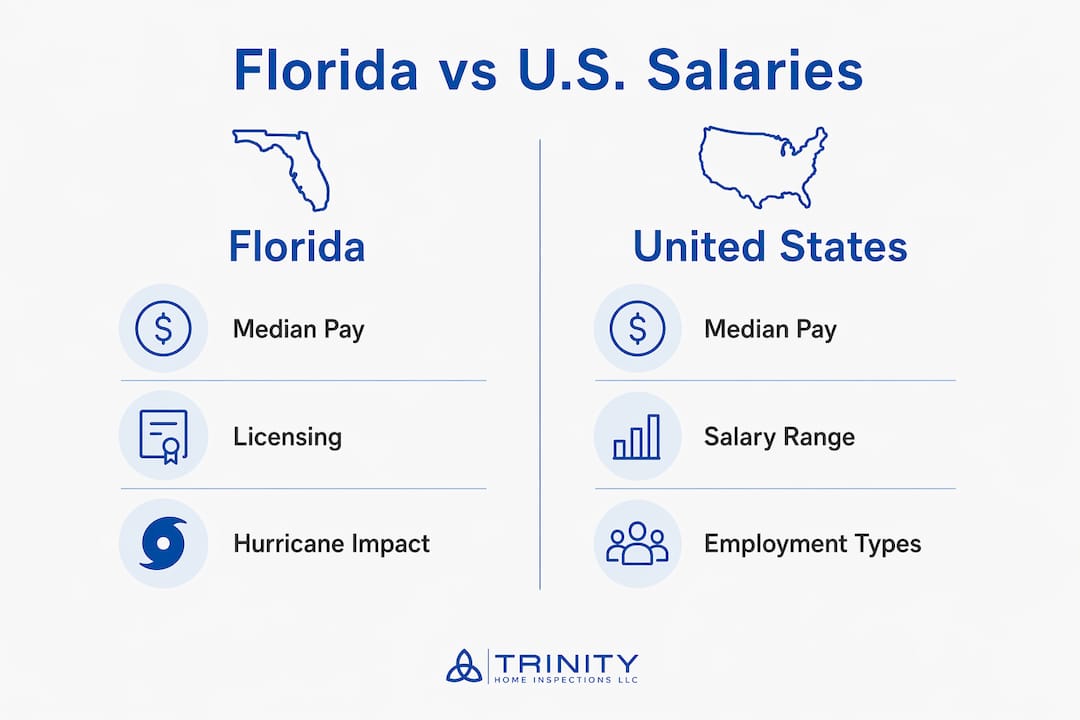
These are illustrative scenarios built from the InspectorData framework and ASHI member data, not guaranteed outcomes. Actual results depend on market, volume, and pricing discipline.
Typical annual expense line items for a self-employed inspector include:
Errors and omissions insurance: $1,500–$3,500/year
General liability insurance: $800–$2,000/year
Inspection software and report platform: $600–$1,500/year
Vehicle costs (fuel, maintenance): $3,000–$6,000/year
Tools, equipment, and calibration: $500–$2,000/year
Marketing and continuing education: $500–$2,000/year
What does home inspection pay look like specifically in Florida?
Florida has one of the more structured licensing frameworks in the country. Under Florida Statute 468.8313, applicants must complete an approved amount of education covering structure, electrical systems, HVAC, roof covering, plumbing, interior and exterior components, and site conditions, plus pass the required examination. That credentialing requirement raises the floor on professional quality and gives licensed inspectors a clear market advantage over unlicensed operators.

Florida’s average home inspector pay tracks near the national BLS median, with meaningful variation by metro. Miami-Dade, Broward, and Palm Beach counties support higher fees because of elevated home values and transaction volume. The Tampa Bay area and Orlando metro are also strong markets. Coastal markets like Naples and Sarasota attract high-value properties that justify premium inspection fees. Rural North Florida and the Panhandle tend to run lower on both volume and per-inspection rates, though the Panhandle’s Gulf Coast corridor sees seasonal spikes tied to vacation property transactions.
Florida’s housing market is also sensitive to hurricane season. Post-storm periods generate surges in inspection demand as buyers, sellers, and insurers all need property assessments. Inspectors who hold wind mitigation and four-point inspection credentials capture a significant share of that insurance-driven volume, which can substantially lift annual income during active storm years.
For Florida buyers navigating inspections alongside financing, understanding how inspections connect to mortgage approval is worth a read before closing.
How can you increase your home inspection income?
These moves have the clearest track record for raising earnings, ranked by impact:
Set a minimum viable price and hold it. Price below market and you signal low confidence. Know your local going rate and start there, not below it.
Add high-margin ancillary services. Sewer scope, radon testing, mold swab, and indoor air quality sampling each add revenue per visit with relatively low incremental time. These are the fastest path to a higher per-inspection average.
Pursue certifications that open new revenue streams. InterNACHI certification is the industry’s most recognized credential. Adding radon, pool, or commercial inspection certifications expands your billable scope. Additional training through programs like the National Home Inspector Examination (NHIE) strengthens your professional standing.
Build agent relationships deliberately. One productive real estate office can generate consistent referrals. Show up reliably, deliver reports the same day, and communicate clearly. Agents refer inspectors who make their transactions easier.
Raise rates in 8–15% increments. Test rate increases with your agent network using a clear value message: faster reports, more thorough tools, better communication. Most clients who value quality will not leave over a modest increase.
Systemize scheduling and reporting. Time spent on admin is time not spent on inspections. Inspection software that automates scheduling, payment, and report delivery directly increases your capacity.
Carry adequate insurance. Errors and omissions coverage and general liability protection are not just legal requirements in most states; they are a selling point. Agents and buyers notice when an inspector carries meaningful coverage.
Pro Tip: Before you raise rates, audit your report quality and turnaround time. Same-day delivery and photo/video-rich reports are the two features agents and buyers mention most when explaining why they refer a specific inspector. Fix those first, then raise the price.
For a deeper look at how additional training and certifications affect pay, the licensing path matters as much as the credential itself.
How were these numbers compiled, and what are their limits?
Sources and dates:
BLS Occupational Employment and Wage Statistics, May 2024: Employer-reported payroll data for construction and building inspectors (SOC 47-4011). Represents W-2 employees only. The most statistically rigorous source, but it undercounts self-employed inspector income.
InspectorData salary and pricing guides (2026): Aggregated from inspector-reported data and business modeling. Includes self-employed fee income and scenario math. Useful for owner-operator benchmarks; subject to self-selection bias.
ASHI member income data: Survey-based; includes solo inspectors and multi-inspector firm owners. The $123,000 average reflects a broad population that skews toward established professionals.
Indeed state and city salary pages: Aggregated from job postings and self-reported figures. Useful for local comparisons; methodology not fully disclosed.
r/homeinspectors forum data: Self-reported, unverified, and not statistically representative. Used here as a qualitative directional check only.
Florida Statute 468.8313: Primary legal source for Florida licensing requirements.
Percentile figures in this article come directly from BLS May 2024 data. Per-inspection fee scenarios were converted to annual estimates using the InspectorData framework and ASHI member averages, then cross-checked against forum-reported ranges for directional consistency.
Trinity Home Inspections holds InterNACHI certification, has completed the National Home Inspector Examination, and carries $1M in errors and omissions coverage and a $2M general liability policy. Local Gulf Coast Alabama income patterns referenced in this article draw on operational experience in the Mobile and Baldwin County markets. For Gulf Coast-specific income context, see home inspection income on the Gulf Coast.
Key Takeaways
Self-employed home inspectors who price at market, add ancillary services, and build strong referral networks consistently out-earn their salaried peers by a wide margin.
Point | Details |
National median (BLS 2024) | The BLS May 2024 median wage is $72,120; the top 10% earn more than $112,320. |
Employee vs. self-employed gap | Employee inspectors typically earn $40,000–$70,000; self-employed owners with full schedules commonly earn $80,000–$150,000. |
Florida licensing requirement | Florida requires 120 hours of approved education plus a state exam before you can charge for inspections. |
Fastest income lever | Adding ancillary services (sewer scope, mold, radon) raises per-inspection revenue without proportional time cost. |
Trinity Home Inspections | InterNACHI-certified, serving Gulf Coast Alabama with same-day reports, free thermal imaging, and full ancillary services. |
What the salary data misses about real inspector earnings
Most salary guides present the BLS median and call it a day. That number is accurate for what it measures, which is W-2 employees, but it tells you almost nothing about what a self-employed inspector running a well-managed business can earn on the Gulf Coast or anywhere else with a healthy real estate market.
The inspectors who genuinely close the gap between the median and the top of the range are not doing it by working longer hours. They are doing it by charging what their service is worth, delivering reports the same day, and building the kind of trust with agents that generates consistent referrals without paid advertising. Adding a sewer scope service or mold testing is not just a revenue line; it is a reason for an agent to call you instead of someone else, because you solve more problems in one visit.
The insurance piece also gets underplayed in most income discussions. Carrying $1M in E&O and $2M in general liability is not just risk management; it is a competitive signal. Agents who have seen an uninsured inspector create a liability problem for their client do not forget it. Coverage at that level tells the market you are serious about your work and your clients’ protection.
For anyone considering this career on the Gulf Coast, the home inspection income in Alabama breakdown is worth reading before you set your initial pricing.
Ready to See What a Professional Inspection Looks Like?
Trinity Home Inspections delivers InterNACHI-certified residential inspections across Mobile, Baldwin, Escambia, Washington, Monroe, and Clarke counties, with same-day photo and video reports, free thermal imaging, and a full suite of add-on services under one roof.
[
What’s included with every Trinity inspection:
Same-day digital report with photos and video
Free thermal imaging (no extra charge)
Color-coded priorities: DIY/Minor, Issues/Defects, Safety/Major
Post-inspection walkthrough by phone or in person
Add-ons available: sewer scope, mold swab, indoor air quality, pool inspection
Sellers preparing to list can also benefit from a pre-listing inspection that surfaces issues before buyers do, giving you negotiating control from the start. Need to research a property’s permit or deed history before scheduling? The property and permit search tool is a good place to start.
Call or text 251-210-7376 or visit TrinityInspectionsLLC.com to schedule your inspection or ask about local pricing.
Useful Sources
U.S. Bureau of Labor Statistics — Construction and building inspectors (May 2024): Primary source for the $72,120 national median and 10th/90th percentile figures. Reflects W-2 employee wages only; does not capture self-employed inspector income.
Florida Statute 468.8313 — Home Inspector Licensing (2025 edition): Official Florida licensing requirements, including the 120-hour education mandate and examination requirements.
InspectorData — Home Inspector Salary and Income Guide (2026): Includes experience-tier ranges, per-inspection fee math, and business model comparisons. Reflects self-employed and employee scenarios; subject to self-selection in underlying data.
InspectorData — Home Inspector Pricing Guide (2026): Covers pricing frameworks, underpricing risks, and the 8–15% rate-increase methodology.
Indeed — Home inspector salaries by location: State and city-level averages aggregated from job postings and self-reported figures. Useful for local comparisons; methodology not fully disclosed.
ISN — Can You Sue a Home Inspector?: Explains how inspection contracts and exculpatory clauses limit legal recovery; negligence or fraud must typically be proven.
LegalMatch — Home inspection lawsuits: Covers legal theories (negligence, breach of contract, misrepresentation) and practical steps for claimants.
InterNACHI — Licensing and Certification: Industry’s primary certification body; relevant to credentialing’s effect on earnings and market trust.
r/homeinspectors (Reddit): Self-reported forum data used as a qualitative directional check only. Not statistically representative; no specific figures cited.
This article provides general salary and career information. Actual earnings vary by market, business model, and individual performance. Consult a licensed professional for legal, financial, or licensing guidance specific to your situation.
FAQ
Where do home inspectors get paid the most?
States with high home values and active real estate markets, including California, New York, Massachusetts, and Washington, consistently rank among the highest-paying locations for home inspectors. Within Florida, Miami-Dade, Broward, and Palm Beach counties support the strongest fees.
How does self-employed inspector pay compare to working for a firm?
Employee inspectors typically earn $40,000–$70,000 annually; self-employed inspectors with full schedules commonly earn $80,000–$150,000, with overhead of roughly $8,000–$18,000 per year reducing gross revenue to net take-home.
Can you challenge a home inspection report?
Yes. The process typically starts with documenting the defect, reviewing the inspection agreement for exculpatory clauses, and obtaining an independent second opinion. Legal action, based on negligence, breach of contract, or misrepresentation, is possible but often limited by contract terms; negligence or fraud must generally be proven to recover beyond the inspection fee.
Does InterNACHI certification increase a home inspector’s earnings?
InterNACHI certification is the industry’s most recognized credential and directly supports higher fees and stronger referral relationships. Inspectors who hold it, like those at Trinity Home Inspections, can credibly market a higher standard of service to agents and buyers.
How many inspections per week does it take to earn six figures?
At an average fee of $400 per inspection, inspectors aiming for substantial gross revenue need to complete a consistent number of inspections weekly, and adding ancillary services can raise the per-visit average, reducing the required number of inspections.
Recommended