
What Do I Need To Become A Home Inspector: State Checklist

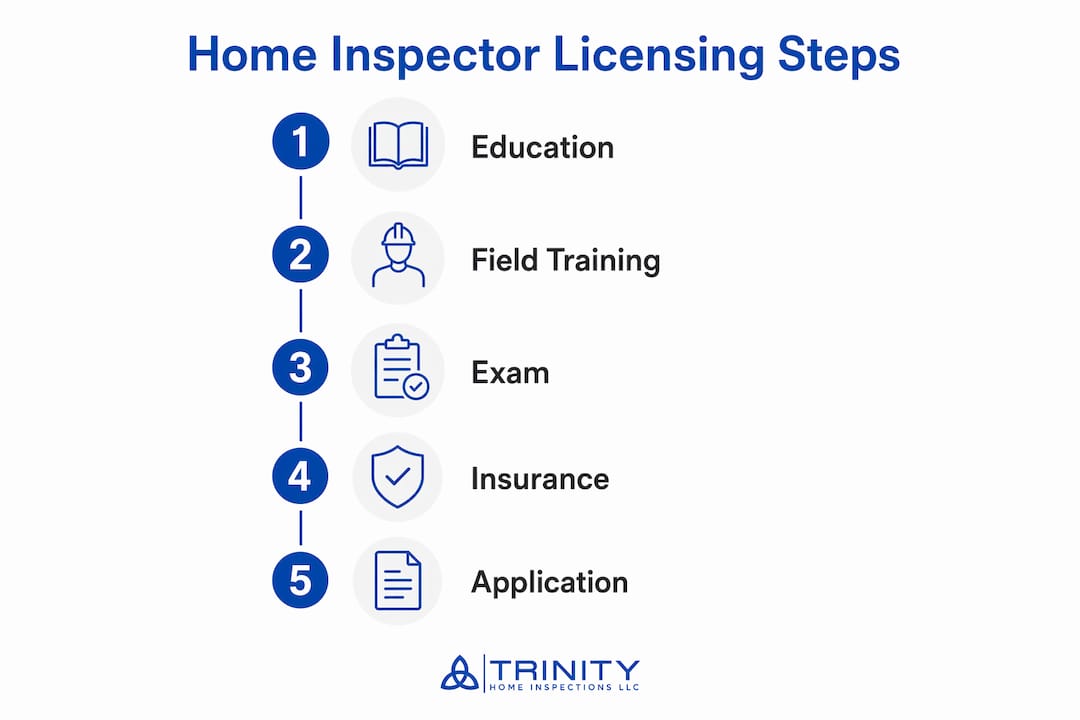
To become a licensed home inspector in the United States, you need state-approved pre-licensing education with varying hour requirements depending on your state, documented field training, a passing score on the NHIE or your state’s exam, proof of general liability and Errors & Omissions insurance, and a completed license application submitted to your state board.
Here is the core checklist to get started:
Check your state board for exact hour requirements, approved course lists, and application forms
Enroll in an approved pre-licensing course that covers the systems your state exam tests
Schedule and document field training with a licensed mentor inspector
Register for and pass the NHIE (or your state’s required exam)
Secure E&O and general liability insurance before your first paid inspection
Submit your license application with all required documents and fees
Pro Tip: Treat voluntary InterNACHI or ASHI certification as business equipment, not a bonus. In most markets, those credentials do more for client trust than a bare-minimum state license ever will.
Who Qualifies to Apply for a Home Inspector License?
Most state boards set a short list of baseline eligibility requirements. Meeting them is straightforward for most applicants, but confirming them early saves time.
Typical prerequisites across regulated states:
Minimum age of 18
High school diploma or GED
Lawful presence in the United States
Clean criminal background, or full disclosure of prior offenses (requirements vary by state)
State variation is real. The New York State Department of State, for example, requires applicants to complete a state-approved training program, pass the NHIE, carry insurance, and submit a formal application before receiving a license. New York’s process is more structured than many states, making it a useful model for understanding what a fully regulated licensing pipeline looks like.
Documents to gather before you apply:
Government-issued photo ID
High school diploma, GED, or official transcripts
Background-check consent form (and fingerprinting appointment, where required)
Course completion certificates once training is done
Pro Tip: Order your background check and fingerprinting as early as your state allows. Some boards accept results only from specific vendors, and processing delays are one of the most common reasons licensing timelines stretch from weeks into months.
How Many Training Hours Do You Need, and What Do Courses Cover?

Pre-licensing education hours vary more than most people expect. State requirements range from roughly 60 to 194 hours depending on where you live. Texas and New York sit at the higher end of that range, with Texas programs requiring more extensive hours. A handful of states sit closer to 60 hours, though that number is trending upward as more states tighten their rules.
Approved courses typically cover:
Structural systems (foundation, framing, roofing)
Electrical panels, wiring, and outlets
HVAC systems and ventilation
Plumbing supply and drain systems
Report writing and documentation
Standards of Practice and professional ethics
When choosing a provider, verify three things: that the course is approved by your specific state board, that it includes NHIE prep if your state accepts that exam, and that it offers a hands-on or field component if your state requires one. InterNACHI offers free online courses and a Certified Professional Inspector (CPI®) credential that many inspectors use alongside or in place of state-mandated programs, particularly in states with lower hour requirements.
For a deeper look at how state-level training differences play out in practice, the house inspector training guide covers the licensing path in detail.
How Does Field Training Work, and How Do You Document It?
Classroom hours teach you what to look for. Field training teaches you how to actually find it. States structure field training in two main ways: a required number of supervised inspections performed alongside a licensed inspector, or a set number of logged field hours. Some states require both.
How to find a mentor:
Join your local InterNACHI chapter and ask about ride-along opportunities
Contact licensed inspectors in your area directly; many are willing to bring on trainees
Enroll in a training program that bundles field ride-alongs into the curriculum
What to record in your field log for each inspection:
Date and property address
Supervising inspector’s name and license number
Systems inspected (roof, electrical, HVAC, plumbing, etc.)
Total hours spent on-site
Mentor’s initials or signature
Pro Tip: Keep both a digital copy and a printed, signed copy of every field log entry. Some state boards request notarized verification during the application review, and scrambling to reconstruct logs after the fact is a headache you can avoid entirely.
Which Exam Do You Need, and How Do You Prepare?
The National Home Inspector Examination (NHIE) is a 200-question, four-hour exam that costs approximately $225 per attempt. It is widely accepted across many regulated states and is administered by the Examination Board of Professional Home Inspectors (EBPHI). Passing it satisfies the exam requirement in most states that mandate one.
That said, not every state accepts the NHIE. Some require a state-specific exam or an additional section covering state laws and regulations. A few states accept both.
Practical steps for exam preparation:
Confirm with your state board whether the NHIE, a state exam, or both are required
Use InterNACHI’s free practice exams and study guides as a baseline
Review your pre-licensing course materials, especially Standards of Practice
Schedule the exam only after completing your required training hours
If you fail, most states impose a waiting period before a retake and charge the full exam fee again. Limits on the number of attempts vary, so check your state board’s retake policy before you sit for the first time.
Pro Tip: Confirm your state’s exam requirement before purchasing any prep course. Paying for NHIE prep in a state that requires its own exam wastes both money and study time.
What Insurance Does a Home Inspector Need?
Insurance is not optional, even in states that do not legally require it. Two policies matter: Errors & Omissions (E&O) and general liability.
E&O covers claims that you missed something during an inspection. General liability covers physical damage you cause at a property — a tipped ladder, an overflowed tub, an appliance left running. Many regulated states require E&O, and real estate agents in most markets will not refer clients to an inspector who lacks it. Common E&O limits run between $100,000 and $250,000; general liability is typically recommended at $1M or higher.
Trinity Home Inspections carries $1M in E&O and a $2M general liability policy, well above what Alabama requires, because the risk of something going wrong at a property is real and the financial exposure to a client can be significant.
Key insurance considerations:
Claims-made vs. occurrence policies: E&O is almost always claims-made, meaning coverage applies only while the policy is active. Understand your retroactive date before switching providers.
Retro dates: If you switch insurers, confirm the new policy covers prior work.
Standard inspection agreement: Use a written contract on every job; it limits liability and sets client expectations clearly.
For context on how inspection findings connect to mortgage and insurance processes, this FHA inspection and appraisal guide explains how results can shift a transaction overnight.
Pro Tip: Carry E&O limits that meet local real estate agent expectations, not just the state minimum. Under-insured inspectors often get quietly removed from agent referral lists.
How Do You Apply for a Home Inspector License?
Once your training, field hours, and exam are complete, the application itself is usually the most straightforward step. The bottleneck is almost always documentation.
Standard application checklist:
Completed state application form (available on your state licensing board’s website)
Course completion certificates from your approved pre-licensing program
Official exam score report (NHIE or state exam)
Proof of E&O and general liability insurance
Government-issued photo ID
Fingerprint card or background-check results (where required)
Application fees vary by state. Fingerprinting and state application fees vary, generally within moderate ranges, though some states charge more. When you add exam fees, course tuition, and insurance, total startup licensing costs can reach several hundred to over a thousand dollars before your first paid inspection.
New York provides a clear example of a fully documented process: the New York State Department of State lists every required document, approved course providers, and the exact application steps on a single page. If your state has a similarly organized board page, use it as your primary checklist.
Submit fingerprints and background checks as early as your state allows. They are the most common bottleneck in the entire process.
What Are the Continuing Education and License Renewal Requirements?
Passing your exam and receiving your license is the beginning, not the finish line. Most states require license renewal on an annual or biennial cycle, and nearly all regulated states attach continuing education (CE) requirements to that renewal.
Common CE patterns:
Annual and biennial continuing education hour requirements vary by state
Some states specify required topics (mold, radon, safety standards); others allow free choice among approved courses
InterNACHI and ASHI both offer CE-eligible webinars, online courses, and in-person seminars that count toward most state requirements. Vendor-sponsored courses sometimes qualify, but check your state board’s approved list before enrolling.
Start collecting CE certificates from your first year of practice. Keep them in a single dedicated folder, digital or physical, so a state audit never catches you scrambling. Renewal portals typically require you to upload or attest to completion, and some states conduct random audits of CE records.
What If Your State Doesn’t Require a License?
A meaningful number of states regulate home inspectors, while others do not have statewide licensing requirements, which means a meaningful number do not. States without statewide licensing requirements include California, Colorado, Georgia, Michigan, Minnesota, Montana, Nebraska, Pennsylvania, and Wyoming, among others. In those states, anyone can legally call themselves a home inspector, which makes voluntary credentialing the primary way to stand out.
What voluntary certification covers:
InterNACHI’s Standards of Practice and Code of Ethics
Standardized exams (InterNACHI’s online exam or the NHIE)
Continuing education requirements that often exceed what licensed states mandate
A recognized credential (CPI®) that agents and clients can verify
InterNACHI’s standards and training often exceed minimum government licensing requirements, which is exactly why the credential carries weight even where no law requires it.
Practical steps for unlicensed states:
Join InterNACHI or ASHI and complete their certification tracks
Display your credentials prominently on your website, business cards, and reports
Reference your Standards of Practice in every inspection agreement
Pro Tip: Voluntary certification in an unlicensed state often opens doors to E&O coverage and agent referral networks that unlicensed, uncertified inspectors simply cannot access. The credential pays for itself quickly.
What Does It Cost and How Long Does It Take?
Most people can complete the full licensing process in two to six months, depending on their state’s training hour requirement, field training availability, and application processing times.
Estimated cost breakdown:
Pre-licensing course tuition: $695–$1,595 depending on the program and included materials
NHIE exam fee: approximately $225 per attempt
Fingerprinting and background check: $40–$75
State application fee: commonly $100–$200
First-year E&O and general liability insurance: varies by provider and coverage level
Rough timeline:
Training (60–194 hours): four to twelve weeks, depending on pace and format
Field training: two to eight weeks, depending on mentor availability
Exam scheduling and results: one to three weeks
Application processing: two to six weeks
Start with the costs that directly affect your ability to work: training and insurance. Specialty tools like thermal cameras and drones are worth adding once you have paying clients, not before.
What Experienced Inspectors Wish They Had Known Earlier
The technical requirements to become a home inspector are learnable. The business realities take longer to figure out.
On tools: Start with a quality flashlight, a reliable ladder, an outlet/GFCI tester, and a moisture meter. Master your Standards of Practice before spending on thermal cameras or drones. Those tools add real value, but only after you know what you are looking for without them.
On communication: Plain-English report writing and calm, clear explanations to clients drive referrals more reliably than technical depth alone. A client who understands your findings tells their agent. That agent calls you for the next transaction. The cycle starts with how well you communicate, not how many systems you inspected.
On business realities: Building a referral pipeline is consistently harder than passing the exam. Most new inspectors underestimate how long it takes to build consistent volume. Maintain your E&O and general liability from your very first paid inspection, keep your ethical standards visible, and treat every report as a marketing document.
Understanding how your inspection reports affect negotiations is also worth studying early. Agents remember inspectors who write clear, fair, well-documented reports.
Key Takeaways
Becoming a licensed home inspector requires approved education, documented field training, a passed exam, proper insurance, and a completed state application — with voluntary certification adding meaningful credibility in any market.
Point | Details |
Education hours vary widely | State requirements range from 60 to 194 hours; verify your state board’s approved list before enrolling. |
NHIE is widely accepted | The 200-question, four-hour exam costs approximately $225 and satisfies the exam requirement in most regulated states. |
Insurance is non-negotiable | Carry E&O ($100k–$250k minimum) and general liability ($1M or more) from your first paid inspection. |
Voluntary certification matters | In unlicensed states, InterNACHI or ASHI credentials are the primary way to build agent trust and referral access. |
Trinity Home Inspections | An InterNACHI-certified inspector in Gulf Coast Alabama carrying $1M E&O and $2M general liability — a working example of exceeding minimums. |
Immediate next steps:
Look up your state licensing board and download the official application checklist
Enroll in a state-approved pre-licensing course
Identify a licensed mentor for field ride-alongs
Register for the NHIE (or confirm your state’s exam requirement)
Obtain E&O and general liability insurance quotes
Order your background check and fingerprinting early
Submit your completed application with all required documents
Pro Tip: If you are in the Gulf Coast Alabama area and want to see professional inspections in action, reach out to Trinity Home Inspections at 251-210-7376 or visit TrinityInspectionsLLC.com to ask about mentorship opportunities or to observe an inspection firsthand.
A Working Inspector’s Straight Talk on Licensing vs. Practice
Licensing gets you in the door. What you do after that determines whether you stay.
The checklist above is real and accurate, but it describes the minimum. Every state board sets a floor, not a ceiling. The inspectors who build lasting practices treat that floor as a starting point. They carry more insurance than required, pursue certifications that exceed state mandates, and write reports that clients can actually use rather than reports that simply satisfy a legal obligation.
The InterNACHI Standards of Practice represent a well-constructed baseline, but the inspectors I respect most use them as a foundation, not a finish line. They test every outlet, not just a representative sample. They walk every roof they can safely access. They explain what they found in plain language, on-site, before the client ever opens the report.
New inspectors sometimes focus so heavily on passing the exam that they underestimate the business side. Referrals come from agents who trust you, and agents trust inspectors who are thorough, honest, and easy to work with. That reputation takes time to build, and it starts with your very first inspection.
If you are serious about this career, treat your certification, your insurance, and your communication skills as equally important investments. The technical knowledge is table stakes. The practice you build on top of it is what actually pays.
Ready to See Professional Inspections Up Close?
If you are working toward your license and want to understand what a thorough, well-documented inspection actually looks like in the field, Trinity Home Inspections serves the Gulf Coast Alabama region, including Mobile, Baldwin, Escambia, Washington, Monroe, and Clarke counties.
[
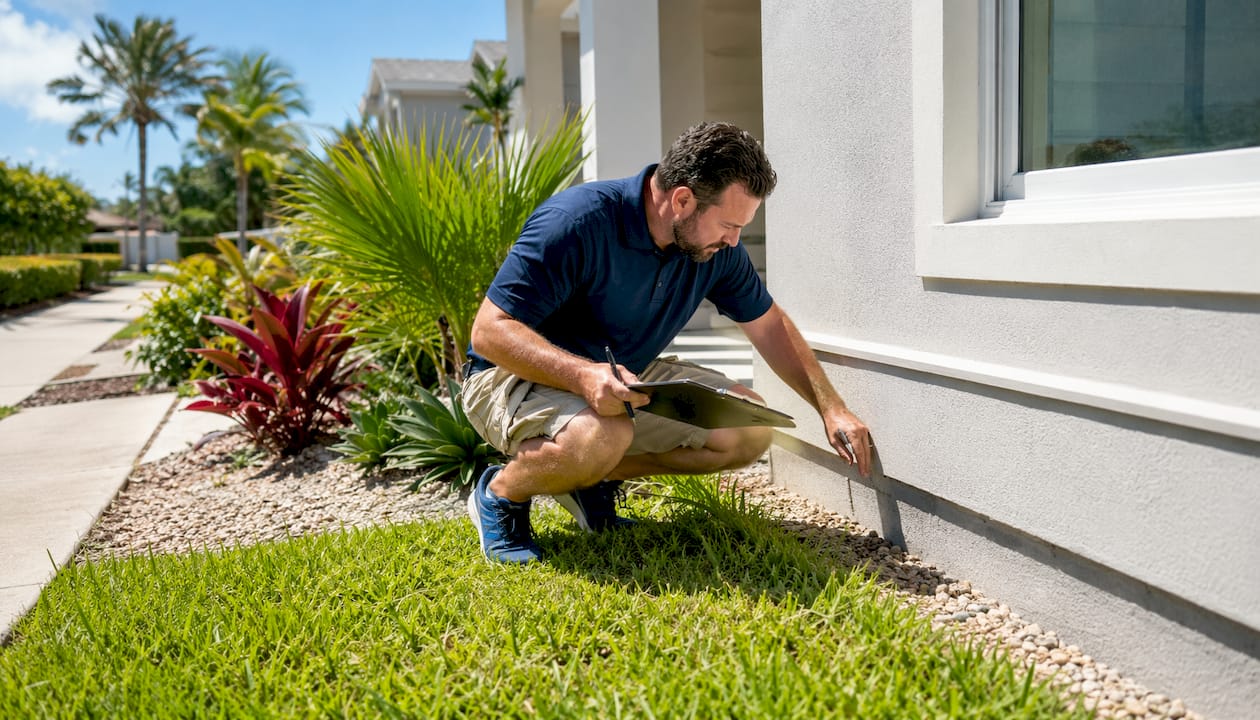
](https://www.TrinityInspectionsLLC.com) Alt text: Trinity Home Inspections inspector in khaki pants and blue shirt with white pocket logo conducting a home inspection in Gulf Coast Alabama
Trinity carries $1M in E&O and a $2M general liability policy, delivers same-day photo and video reports, and includes free thermal imaging on every inspection. For sellers considering a pre-listing inspection before putting a home on the market, Trinity provides a clear picture of a property’s condition so there are fewer surprises at closing.
What’s included with every Trinity inspection: same-day digital report, color-coded priority sections, thermal imaging, post-inspection walkthrough, and access to add-on services including mold testing, sewer scope, and indoor air quality sampling.
Call 251-210-7376 or visit TrinityInspectionsLLC.com to schedule an inspection or ask about ride-along opportunities.
Useful Sources to Verify Your State’s Requirements
Before you enroll in any course or submit any application, confirm the details with your state’s official licensing board. Requirements change, and a third-party summary (including this one) is never a substitute for the primary source.
Primary sources to bookmark:
Your state licensing board: Search “[your state] home inspector licensing board” to find the official application page, approved course list, and fee schedule
New York State Department of State: dos.ny.gov/become-home-inspector — a well-organized example of a full state licensing page
Maryland Department of Labor: labor.maryland.gov — detailed FAQs on home inspector licensing requirements
NHIE / EBPHI: Search “EBPHI NHIE” to find exam registration, candidate handbook, and scheduling
InterNACHI licensing and certification: nachi.org/licensing-and-certification — state-by-state licensing summaries and voluntary certification tracks
InterNACHI’s 15-step guide: nachi.org/become-home-inspector — practical checklist for new inspectors
State hour comparison guide: inspectordata.com — useful overview of hour requirements by state
Always verify current requirements directly with your state board before enrolling in a course or submitting an application. Rules update regularly, and the official source is always the authoritative one.
FAQ
Is becoming a home inspector hard?
The licensing process is manageable for most people — the coursework, field training, and exam are structured and completable within a few months. The harder part is building a steady client base after you are licensed, which depends on local reputation and referral relationships more than technical knowledge alone.
How many hours of training do I need to become a home inspector?
Training hour requirements vary by state from roughly 60 to 194 hours; high-hour states like Texas commonly require 140 or more. Check your state board’s approved course list for the exact requirement in your state.
Do I need to pass the NHIE to become a home inspector?
The NHIE is a 200-question, four-hour exam accepted by many regulated states, but not all. Some states require their own exam or additional state-law sections, so confirm your state’s requirement before registering.
What insurance does a home inspector need?
Most regulated states require E&O insurance, and general liability is strongly recommended regardless of state law. Common E&O limits run $100,000–$250,000; general liability is typically $1M or more. Trinity Home Inspections carries $1M in E&O and $2M in general liability as a working standard.
Can I become a home inspector in a state that doesn’t require a license?
Yes. In states without mandatory licensing, voluntary credentials from InterNACHI or ASHI serve as the primary way to demonstrate competence and win agent referrals. InterNACHI’s standards often exceed what licensed states require, making the CPI® credential meaningful even where no law demands it.
Recommended

