
NEC 210.70(C): Why Attics Need a Light at the Hatch to Prevent Falls

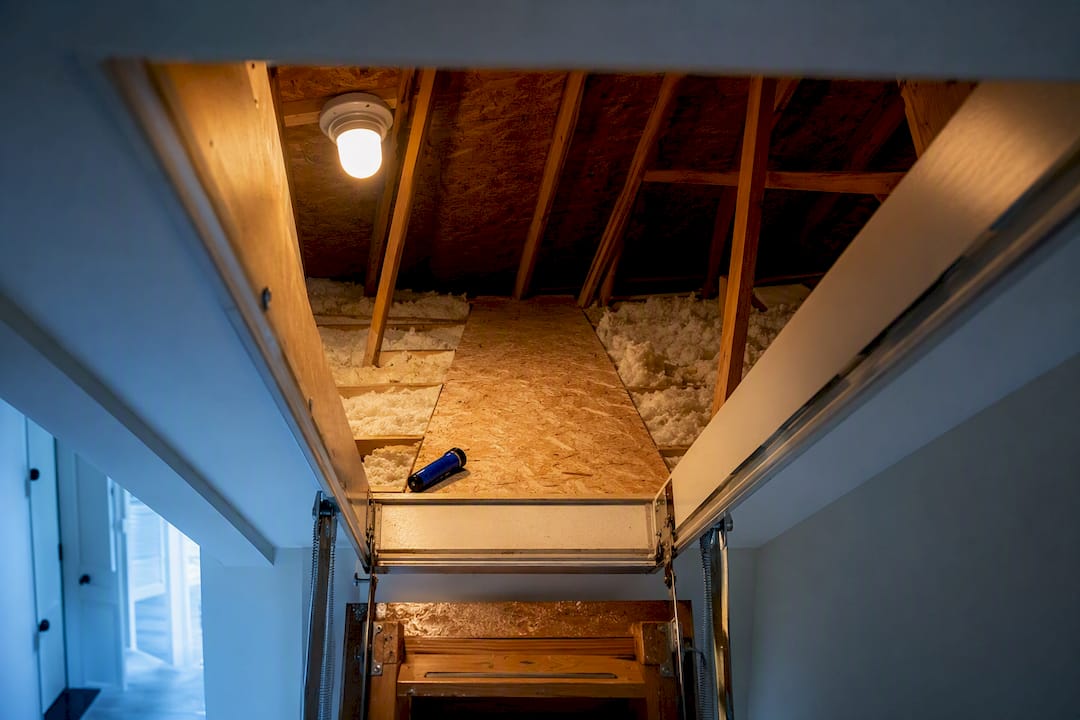
An attic needs a light near the access opening because the National Electrical Code requires it whenever the space is used for storage or holds equipment that needs servicing, and because a lit entry point is what keeps someone from falling through open floor joists in the dark. NEC 210.70© calls for a switched lighting outlet controlled from the usual point of entry. That single fixture is often the difference between a routine furnace check and a trip to the emergency room.
TL;DR:
Attics used for storage or containing serviceable equipment require a switch-controlled light at the usual entry point to comply with NEC 210.70©.
The light should be near the equipment needing service and reachable from the entry, with a wall switch or listed control, not just a pull chain fixture.
Suitable fixtures include LED or IC-rated recessed lights, and wiring must be permanent, properly covered, and installed by a professional if needed.
In finished or habitable attics, general room lighting is necessary, and poor ventilation can increase fire and safety risks in hot attics.
Common inspection issues include missing switches, non-IC fixtures in insulation, and extension cords replacing permanent wiring, which pose fall and fire hazards.
What Does the Electrical Code Require for Attic Lighting?
The rule is more specific than most homeowners realize, but it’s not complicated once you break it down. NEC 210.70 requires at least one lighting outlet, controlled by a switch, in any attic used for storage or containing equipment that needs servicing, such as a furnace, air handler, or water heater. That switch has to sit at the usual point of entry, not somewhere inside the attic where you’d have to feel around in the dark to find it.
A few practical clarifications matter here:
The switch must be reachable from where you actually enter, whether that’s a hallway ceiling hatch, a scuttle opening in a closet, or the base of a pull-down ladder.
The light itself should be positioned near equipment requiring service, not just anywhere convenient.
A pull-chain fixture alone doesn’t satisfy the code. It needs a companion wall switch or listed wall-mounted control at the point of entry.
Finished, habitable attics play by different rules entirely. Those spaces need standard room lighting like any other living area, not just a single service fixture near the hatch, according to inspection-industry summaries of the code.
What Safety Risks Does Attic Access Lighting Reduce?
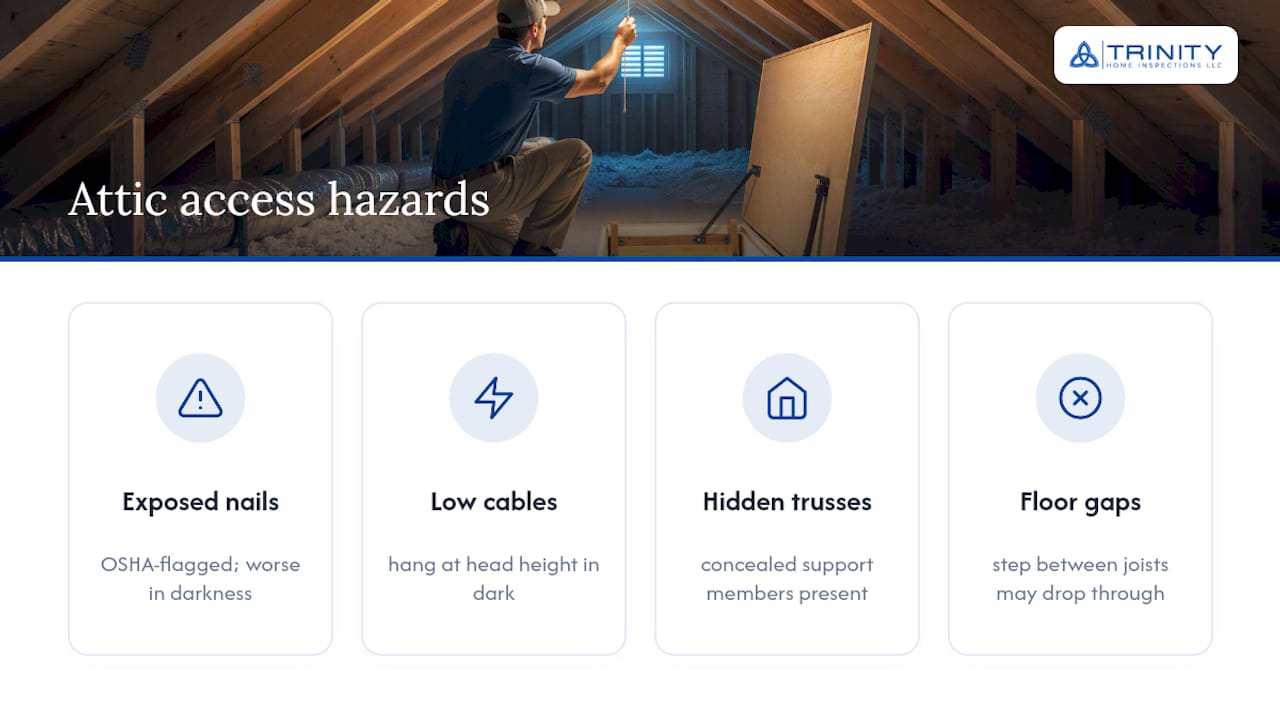
The dangers inside an unlit attic aren’t hypothetical. OSHA’s guidance on working in attics flags exposed nails, low-hanging cables, hidden truss chords, and drop-offs between joists as routine hazards, and every one of them gets worse the moment the lights are off.
Attic floors aren’t floors at all in most homes. They’re joists with insulation laid across them, and stepping between the wrong two joists means putting a foot straight through the ceiling below. A light positioned right at the access point lets you see where solid footing actually is before you commit your weight to it.
Visibility matters just as much once you’re inside. Anyone carrying a box, checking for a roof leak, or crouching next to a furnace to change a filter needs to see what’s around their hands and feet, not just what’s directly in front of them. That’s a genuine fall and trip hazard OSHA specifically warns workers to plan around, and it applies just as much to a homeowner grabbing holiday decorations as it does to an HVAC technician on a service call.
Where Should the Light and Switch Go?
Placement is where a lot of otherwise-compliant attics still fall short in practice, mostly because the switch ends up somewhere inconvenient rather than genuinely at the entry point.
Here’s how the code plays out across the three most common access types:
Ceiling hatch or scuttle opening. Mount the switch on the wall directly beside the opening, at a height you can reach without a ladder, so the light comes on before you climb up.
Pull-down attic stairs. Put the switch where the ladder rests once it’s extended, since that’s the practical point of entry most codes reference, not the folded position.
Platform or walk-up attic access. Position the primary luminaire near the equipment needing service, such as an air handler, with a secondary switch at the doorway itself.
Pro Tip: If you’re replacing a pull-chain fixture with a switch, run the wiring so the switch sits at standing height right beside the access, not tucked behind boxes or insulation where you’ll forget where it is six months from now.
Which Fixtures Are Safe for Attic Installation?
Attics run hot in summer and get packed with loose or blown insulation, so fixture choice matters more than it would in a hallway closet.
Surface-mounted fixtures with a pull chain are simple and cheap, but they need a companion wall switch to meet code, and the chain itself becomes one more thing to fumble for in low light.
Recessed IC-rated fixtures can sit in direct contact with insulation without becoming a fire risk, which matters since standard recessed cans overheat when insulation is packed against them.
LED surface fixtures run cooler than incandescent bulbs and hold up better to the temperature swings typical of an unconditioned attic.
Junction boxes need to be secure and properly covered, and an extension cord run to a work light is never a substitute for permanent wiring, even temporarily. If the wiring path crosses framing you’re not confident cutting into, or the attic lacks an existing circuit to tap, that’s the point to call a licensed electrician rather than improvise.
When Is Attic Lighting Actually Required?
Not every attic needs a wired light, but most do once you look at how the space actually functions.
Attics used for storage, holiday boxes, spare furniture, seasonal gear, generally require at least one switched lighting outlet.
Attics containing equipment that needs regular servicing, furnaces, air handlers, water heaters, always need a code-compliant light and switch near that equipment.
Finished or habitable attic rooms need full room lighting, not a single service fixture, the same way any bedroom or den would.
If you see a permanent platform, ductwork, or a service ladder that’s clearly used often, that’s usually a strong sign the space counts as storage or service access under the code, even without a formal room conversion. Poor attic ventilation can also push fixture heat concerns higher, which is one more reason IC-rated or LED fixtures make sense in Gulf Coast attics that run hot for most of the year.
Quick Safety Checklist Before You Touch Attic Lighting
Before you grab a ladder or open a panel, run through this short list.
Confirm the ladder or step stool is stable and rated for your weight.
Kill power to the circuit at the breaker before touching any wiring or fixture.
Put on eye protection and gloves. Attic insulation and exposed nails don’t mix well with bare skin.
Check whether the existing fixture is IC-rated if it touches or sits near insulation.
Verify the switch is actually at the point of entry, not buried somewhere inside the attic.
Look for temporary lamps, extension cords, or exposed splices standing in for permanent wiring.
Pro Tip: If you find bare wire nuts with no junction box cover, stop and call an electrician. That’s not a DIY fix, it’s a fire hazard waiting on the next power surge.
What Inspectors See: Why Attic Lighting Gets Flagged
Missing switches at the point of entry, non-IC fixtures buried in insulation, and extension cords doing the job of permanent wiring are among the most common defects we run into during attic inspections. These issues get flagged because they turn a routine filter change into a real fall or fire risk. As InterNACHI-certified inspectors, Trinity Home Inspections documents these findings with thermal imaging and same-day photo and video reports, so you know exactly what needs attention before it becomes a bigger problem.
— Matt
Get a Professional Look at Your Attic Access and Lighting
If you’re buying, selling, or just want peace of mind about what’s happening above your ceiling, Trinity Home Inspections checks attic access and lighting as part of every standard home inspection across Coastal Alabama, no separate add-on required.
Here’s what’s typically included when a professional inspects your attic access:
Visual inspection of the access opening, ladder, or hatch for safe entry
Verification that the switch and light actually work and sit at the correct location
Photos and video documenting fixture type, wiring condition, and any hazards
Plain-English safety recommendations, plus a referral to a licensed electrician if rewiring is needed
We also flag related attic issues while we’re up there. If you’re curious what a full attic inspection typically costs, or you’re a seller wanting to catch problems before they show up in a buyer’s report, our pre-listing inspection service covers the same ground. Call 251-210-7376 or visit Trinityinspectionsllc to schedule your inspection today.
Where to Verify the Code and Safety Details Yourself
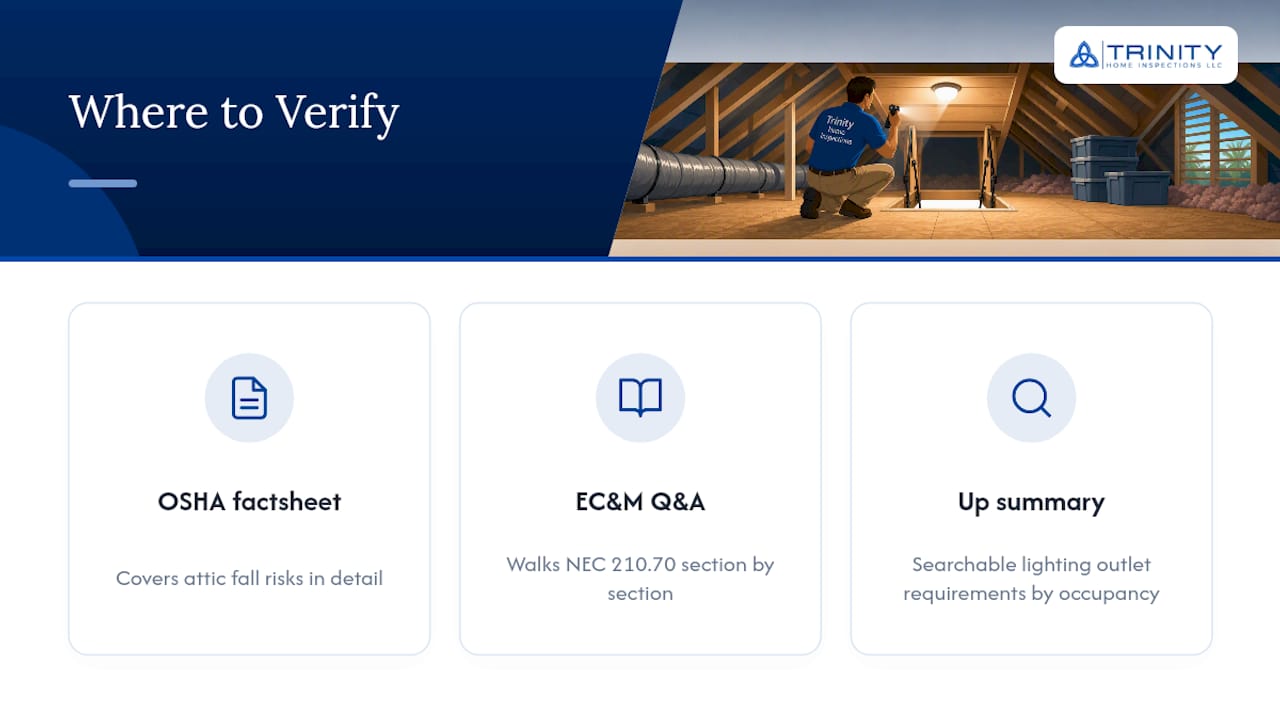
For readers who want to check the code language directly rather than take our word for it, OSHA’s attic hazards factsheet covers fall risks in detail, and EC&M’s code Q&A walks through NEC 210.70 section by section. Up offers a searchable summary of lighting outlet requirements across occupancy types if you want to compare attic rules against other spaces in your home.
Sources
FAQ
Is an Attic Light Required by Code?
Yes, if the attic is used for storage or contains equipment needing service, NEC 210.70 requires at least one switched lighting outlet with the control at the usual point of entry.
What Is the 7 and 7 Rule for Attics?
This isn’t a recognized National Electrical Code or building code standard. If you’ve seen it referenced elsewhere, treat it as informal guidance rather than an enforceable requirement, and rely on NEC 210.70 for the actual lighting rule.
Are You Supposed to See Sunlight in Your Attic?
No, visible daylight through the roof deck or soffits usually points to gaps, damaged flashing, or missing sheathing rather than normal ventilation, and it’s worth having checked during an attic safety inspection.
Is It Bad to Leave the Attic Door Open?
Leaving an attic hatch open can let conditioned air escape and pull unconditioned attic air into your living space, which affects energy use and indoor comfort more than it creates an immediate safety issue. Closing it after each visit, with a working light at the entry so you can see your way out safely, is the better habit.
Recommended

