
How To Interpret Inspection Reports: Alabama Buyer's Guide
- Matt Cameron
- Jul 9
- 8 min read

A home inspection report is a documented snapshot of a property’s major systems and visible conditions at the time of inspection. Knowing how to interpret inspection reports is the difference between a confident purchase and a costly mistake. Industry-standard reports run 30–70 pages, include annotated photos, and organize findings by severity. Standards set by InterNACHI and ASHI guide how inspectors document and communicate those findings. Trinity Home Inspections follows InterNACHI’s Standards of Practice to deliver same-day reports that give Alabama buyers and agents a clear picture before closing.
How to interpret inspection reports: structure and key components
Reading an inspection report efficiently starts with understanding its layout. The executive summary separates deal-breaker safety hazards and major defects from routine maintenance items. Skipping straight to the middle of a 50-page report without reading the summary first leads to poor prioritization and unnecessary anxiety.
Standard sections in every report
A well-organized inspection report follows a consistent structure:
General information: Property address, inspection date, weather conditions, and inspector credentials.
Executive summary: A grouped list of findings sorted by severity. Read this first.
System-specific sections: Roof, foundation, electrical, plumbing, HVAC, interior, and exterior each get their own section with findings and photos.
Annotated photos: Images linked directly to findings so you can see exactly what the inspector documented.
Limitations and scope: A list of areas that were inaccessible or outside the inspection scope.
Condition codes explained
Inspectors use standardized codes to label the status of each component. Understanding these codes is the fastest way to read a report accurately.
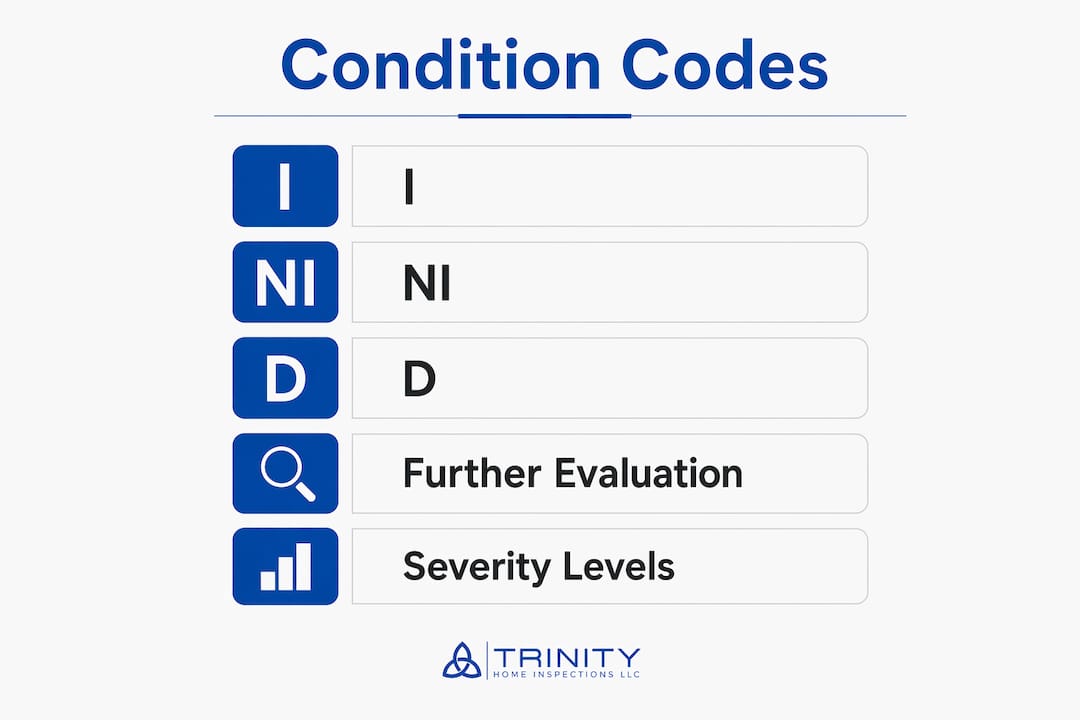
Code | Meaning | What to do |
I (Inspected) | Component was inspected and found acceptable | No action needed |
NI (Not Inspected) | Component was inaccessible or out of scope | Schedule follow-up |
NP (Not Present) | Component does not exist at this property | No action needed |
D (Deficient) | Component has a defect requiring attention | Prioritize by severity |
M (Monitor) | Low urgency; watch for changes over time | Note for future maintenance |
The “D” code covers everything from a missing outlet cover to a failing roof. That range is exactly why severity labels matter more than the code alone. Trinity Home Inspections uses a color-coded report format with sections for Safety/Major, Issues/Defects, and DIY/Minor so you can sort findings at a glance without guessing.
What do inspector terms and severity codes actually mean?
Inspector terminology varies, but standardized codes are the foundation of accurate report reading. Misreading a single term can lead to either panic over a minor item or complacency about a serious defect.
Common terms and their real implications
“Monitor” means the condition is stable now but could change. It is low urgency. Check it again in six months.
“Repair recommended” means the item needs attention in the near term. Budget for it before or after closing.
“Further evaluation by a qualified specialist” means the inspector identified symptoms of a problem that exceeds general inspection scope. This is not optional language.
“Not inspected” means the inspector could not access or assess the component. It is not a clean bill of health.
“Safety hazard” means the condition poses an immediate risk to occupants. Treat this as non-negotiable in negotiations.
How severity labels connect to urgency
Severity labels tell you how fast to act, not just whether something is wrong. A cracked outlet cover is deficient but low urgency. A double-tapped breaker in the electrical panel is deficient and a safety concern. Both carry the “D” code, but they belong in completely different conversations with your agent and seller.
Real estate agents advise focusing repair requests on safety and major systems, using the executive summary as the foundation for negotiation. Bringing a list of 40 cosmetic items to the seller weakens your position. Bringing three documented safety hazards strengthens it.
Pro Tip: Print or export the executive summary separately and share it with your real estate agent before your negotiation meeting. It keeps the conversation focused on what actually matters.
What “further evaluation” really signals
A specialist referral from your inspector signals symptoms of hidden or complex issues beyond general inspection scope. Ignoring these referrals risks costly post-purchase repairs. Common specialists include structural engineers, licensed electricians, and master plumbers. If your report recommends a structural engineer, that recommendation exists because the inspector saw something that warrants expert analysis. Act on it before closing.
How to classify findings into tiers for decisions and negotiations
A practical classification framework turns a 50-page report into a clear action plan. The three-tier framework used by experienced buyers and agents prioritizes findings by safety, structural integrity, and active damage.
The four-tier classification system
Tier 1: Safety hazards. These include exposed wiring, missing smoke detectors, carbon monoxide risks, and gas leaks. Address these in every negotiation. They are non-negotiable.
Tier 2: Major structural defects. Foundation cracks, roof failures, and compromised load-bearing walls fall here. Structural repairs range from $5,000 to $50,000 or more. Know the cost before you decide.
Tier 3: Active water intrusion and major system failures. Sewer line replacements cost $3,000 to $25,000. HVAC systems at end of life, active roof leaks, and failing water heaters belong in this tier.
Tier 4: Maintenance and cosmetic items. Peeling paint, worn caulk, and minor grading issues are buyer responsibilities in most transactions. Do not use these as negotiation points.
Alabama-specific findings to watch for
Gulf Coast Alabama homes carry specific risks that show up regularly in inspection reports. Moisture intrusion is common in crawl spaces and attics due to the region’s humidity. Older homes in Mobile and Baldwin County may have original knob-and-tube wiring or galvanized plumbing. Homes near the coast face accelerated corrosion on HVAC components and fasteners. These are Tier 1 and Tier 2 concerns that deserve immediate attention in your report review.
Pro Tip: Cross-reference your inspection findings with the seller’s disclosure statement. If the seller disclosed no known water damage but the report shows staining and elevated moisture readings, that discrepancy matters legally and in negotiation.
Using the tiers to make your walk-away decision
Tier 1 and Tier 2 findings together tell you whether a property is worth pursuing. A home with three safety hazards and a failing foundation is a different conversation than a home with 30 minor maintenance items. Understanding severity prevents overreaction to volume and keeps your focus on what actually affects safety and value. Use the repair prioritization guide to build your post-inspection action list.
How to use photos, limitations, and specialist referrals effectively
Annotated photos are the most underused part of any inspection report. Every photo is linked to a specific finding and shows you exactly what the inspector documented. If a photo shows discoloration on a ceiling, that visual evidence supports your repair request far better than a written description alone.
What “Not Inspected” actually means
NI items are not approved areas. They are signals for follow-up. Common inaccessible areas include:
Attics with insufficient clearance or no access hatch
Crawl spaces with standing water or blocked entry
Winterized pools and spa systems
Areas blocked by stored belongings or locked doors
Underground sewer lines (requires a separate sewer scope)
Buying a home with multiple NI items without scheduling follow-up inspections means accepting unknown risk. Sewer scope inspections are one of the most common and valuable follow-ups, especially for homes built before 1980.
Acting on specialist referrals before closing
Specialist referrals in your report are not suggestions. They are documented findings that require expert analysis. A general inspector identifies symptoms. A structural engineer, licensed electrician, or master plumber diagnoses the cause and estimates the repair cost. Getting that specialist report before closing gives you real numbers for negotiation, not guesses.
Contact your inspector within 24–48 hours of receiving your report if you have questions. Buyers who follow up promptly with their inspector get clearer answers and avoid misinterpreting findings during the negotiation window. Most inspectors are glad to clarify their notes by phone.
Common mistakes to avoid when reading inspection reports
Skipping the executive summary and reading findings out of order
Treating every “D” code as equal urgency regardless of severity
Ignoring NI items because they were not visually confirmed
Skipping specialist inspections to save time or money before closing
Using cosmetic findings as negotiation points and weakening your position on real defects
Key Takeaways
Reading a home inspection report correctly means starting with the executive summary, classifying findings by severity tier, and acting on specialist referrals before closing.
Point | Details |
Start with the executive summary | The summary groups findings by severity and is your best tool for prioritizing negotiations. |
Understand condition codes | NI does not mean approved; “D” covers a wide severity range; always read the label alongside the code. |
Use the four-tier framework | Classify findings into safety, structural, active damage, and cosmetic tiers before negotiating. |
Act on specialist referrals | Inspector referrals signal complex issues; get specialist reports before closing to know real costs. |
Follow up within 24–48 hours | Contact your inspector promptly for clarifications while the negotiation window is still open. |
What I’ve learned from reading hundreds of Alabama inspection reports
The most common mistake I see buyers make is panicking over page count. A 65-page report with 40 findings does not mean the house is falling apart. Long reports filled with minor maintenance items often indicate a thorough inspector, not a troubled property. The severity and location of findings matter far more than how many pages the report runs.
What I tell every buyer I work with in Mobile and Baldwin County is this: read the executive summary first, then stop. Take a breath. Then go back through the system sections with fresh eyes. You will find that most findings fall into Tier 4, and the real conversation is about two or three items at most.
The other thing I see buyers miss is the NI section. People assume that if the inspector did not find a problem, there is no problem. That is not what NI means. It means the inspector could not see it. In Gulf Coast Alabama, that matters especially for crawl spaces, attics, and older sewer lines. Schedule the follow-up. The cost of a sewer scope or a crawl space evaluation is small compared to what you might inherit.
My honest advice to real estate agents: use the executive summary as your negotiation anchor. Focus your repair requests on Tier 1 and Tier 2 findings. Sellers respond to documented safety hazards and structural concerns. They dig in when buyers bring a list of 30 cosmetic items. Keep it focused, and you will close more deals with better outcomes for your clients.
— Matt
Trinity Home Inspections is ready to walk you through your report
[
Trinity Home Inspections delivers same-day, color-coded reports packed with annotated photos and video so you never have to guess what a finding means. Every report includes a clear executive summary organized by Safety/Major, Issues/Defects, and DIY/Minor. When something in the report needs a closer look, add-on services like sewer scope inspections and mold testing are available in one visit. Sellers preparing for listing can also benefit from a pre-listing inspection to reduce surprises before buyers arrive. Call 251-210-7376 or visit TrinityInspectionsLLC.com to schedule your inspection today.
What’s included with every Trinity Home Inspections report:
Same-day digital delivery with photos and video
Color-coded severity sections for fast prioritization
Executive summary for negotiation-ready findings
Free thermal imaging when conditions allow
Post-inspection walkthrough by phone or in person
FAQ
What is a home inspection report?
A home inspection report is a written record of the visible condition of a property’s major systems at the time of inspection. It includes findings, condition codes, annotated photos, and a list of inaccessible areas.
How long does a typical home inspection report run?
Standard reports are typically 30–70 pages depending on the size and age of the home. Page count reflects thoroughness, not necessarily the severity of problems found.
What should I read first in an inspection report?
Read the executive summary first. It groups findings by severity and gives you an immediate picture of safety hazards, major defects, and maintenance items without requiring you to read every page.
What does “Not Inspected” mean on an inspection report?
“Not Inspected” means the inspector could not access or assess that component. It is not a clean bill of health. Schedule follow-up inspections for any NI items before closing.
How do I use an inspection report in negotiations?
Focus your repair requests on Tier 1 safety hazards and Tier 2 structural defects. Use the negotiation strategies guide to build a focused, credible repair request that sellers are more likely to act on.
Recommended

