
HVAC Fresh Air Intake Code for Alabama Homes

Many buyers and sellers assume every HVAC system must have a dedicated fresh air intake by code. That assumption is wrong, and it can lead to costly surprises during a real estate transaction on Alabama’s Gulf Coast. The truth is that code requirements for ventilation are nuanced, layered across state and local enforcement, and heavily dependent on how a home is built. Whether you are buying in Fairhope, selling in Gulf Shores, or representing a client in Mobile, understanding what the code actually requires gives you real leverage at the negotiating table.
Key Takeaways
Point | Details |
Local codes matter | Alabama uses model codes, but enforcement varies by city or county. |
Natural vs. mechanical intake | Fresh air intake is only required mechanically if windows can’t provide enough ventilation. |
Energy efficiency affects requirements | Tightly built homes often require mechanical ventilation under current codes. |
Real estate implications | Failing to meet ventilation code can jeopardize home sales or cause costly issues. |
How HVAC fresh air intake codes work in Alabama
Let’s lay the groundwork by clarifying which codes apply and who enforces them.
Alabama does not write its own residential mechanical code from scratch. Instead, the state adopts model codes from ICC, including the 2021 International Residential Code (IRC) for residential construction and the 2021 International Mechanical Code (IMC) for HVAC and mechanical systems. Local jurisdictions like Baldwin County and Mobile County are the ones who actually enforce these codes on the ground, and they may adopt newer editions or local amendments over time.
This matters because a code requirement that applies in one county may be enforced differently in another. Always verify with your local building department before assuming anything.
When it comes to fresh air intake specifically, the code does not simply say every HVAC system needs one. The requirement depends on the ventilation strategy the home uses. The IMC standards for ventilation outline two acceptable paths: natural ventilation through openable windows and doors, or mechanical ventilation through equipment.
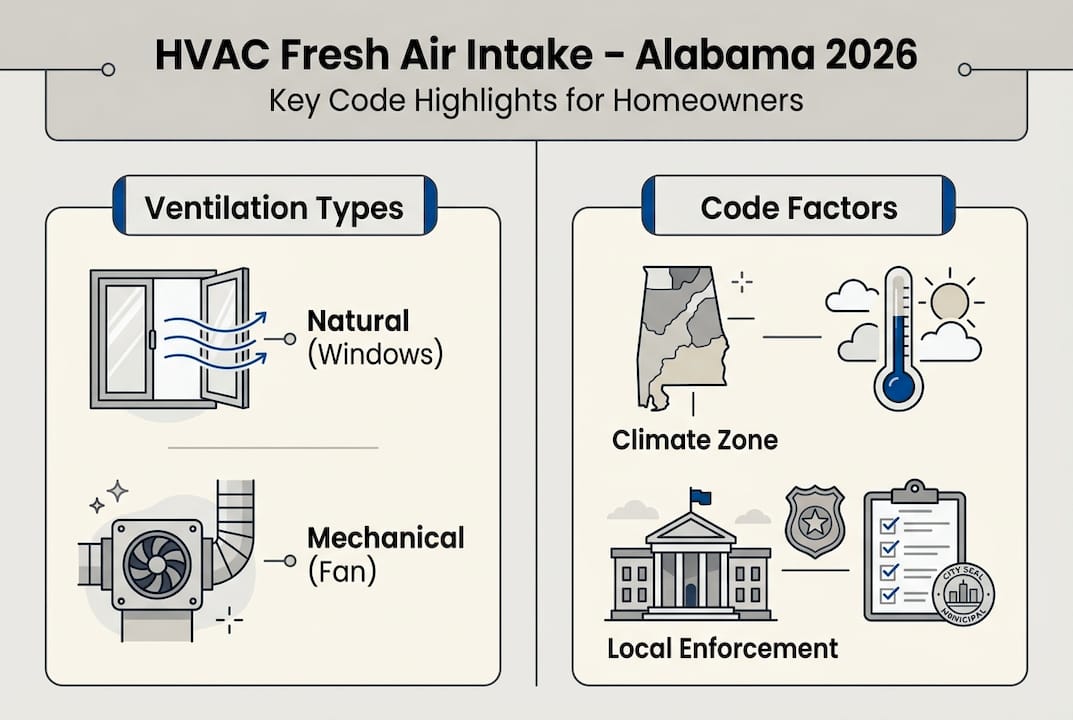
Here is a quick comparison of the two approaches:
Ventilation type | How it works | When it qualifies |
Natural ventilation | Openable windows and doors | Openable area equals at least 4% of floor area |
Mechanical ventilation | Fans, ERVs, HRVs, or dedicated intakes | Required when natural ventilation is not feasible |
Key points to keep in mind about Alabama’s code framework:
The IRC and IMC are the primary references for residential ventilation requirements.
Local counties enforce these codes and are your first point of contact for permit questions.
A fresh air intake is not automatically required on every HVAC installation.
The home’s construction type and energy performance determine which ventilation path applies.
“The code gives builders two options: open the windows enough, or install mechanical ventilation. The problem is that modern energy-efficient homes often cannot rely on the first option.”
For a broader look at keeping your system running well, reviewing basic HVAC maintenance is a good starting point before diving into compliance questions.
Residential ventilation: What the code really requires
With codes and authorities established, let’s clarify what those codes actually say about fresh air in homes.
The IRC and IMC give natural ventilation the first shot at meeting the requirement. To qualify, the openable area of windows and exterior doors must equal at least 4% of the floor area being served. For a 2,000 square foot home, that means at least 80 square feet of openable window and door area. That sounds like a lot, and in many older homes it is easily met. In tightly sealed modern builds, it often is not.
When natural ventilation cannot meet that threshold, mechanical ventilation steps in. Alabama’s Gulf Coast falls in Climate Zone 2A, which means IRC Chapter 15 and ASHRAE 62.2 govern how much fresh air a home must receive mechanically. ASHRAE 62.2 is the industry standard for residential ventilation rates, and it uses a straightforward formula to calculate the minimum airflow needed.
The ASHRAE 62.2 formula: Qfan = 0.03 × floor area (ft²) + 7.5 × (bedrooms + 1) cfm
For a 1,800 square foot home with 3 bedrooms, that works out to: 0.03 × 1,800 + 7.5 × 4 = 54 + 30 = 84 cfm of mechanical fresh air required.
Beyond whole-house ventilation, the code also requires specific exhaust ventilation in certain rooms:
Bathrooms must have either an openable window or a mechanical exhaust fan.
Kitchens require exhaust ventilation to remove cooking byproducts.
Laundry rooms and utility spaces with combustion appliances have their own exhaust requirements.
All exhaust fans must vent to the exterior, not into the attic or crawl space.
For Gulf Coast homes specifically, bathroom exhaust requirements are worth reviewing in detail because the high humidity here makes proper exhaust fan operation a health issue, not just a code checkbox.
Pro Tip: During a home inspection or walkthrough, open every window and measure whether the total openable area reaches 4% of the home’s square footage. If it falls short and there is no mechanical ventilation system installed, you may have a code compliance issue worth flagging before closing.
The ASHRAE 62.2 residential standards provide a detailed breakdown of the calculation method and exceptions that apply to different home types.
Why energy-efficient homes often need mechanical fresh air
Not every home needs extra mechanical ventilation, but energy-efficient homes are a special case.
New construction on Alabama’s Gulf Coast is increasingly built to tighter energy standards. Better insulation, sealed ductwork, and high-performance windows reduce the amount of air that leaks in and out of the building envelope. That is great for your energy bill. It creates a real problem for indoor air quality.
A tight home has a low ACH50 (air changes per hour at 50 pascals of pressure), which is measured during a blower door test. When that number drops low enough, the home no longer gets enough fresh air through natural leakage. Tight homes need mechanical ventilation to avoid indoor air quality issues like elevated humidity, VOC buildup, and carbon dioxide accumulation.
Here is what buyers and sellers should know about tight homes and ventilation:
ERV (Energy Recovery Ventilator): Brings in fresh air while transferring heat and moisture from outgoing air. Best for humid climates like the Gulf Coast.
HRV (Heat Recovery Ventilator): Similar to an ERV but optimized for cold climates. Less common here but occasionally installed.
Dedicated supply fans: A simpler option that introduces outdoor air directly into the HVAC return.
Exhaust-only systems: Use bathroom or utility fans to depressurize the home and draw in outdoor air passively.
If a home was built or renovated to meet current energy codes, it almost certainly needs one of these systems. Checking permit records and inspection reports will tell you whether one was installed and whether it passed inspection. You can also look at ventilation in older homes to understand how older construction handled this differently.
Pro Tip: Ask the seller or listing agent for the blower door test results if the home was built after 2015. A result below 3 ACH50 almost always means mechanical ventilation is required by code. If no ERV or HRV is documented, that is a negotiating point.
For additional context on how ventilation affects the whole building system, proper attic ventilation and signs of ventilation issues are worth reviewing before your inspection.
Practical steps for verifying HVAC ventilation during real estate transactions
So, how do you actually check if a home passes code at the point of sale or purchase?
Verifying HVAC ventilation compliance does not require an engineering degree. It requires asking the right questions and knowing what documents to request. Non-compliant ventilation may fail blower door or energy tests during transactions, which can delay closing or trigger required repairs. Getting ahead of this issue protects everyone involved.
Follow these steps to verify ventilation compliance before closing:
Request permits and inspection records. Ask for the original building permit and any mechanical inspection sign-offs. These documents confirm whether a ventilation system was installed and approved.
Ask for blower door test results. If the home was built under current energy codes, a blower door test was likely required. Low ACH50 results confirm the need for mechanical ventilation.
Walk through and test every window. Open each window and estimate whether the total openable area reaches 4% of the home’s floor area. This is the natural ventilation threshold.
Test all bathroom and kitchen exhaust fans. Run each fan and verify it exhausts to the exterior. A tissue held near the grille should be pulled toward the fan.
Locate and document any ERV, HRV, or dedicated fresh air equipment. Check the mechanical room, attic, or crawl space. If present, confirm it is operational and has a maintenance record.
Key statistic: Homes built to IECC 2021 standards must achieve no more than 3 ACH50 in Climate Zone 2A, making mechanical ventilation a near-universal requirement for new Gulf Coast construction.
Additional items to verify during a transaction walkthrough:
Confirm exhaust fans vent to the exterior, not into the attic.
Check that fresh air intakes are not blocked by insulation or debris.
Verify that HVAC filters are not so clogged they restrict airflow to the system.
For seasonal readiness, HVAC seasonal preparedness covers the maintenance steps that keep a system code-ready year-round. Managing Gulf Coast humidity is also directly tied to whether your ventilation system is working as designed. The full ASHRAE 62.2 documentation is available for those who want to verify the calculation methodology themselves.
The real impact of ventilation code in Gulf Coast real estate
Let’s step back and consider why this matters beyond passing an inspection.
Ventilation code compliance has become one of the quieter deal-killers in Gulf Coast real estate transactions. Most agents focus on the obvious items: roof condition, foundation, electrical panels. Ventilation rarely comes up until it causes a failed energy test or a mold report surfaces during due diligence. By then, the deal is already under stress.
Here is the uncomfortable truth: a home with inadequate mechanical ventilation in a humid climate like Mobile or Baldwin County is not just a code violation. It is a mold risk waiting to develop. Elevated indoor humidity, poor air circulation, and warm temperatures create exactly the conditions where mold colonies establish themselves inside walls and under floors, often invisibly.
Savvy sellers who can document code-compliant ventilation, including ERV installation records and passed inspections, use that paperwork as a genuine value-add. It signals to buyers that the home was built and maintained with care. Buyers who understand this can use the absence of documentation as leverage to negotiate repairs or price reductions before closing. Learning how to protect your Gulf Coast HVAC is part of that same mindset. The code is not just a bureaucratic hurdle. It is a minimum standard designed to keep people healthy in one of the most challenging climates in the country.
How we help you ensure HVAC code compliance
Ready to make ventilation code compliance a non-issue in your next real estate deal?
At Trinity Home Inspections, we inspect HVAC and ventilation systems thoroughly on every inspection. We check exhaust fan operation, look for ERV and HRV equipment, verify that fresh air pathways are clear, and flag anything that suggests the home may not meet current ventilation standards.

Our pre-sale or pre-listing inspections help sellers identify ventilation issues before they become deal-breakers. If mold is a concern, our mold testing services can confirm whether inadequate ventilation has already caused a problem. We also offer a full property and permit search to verify whether mechanical ventilation was permitted and inspected. Same-day reports, free thermal imaging, and InterNACHI-certified inspectors. That is what you get with Trinity.
Frequently asked questions
Is a fresh air intake always required for HVAC systems in Alabama homes?
No, natural ventilation through windows can satisfy the code if openable area equals at least 4% of floor area, but mechanical fresh air intake is required when the home is too tightly built for natural ventilation to work.
How do I calculate if my Alabama home needs mechanical ventilation by code?
Use the ASHRAE 62.2 formula: Qfan = 0.03 × floor area (ft²) + 7.5 × (bedrooms + 1) cfm, which gives you the minimum mechanical fresh air rate required for your specific home size and bedroom count.
Do local Alabama counties have unique codes for HVAC fresh air intake?
Gulf Coast counties enforce statewide model codes without unique regional amendments for fresh air intakes, but you should always confirm current adoption status with your local building department before making assumptions.
Can non-compliance with HVAC ventilation requirements delay a home sale?
Yes, missing mechanical ventilation can cause a failed blower door or energy test during the transaction process, which may require costly repairs or hold up closing until the issue is resolved.
Recommended

