
HVAC Variable Speed Motors: Maximize Comfort and Savings

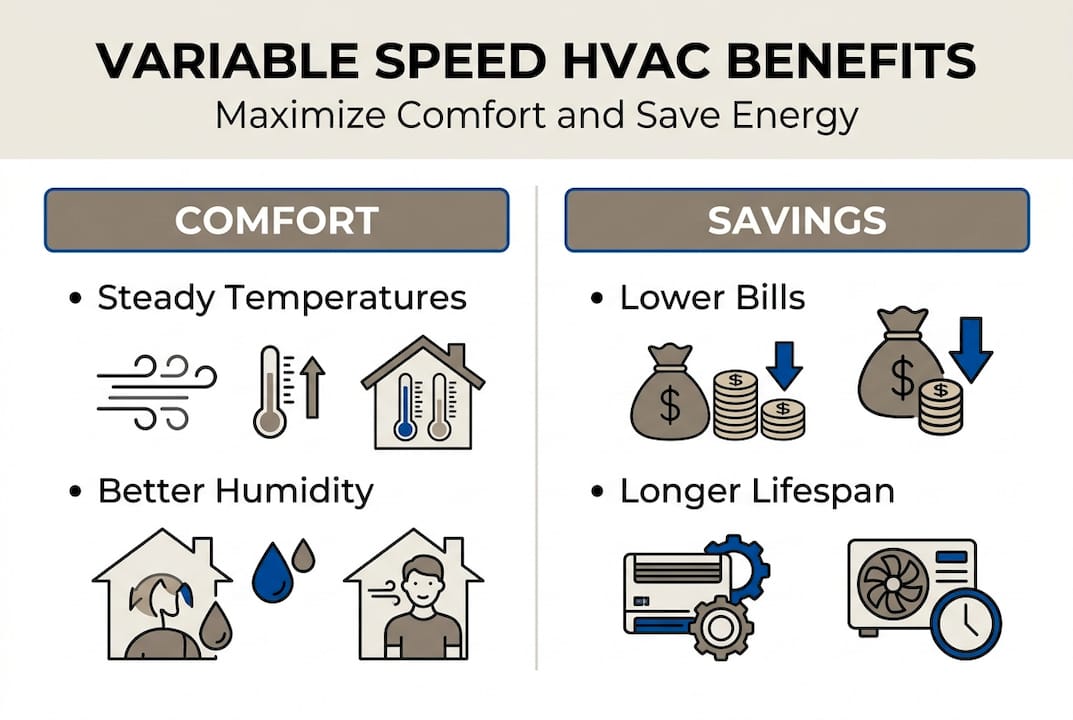
Variable speed HVAC motors cut energy costs by 25 to 40% and improve humidity control.
They run longer at lower speeds, removing more moisture, ideal for humid Gulf Coast climates.
Despite higher upfront costs, long-term savings and better indoor air quality make them worthwhile.
Most homeowners assume a bigger, more powerful HVAC system means better comfort. The reality is almost the opposite. Upgrading to a variable speed motor can cut energy costs 25 to 40% while keeping your home noticeably drier and more comfortable, especially on the Gulf Coast where summer humidity is relentless. These motors, known as ECMs (electronically commutated motors), adjust their speed continuously to match what your home actually needs at any given moment. This guide breaks down exactly how they work, what they cost, how they perform in Alabama’s humid climate, and whether the investment makes sense for your situation.
Key Takeaways
Point | Details |
Boosts comfort and air quality | Variable speed motors keep temperatures steady and air less humid for healthier living. |
Saves energy and money | Homeowners can cut energy bills by up to 40 percent compared to single-speed HVAC systems. |
Best for humid climates | These motors excel at controlling humidity and preventing mold in Gulf Coast homes. |
Higher upfront investment | While initial costs are greater, long-term savings and improved lifespan make it worthwhile for many. |
What sets variable speed HVAC motors apart?
To understand why variable speed motors matter, you first need to know what you’re comparing them to. Most older HVAC systems use PSC motors, which stands for permanent split capacitor. A PSC motor has two modes: full blast or completely off. It’s like a car that can only drive at 70 mph or sit in park. There’s no middle ground.
ECM motors adjust continuously using electronic controls and inverters to match airflow and temperature demand in real time. If your home only needs 40% of the system’s capacity to maintain your set temperature, the motor runs at 40%. That precision changes everything about how your home feels and how much energy you use.
Here’s a quick side-by-side comparison:
Feature | PSC motor (standard) | ECM motor (variable speed) |
Speed settings | Fixed (on/off) | Continuous adjustment |
Energy efficiency | ~60% | 80% or higher |
Noise level | 70 to 75 dB | 50 to 55 dB |
Humidity control | Limited | Excellent |
Lifespan | 8 to 12 years | 15 to 20+ years |
Upfront cost | Lower | Higher |
The practical benefits of this flexibility go beyond the numbers. Because the motor ramps up gradually rather than slamming on at full power, you get:
Fewer temperature swings from room to room
Less noise when the system kicks on and off
Fewer start and stop cycles, which reduces wear on components
More consistent airflow, which helps your filter catch more particles
Better dehumidification, which is critical on the Gulf Coast
Keeping up with HVAC maintenance tips is still essential with any motor type, but a variable speed system rewards good maintenance with noticeably better performance and longer service life.
Comfort and humidity: The Gulf Coast advantage
Here’s where variable speed motors truly earn their place in Alabama homes. The Gulf Coast doesn’t just get hot. It gets wet. Humidity levels regularly push above 70% outdoors during summer months, and that moisture finds its way inside. Standard single-stage systems struggle to keep up because they run in short, powerful bursts that cool the air quickly but don’t run long enough to pull adequate moisture out.

Variable speed motors excel at dehumidification by running longer at lower speeds, maintaining indoor humidity between 45 and 50% compared to 60% or higher with single-stage systems. That gap is the difference between a home that feels fresh and one that feels clammy no matter how low you set the thermostat.
Here’s why that works. Moisture removal happens when warm, humid air passes slowly over a cold evaporator coil. The longer that contact time, the more moisture gets pulled out. A variable speed motor running at 60% capacity for two hours removes far more humidity than the same system blasting at 100% for 45 minutes.
Humidity scenario | Single-stage system | Variable speed system |
Typical indoor humidity | 60%+ | 45 to 50% |
Mold risk level | Higher | Significantly lower |
Comfort rating (Gulf Coast summer) | Clammy | Noticeably drier |
Air passes over coil | Short bursts | Extended contact |
“In humid climates like Alabama’s Gulf Coast, variable speed systems running at lower speeds for longer periods are simply better at pulling moisture from the air. The result is a home that feels cooler even at a higher thermostat setting.”
For homeowners dealing with managing home humidity in Baldwin or Mobile County, this isn’t a minor upgrade. It’s a meaningful quality-of-life improvement. And for those focused on coastal HVAC care, pairing a variable speed system with proper maintenance protects your investment from the salt air and moisture that accelerate wear on the Gulf Coast.
Pro Tip: Set your thermostat fan to “auto” rather than “on” with a variable speed system. Running the fan continuously on “on” mode can actually reintroduce moisture from the coil back into your air during the off cycle.
Energy savings and lifespan: Is it worth the cost?
Comfort matters, but does a variable speed motor pay off long-term? Let’s follow the money.
The numbers are hard to ignore. Variable speed motors use up to 75% less fan energy compared to PSC motors, with overall system savings of 25 to 40% versus single-stage systems. For a typical 2,000 square foot Gulf Coast home, that translates to monthly savings of $40 to $80 on your energy bill.
Annually, that’s $500 to nearly $1,000 back in your pocket. Over the 15 to 20 year lifespan of an ECM motor, compared to just 8 to 12 years for a PSC motor, the total savings can be substantial. You’re also replacing the unit less frequently, which adds to the long-term value.
Here’s a breakdown to help you think through the numbers:
Cost factor | PSC system | Variable speed ECM system |
Upfront equipment cost | Lower baseline | $2,000 to $4,000 more |
Monthly energy savings | Baseline | $40 to $80 less |
Average lifespan | 8 to 12 years | 15 to 20+ years |
Estimated payback period | N/A | 5 to 10 years |
ENERGY STAR rebate eligibility | Sometimes | Often qualifies |
To calculate your own payback period, follow these steps:
Get a quote for the variable speed system upgrade from a licensed HVAC contractor.
Pull your last 12 months of energy bills and calculate your average monthly cost.
Estimate 30% savings on that monthly average as a conservative projection.
Divide the upgrade premium by your estimated monthly savings to find your payback in months.
Check with Alabama Power or your local utility for available rebates, which can cut the payback period significantly.
For homeowners focused on saving on HVAC energy, a variable speed motor is one of the highest-impact upgrades available. Combining it with home energy efficiency improvements like better insulation or a tankless water heater compounds the savings even further.
The fine print: Downsides, maintenance, and when not to upgrade
Of course, no technology is perfect. Here’s what you absolutely need to consider before deciding.
The most significant barrier is upfront cost. Variable speed systems typically run 50 to 70% more than standard single-stage systems, adding $2,000 to $4,000 to the purchase price. That’s a real number, and it matters if you’re on a tight budget or don’t plan to stay in the home long enough to recoup it.
Repairs are also more involved. The advanced electronics that make ECM motors so efficient require trained technicians to diagnose and fix. You can’t troubleshoot these with a basic HVAC toolkit. When something goes wrong, the repair bill will likely be higher than what you’d pay for a PSC motor fix.
Here are the main drawbacks to weigh carefully:
Higher upfront cost, often $2,000 to $4,000 more than a standard system
Electronics require specialized repair, not a DIY fix
Longer payback window, typically 5 to 10 years
Compatibility issues with older ductwork or thermostats
Not always necessary for mild climates or short-term ownership
One interesting edge case worth knowing: ECM motors maintain airflow even when filters are dirty or static pressure is high, unlike PSC motors that simply slow down and underperform. That’s actually an advantage in one sense, but it can also mask a dirty filter problem because you won’t notice the airflow drop as quickly. This makes regular filter changes even more important.
If you’re a short-term owner, a flipper, or you’re in a mild climate zone outside the Gulf Coast, a standard two-stage system may serve you just fine. For protecting your HVAC investment regardless of motor type, consistent maintenance is your best defense against premature failure.
Pro Tip: Schedule a professional tune-up every year and change your filter every 30 to 60 days in Gulf Coast conditions. Salt air and high humidity accelerate buildup, and a clean system is the single best way to protect expensive ECM electronics.
Expert perspective: The real-world value and the smart homeowner’s checklist
Here’s an honest take from the Gulf Coast perspective: variable speed motors are genuinely worth it for most homeowners who plan to stay put for five or more years. The humidity argument alone is compelling. Mold remediation in a Gulf Coast home can cost thousands of dollars. Allergy symptoms from poor indoor air quality affect your family’s health every single day. A system that keeps indoor humidity at 45 to 50% rather than 60% or above isn’t just a comfort upgrade. It’s a health and property protection decision.
That said, flippers and short-term owners probably won’t recoup the premium. Be honest with yourself about your timeline.
Use this checklist to decide:
Home size: Larger homes (1,800+ sq ft) see bigger savings and faster payback
Humidity sensitivity: Allergy sufferers and families with young children benefit most
Ownership timeline: Plan to stay 5+ years to recoup the investment
Local rebates: Check Alabama Power and ENERGY STAR programs before buying
Current system age: If your unit is already 10+ years old, the upgrade math gets easier
For Gulf Coast homeowners, the combination of mold prevention, lower bills, and better air quality makes variable speed motors one of the smartest long-term investments you can make. Start with a solid humidity control guide to understand your baseline before upgrading.
Connect with local HVAC and home comfort experts
Upgrading your HVAC system is a significant investment, and you deserve to know exactly what you’re working with before spending a dollar. A professional home inspection can reveal hidden moisture issues, insulation gaps, or existing HVAC problems that could affect your upgrade decision.

At Trinity Home Inspections, we serve homeowners across Baldwin, Mobile, Escambia, and surrounding Gulf Coast Alabama counties with InterNACHI-certified inspections, free thermal imaging, and same-day reports. If humidity or mold is a concern, our mold inspections and air quality testing give you real answers. Need to verify permits on a new system install? Our permit and deed search services have you covered. Reach out today and get the clarity you need to make a confident decision.
Frequently asked questions
How much can I actually save by switching to a variable speed HVAC motor?
Typical homeowners save $40 to $80 a month in energy costs, with total annual savings between $500 and $1,000 depending on home size and usage.
Will a variable speed motor really help with humidity in Alabama?
Yes, these motors can keep home humidity at 45 to 50%, dramatically improving comfort compared to standard systems that often let humidity climb above 60% in Gulf Coast homes.
How long do variable speed (ECM) motors last?
Variable speed motors typically last 15 to 20 years, which is significantly longer than most standard PSC motors that average 8 to 12 years.
Are repairs more expensive for variable speed motors?
Yes, repairs are usually pricier due to advanced electronics, and the payback period runs 5 to 10 years through a combination of energy savings and available rebates, so professional service is strongly recommended.
Can I upgrade just the motor, or do I need a whole new HVAC system?
Upgrading just the motor is sometimes possible, but full benefits usually require a compatible system because ECM motors rely on electronic controls that may not work optimally with older equipment.
Recommended

