
Protect your roof from Gulf Coast storms: proven steps

Living on the Gulf Coast means you know the drill. A named storm forms in the Gulf, forecast tracks shift overnight, and suddenly you’re watching your neighbor’s shingles peel off and land in your yard while your insurance adjuster’s phone goes straight to voicemail. Roof damage is the single most common and most expensive claim after a Gulf Coast hurricane, yet most of it is preventable with the right preparation and upgrades. This guide walks you through exactly how to assess your roof, choose the right materials and installation methods, act fast when a storm threatens, and understand the life safety measures that go beyond property protection.
Key Takeaways
Point | Details |
Start with expert inspection | A thorough inspection is essential to spot weaknesses before making upgrades. |
FORTIFIED Roof upgrades work | Certified system-level upgrades offer proven protection and reduce storm damage in coastal Alabama. |
Build a continuous load path | Securing the roof to the walls helps prevent blow-off during hurricanes and high winds. |
Act fast after storms | Document damage and use emergency tarping to avoid further water intrusion until repairs can be made. |
Consider life safety options | Safe rooms offer extra protection for you and your family in extreme weather events. |
Assessing your roof’s storm readiness
Before any upgrades can make a difference, it’s crucial to know what you’re working with.
A lot of homeowners in Baldwin County, Mobile County, and along the Escambia shoreline assume they are fine because their roof is only a few years old. That assumption can be expensive. Age alone does not guarantee storm readiness. A roof replaced five years ago by a crew that skipped proper edge metal installation or used under-fastened shingles is a liability waiting to happen the moment winds climb past 70 miles per hour.
What to look for during a visual inspection:
Missing, cracked, or curling shingles
Lifted or separated flashing at chimneys, vents, skylights, and walls
Exposed or rusting fasteners along the drip edge and ridge
Soft or spongy spots that may indicate decking rot underneath
Granule loss in gutters, which signals shingle aging
Gaps or separations at roof-to-wall connections visible from the attic
Improper overlap or buckling at valleys, where water concentrates
Research from the Insurance Institute for Business and Home Safety found that roof cover and attachment quality matter far more than simply “how new” the roof is. Inspections following Hurricane Ian in Southwest Florida confirmed that even recently replaced roofs failed when the underlying cover installation quality and flashing details were substandard. This means your inspection checklist must go beyond asking when the roof was last replaced. You need to verify how it was installed.
For homeowners and investors in this region, roof inspections in coastal Alabama require a trained eye that understands local wind exposure, salt air corrosion, and the specific attachment methods that Alabama’s coastal building codes require. Working with certified Baldwin County home inspectors who walk the roof, check the attic, and use thermal imaging to identify hidden moisture gives you a real baseline to work from.
Pro Tip: Check your attic before hiring anyone. Look for daylight showing through the roof boards, water stains on rafters, and whether you can see the underside of the deck boards pulling away from rafters at the edges. These are early warning signs that your roof’s attachment is already compromised.
Key materials and upgrades for storm protection
Once you’ve assessed your roof’s needs, it’s time to focus on proven upgrades that deliver real protection.
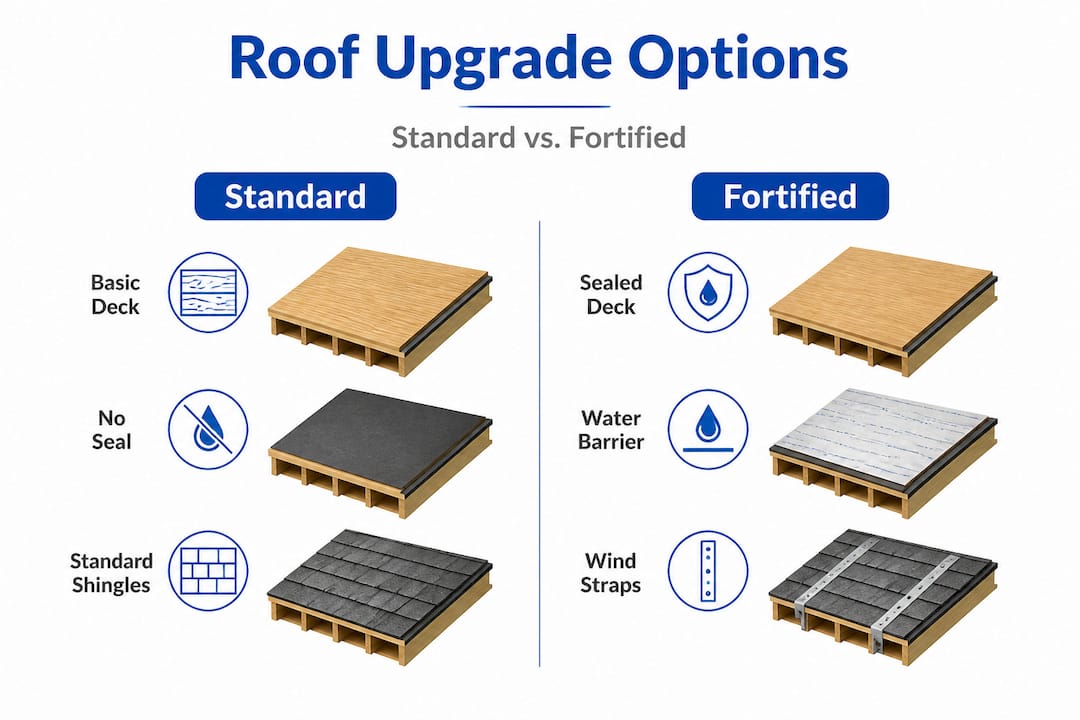
One of the most important lessons learned from Gulf Coast storms over the past two decades is that individual material choices, like switching from standard three-tab shingles to architectural shingles, do not provide adequate protection on their own. Protection comes from how the entire roof system works together. A high-rated shingle installed over an unsealed deck without proper edge metal is still a system that will fail under hurricane-force wind pressures.
Standard approach vs. strengthened system approach:
Feature | Standard installation | Strengthened system |
Roof deck | Single layer, no sealing | Sealed with self-adhering membrane |
Edge metal | Lightweight drip edge | Heavy-gauge, enhanced edge detail |
Shingle attachment | Code-minimum nailing pattern | Enhanced fastening, sealed tabs |
Roof-to-wall connection | Basic toe-nail | Hurricane straps or clips |
Certification | None required | FORTIFIED or equivalent third-party verified |
The FORTIFIED Roof program, developed by IBHS and recognized by the Alabama Department of Insurance, is the most widely tested and documented approach to whole-system roof strengthening available in this state. It requires a sealed roof deck using a fully adhered synthetic underlayment or equivalent, enhanced edge metal fastening to prevent edge peel, and proper shingle-level installation quality, all verified by a certified third-party inspector. Alabama homeowners who achieve FORTIFIED designation often qualify for meaningful insurance premium discounts through several state-recognized carriers.
The Alabama Department of Insurance also confirms that system-level roof upgrades combining uplift resistance, secondary water barriers, and edge detailing consistently outperform single-element upgrades in real storm events. This is not theoretical. Gulf Shores and Orange Beach communities have documented dramatic differences in post-storm outcomes between FORTIFIED-certified homes and non-certified neighbors on the same street.
What a secondary water barrier actually does:
Think of the secondary water barrier as your backup plan when the first layer of protection fails. In a major hurricane, wind-driven rain can get under shingles even when shingles survive. A self-adhering modified bitumen membrane applied directly to the roof deck seals around nails and fasteners, keeping water out of the structure even if the shingles above it are damaged. This single upgrade has prevented tens of millions of dollars in interior water damage across coastal Alabama.
Pro Tip: When getting a roofing bid, ask specifically whether the secondary water barrier will be “fully adhered” or just “mechanically attached.” Fully adhered means it bonds directly to the deck and seals penetrations. Mechanically attached still allows water pathways. In coastal Alabama, fully adhered is the right answer.
For more on what sets coastal Alabama roof inspection tips apart from inland approaches, including how to verify material quality and installation before a storm season, the link covers the specifics in detail.
Installation details: Building a continuous load path
Even the best roofing materials need proper installation to stand up to storms, and here is where structural attachment makes a world of difference.
When a hurricane pushes wind against your home, the pressure is not just horizontal. Roof geometry causes uplift forces that try to peel the roof structure upward and away from the walls. A roof that is simply resting on top of your wall framing, held by toe-nailing alone, is vulnerable to complete blow-off in winds above 90 to 100 miles per hour. The solution is a continuous load path, a structural connection that runs from the roof rafters or trusses all the way down to the foundation.
The core component is the hurricane strap or clip, which is a metal connector that fastens each roof truss or rafter to the wall’s top plate below it. When installed correctly, these connectors dramatically increase the uplift resistance of the entire roof structure. GAF’s technical guidance confirms that hurricane straps and clips are a fundamental mechanical methodology for preventing roof blow-off, and many hurricane-prone areas of Alabama require them in new construction by law.
Steps to verify and improve uplift protection:
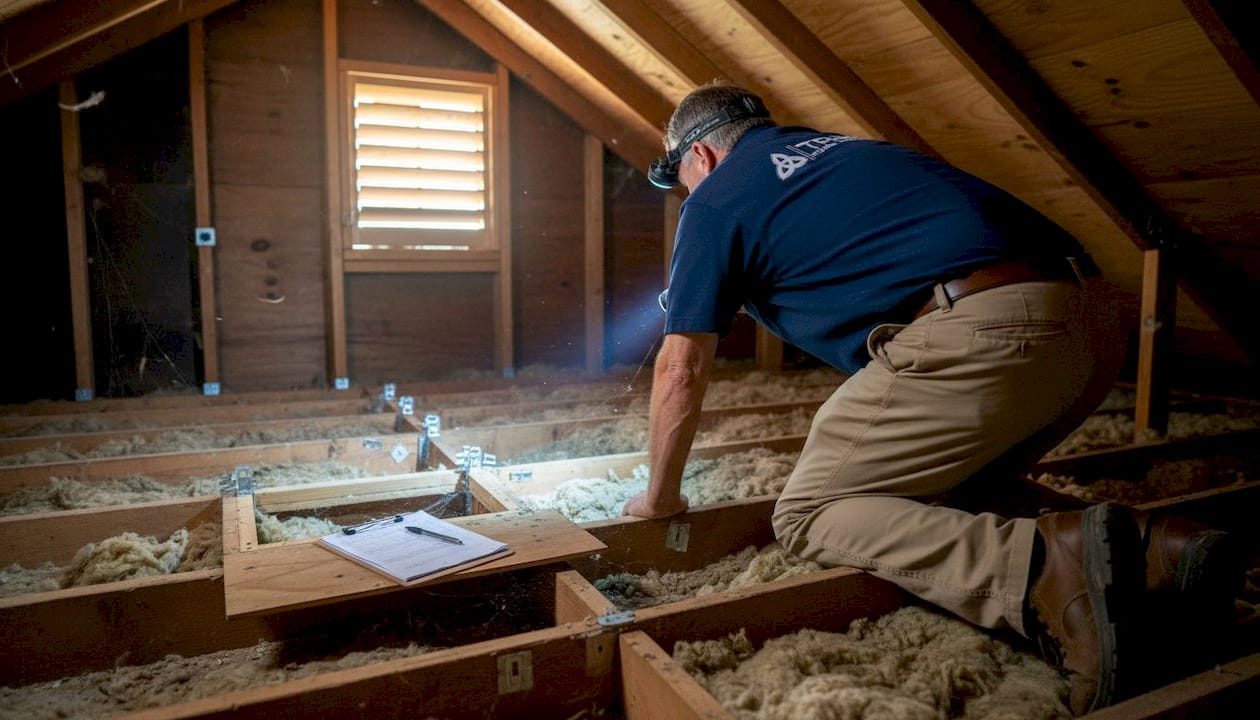
Access your attic and visually inspect the connection point where each truss meets the wall’s top plate.
Look for metal connectors on both sides of each truss-to-wall joint. Single-sided connectors offer less resistance than double-sided clips.
Count the number of nails or screws in each connector. Compare against the manufacturer’s spec sheet for that product. Under-nailed straps provide a fraction of their rated capacity.
Check that the connectors are free of corrosion. Salt air in coastal Alabama degrades uncoated metal quickly. Galvanized or stainless connectors are required in high-wind coastal zones.
Hire a licensed contractor to install or upgrade connectors if any are missing, under-fastened, or corroded.
Request a wind mitigation inspection or report after the work is complete. This document records the upgrade and supports insurance discount applications.
Hurricane strap types and typical uplift capacity:
Connector type | Typical uplift capacity | Best use case |
H2.5A strap (single) | 250 to 440 lbs | Light-frame rafter to top plate |
H10 strap (heavy-duty) | Up to 1,575 lbs | High-wind coastal truss connections |
LSTA strap (long strap) | 540 to 685 lbs | Trusses with limited face surface |
Double-sided clip | 575 to 900 lbs | New construction with clear access |
“Storm-resistant roof upgrades that build a continuous load path from roof to walls are a key mechanical methodology for preventing roof blow-off and represent one of the highest-impact structural improvements available to coastal homeowners.”
For homeowners in southern Baldwin County, a Foley AL home inspection that includes attic access and connector verification is the most reliable way to confirm your current load path status before investing in surface-level improvements.
Emergency actions when a storm is coming—or after damage hits
Preparation is vital, but quick and focused action can also save thousands if your home or rental property is in a storm’s path.
When a storm watch turns into a warning, the window for meaningful preparation shrinks fast. Most homeowners wait too long. By the time a storm is 24 hours out, roofers and tarping crews are booked solid across three counties. The time to act is before the season even starts.
Before a storm arrives:
Walk the perimeter of your home and look for any overhanging branches within striking distance of the roof. Trim them at least 10 feet back.
Clear gutters and downspouts completely. Clogged gutters cause water to back up under the edge of the roof during heavy rainfall.
Check that any skylights, vents, and attic fans are properly sealed and latched.
Move or secure any outdoor equipment, furniture, or decorations that could become wind-borne projectiles.
Photograph your roof from ground level and from any safe upper-floor windows. This creates a pre-storm baseline for insurance purposes.
Confirm your homeowner’s insurance is current and that you have your policy number and adjuster contact saved outside your phone.
After the storm, take these steps immediately:
Do not get on the roof yourself in wet conditions or if structural damage is suspected. Safety first, always.
Walk the perimeter from ground level and note any obvious missing shingles, damaged ridge caps, or lifted flashing.
Document everything photographically before touching anything. Take wide shots, close-ups, and images of any interior ceiling staining or water entry.
If active leaking is occurring into the living space, emergency tarping is the right immediate step to prevent further interior damage while permanent repairs and insurance documentation are arranged.
Call your insurance carrier to open a claim as quickly as possible. Claim queues fill up fast after a major Gulf Coast event.
“After storms, temporary mitigation measures like emergency tarping of active leaks are commonly recommended to prevent further interior damage while permanent repairs and insurance documentation are arranged. Acting fast on this step protects both the structure and the claim.”
Once conditions are safe, scheduling a storm damage inspection with a certified inspector gives you an independent, documented record of damage that carries weight with insurance adjusters and contractors alike. A professional report with photos and thermal imaging is far more persuasive than your own notes when negotiating a repair settlement.
Beyond protection: Safe rooms and life safety for extreme events
Protecting your property is key, but in the face of extreme storms, your safety must come first.
Even the most fortified roof system has limits. A direct hit from a major hurricane or a violent EF3 or EF4 tornado can cause catastrophic structural failure regardless of how well the roof is attached. At that level of event, the conversation shifts from property protection to life safety.
FEMA publishes detailed design and construction guidance specifically for safe rooms for tornadoes and hurricanes. A FEMA-compliant safe room, whether it is a reinforced interior room, an above-ground steel unit, or a below-ground shelter, is engineered to provide near-absolute protection from wind-borne debris and extreme pressures even when the structure around it suffers significant damage.
For families living in coastal Alabama mobile homes or older wood-frame construction, a safe room is not a luxury. Mobile homes, in particular, are at severe risk even in Category 1 storms, and many manufactured housing communities in Monroe, Washington, and Clarke counties sit in areas without nearby public shelters.
For real estate investors, the safe room conversation matters on two levels:
First, a FEMA-compliant safe room is a documented selling feature that appeals to families with children and buyers relocating from other parts of the country who may have less Gulf Coast storm experience. Second, insurance carriers are increasingly factoring life safety improvements into risk profiles for high-value rental properties.
The cost of adding an above-ground safe room to an existing home typically runs from $3,000 to $9,000 depending on size and installation complexity. Compared to the potential cost of a storm-related fatality or total property loss, that investment is straightforward to justify.
What most homeowners get wrong about roof storm protection
While the steps above make your roof stronger, there is a bigger picture many overlook.
After inspecting homes across Baldwin, Mobile, and Escambia counties, the most common mistake we see is not a lack of effort. It is misplaced effort. Homeowners spend real money on upgraded architectural shingles with high wind ratings, and they feel confident. The shingles look great. The warranty literature is impressive. Then a Category 2 storm rolls through, and the entire roof deck peels away because the attachment underneath was never touched.
The shingle is the last line of defense, not the first. A 130-mph-rated shingle installed over a deck that was never sealed and fastened to trusses with only basic toe-nails is a false sense of security. Real protection is a system where every layer, from truss connector to ridge cap, is designed and verified to work together.
This is especially important for real estate investors managing multiple properties across the region. Treating roof wind mitigation as both a physical risk reducer and an insurance opportunity is the right framework, but only if you follow through on FORTIFIED program verification. The program relies on third-party inspection and certification, meaning you cannot self-certify. You need a qualified inspector to verify the work and issue the documentation that triggers the insurance discount. Without that step, you have made the upgrade but left the financial benefit on the table.
We also consistently see homeowners skip the attic inspection as part of their storm preparation. The attic is where you can actually see whether your roof is attached properly, whether moisture has already compromised the deck, and whether any previous storm damage was patched but not repaired correctly. A detailed roof inspection guide walks through what a thorough attic-to-ridge assessment looks like in practice.
The other piece that gets overlooked is documentation timing. Homeowners who have their roof inspected and documented before a storm, and then again after, are in a dramatically stronger position with their insurance carrier than those who call for the first time after the damage is done. Pre-storm documentation removes ambiguity about what was pre-existing versus what the storm caused. That distinction can mean the difference between a full payout and a partial one.
Gulf Coast Alabama is one of the most storm-exposed real estate markets in the United States. That reality deserves more than a new layer of shingles every decade. It deserves a full-system approach, third-party verification, and a paper trail that protects your investment.
Get expert help to storm-proof your roof
Professional support can make roof storm protection far less stressful and far more effective.
Whether you own a single-family home in Fairhope or manage a portfolio of rental properties across Orange Beach, working with a certified inspector before and after storm season gives you a clear, documented picture of exactly where you stand. At Trinity Home Inspections, we walk roofs, access attics, use FAA-licensed drones where boots cannot safely go, and deliver same-day reports packed with photos and video so you have the evidence you need for upgrades, insurance, and negotiations.
[
Before you list a property or close on one, a pre-sale home inspection that covers roof attachment, deck condition, flashing quality, and load path integrity gives both buyers and sellers the clarity to move forward with confidence. We also help investors research property records and permits in Alabama to confirm whether permitted repairs and upgrades were actually completed to code. Reach out today and let us help you build a roof protection plan grounded in facts, not guesswork.
Frequently asked questions
What is the FORTIFIED Roof program and how does it help in Gulf Coast storms?
The FORTIFIED Roof program is a third-party certification system that strengthens roofs with sealed decks, reinforced edge metal, and enhanced fastening, all verified by a certified inspector, and it has a proven track record of reducing hurricane damage in coastal Alabama. Homeowners who achieve this FORTIFIED designation often qualify for insurance premium discounts through participating Alabama carriers.
Are hurricane straps required for houses in Alabama?
Many hurricane-prone areas of Alabama require hurricane straps in new construction by law to help prevent roof blow-off during storms. GAF’s technical guidance confirms that hurricane straps and clips are metal connectors required in these zones to help reduce structural damage.
What should I do if my roof is leaking right after a hurricane?
Immediately document all visible damage with photos and video, then apply emergency tarping to stop active water entry, and schedule a certified inspection as soon as conditions are safe. The American Roofing Guide confirms that emergency tarping is a widely recommended mitigation step to protect interiors while insurance claims are processed.
How can investors benefit from upgrading roofs for storms?
Roof wind mitigation reduces physical risk and can unlock meaningful insurance discounts, but only when upgrades are properly inspected and certified. The Alabama Department of Insurance confirms that FORTIFIED program benefits depend on third-party verification, so investors need certified documentation to realize the full financial return.
Does installing a safe room protect my roof from storms?
Safe rooms are designed primarily for occupant life safety during extreme wind events, not for protecting the roof system itself. FEMA P-361 specifies that safe rooms provide near-absolute protection for occupants, while the roof and structure around them may still sustain significant damage in major storms.
Recommended

