
Do You Need Return Air in Every Room? A Homeowner's Guide

Updated: May 11
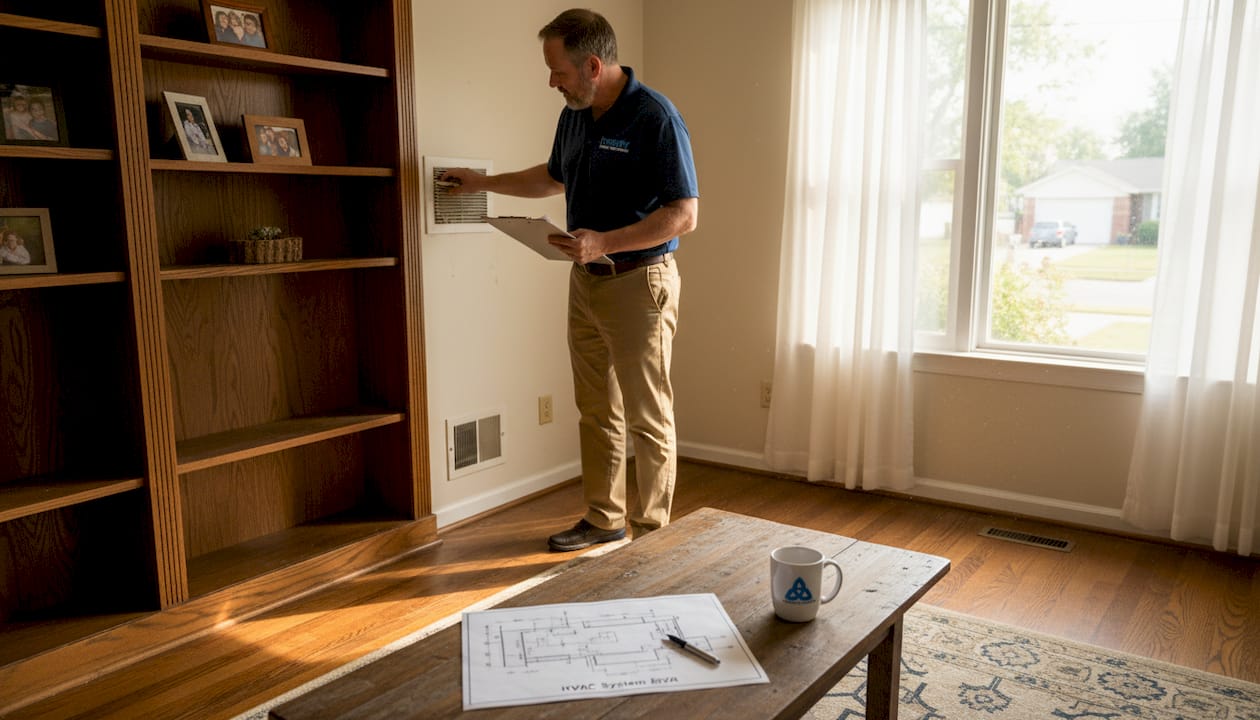
A surprisingly common belief among homeowners is that every room in a house needs its own return air vent for the HVAC system to work properly. If you have ever walked through an older home in Fairhope or a newer build in Spanish Fort and counted the vents in each room, you have probably wondered whether you are missing something. The truth is more nuanced, and understanding it can save you money, prevent unnecessary renovations, and dramatically improve how comfortable your home feels year round, especially in a Gulf Coast Alabama climate where your HVAC system works harder than almost anywhere else in the country.
Key Takeaways
Point | Details |
Balanced airflow matters | Properly designed return air keeps your HVAC system efficient and avoids comfort issues. |
Not every room needs a return | Strategic placement and right sizing are more important than having a return vent in every room. |
Focus on pressure and capacity | Solve comfort and efficiency problems by evaluating air pressure and total return capacity, not just vent quantity. |
Bedrooms may need extra help | Rooms with closed doors or poor airflow benefit from dedicated return pathways or transfer grilles for better air quality. |
Code: Return vs. fresh air | Understand the difference between return air for circulation and ventilation codes to meet home health and safety requirements. |
Understanding return air: What it does for your home
Before you can answer the question of how many return vents you need, you have to understand what return air actually does. Your HVAC system moves air in two directions. Supply air is the conditioned air that gets pushed out through the vents you see in your floors, walls, or ceiling. Return air is the opposite: it is the air that gets pulled back into the system to be filtered, conditioned again, and recirculated. Learning how a cold air return works is one of the most practical things a homeowner can do before making any changes to their system.
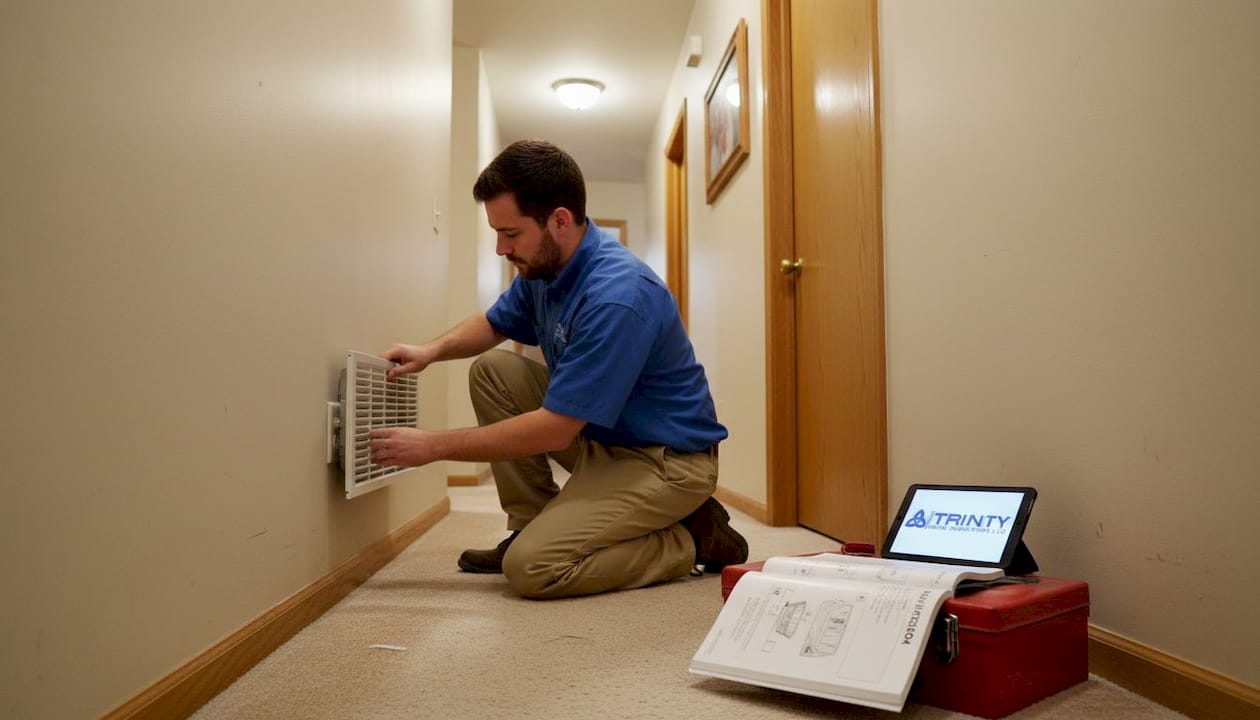
The return side of your duct system is responsible for maintaining balanced air pressure throughout your home. When there is not enough return capacity, your system has to work harder to pull air back in. This creates what HVAC professionals call high static pressure, which is the resistance the blower fan has to fight against. Think of it like trying to breathe through a straw instead of your mouth. The HVAC’s role in home comfort extends far beyond just temperature control. Pressure balance, humidity management, and air filtration all depend on a properly designed return system.
Here are the most important things return air does for your home:
Pulls stale, warm, or humid air back to the air handler for reconditioning
Maintains negative pressure balance on the return side to prevent air stagnation
Feeds the air filter, which protects the blower motor and evaporator coil
Helps distribute conditioned air more evenly by creating a complete loop
Reduces strain on the blower motor, which extends equipment life
Key insight: As return-air sizing is about supplying enough total return capacity and managing duct system pressure, the goal is never simply to count grilles. It is to make sure your system can breathe freely in both directions.
Recognizing the symptoms of poor return air early is critical, because the damage to your equipment builds silently over months before comfort problems become obvious.
Do you need a return air vent in every room?
Here is the direct answer: no, you do not. You typically do not need a return-air vent in every room. What you need is enough properly sized return-air pathways to maintain balanced airflow and pressure across the house. That is a very different goal than placing a grille in every single room.
Most HVAC engineers work from general guidelines that suggest one adequately sized return vent per 600 to 900 square feet of living space, or at minimum one return per floor or major zone of the home. A well-designed system in a 2,400 square foot home might function perfectly with just two or three centrally located return vents, provided those vents are large enough and positioned correctly.
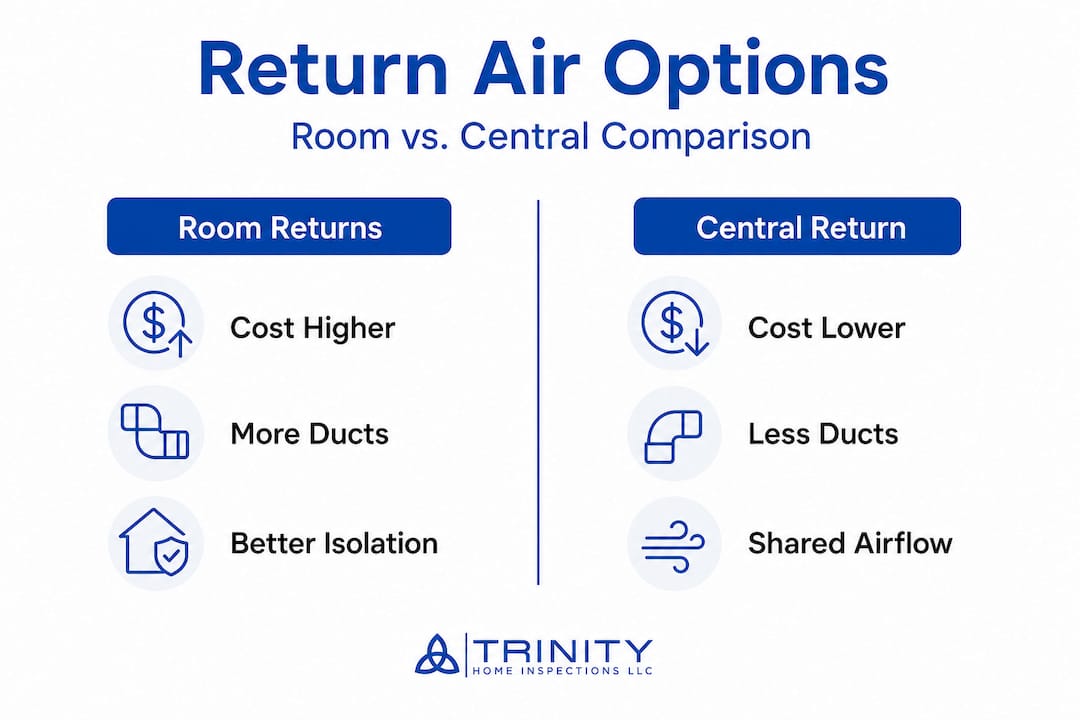
Comparison: Individual room returns vs. centralized return paths
Feature | Individual room returns | Centralized or shared return paths |
Cost | Higher, more ductwork needed | Lower upfront cost |
Comfort with closed doors | Better pressure balance | Can cause stuffiness in closed rooms |
Filter access | More filter points to maintain | Fewer, easier to maintain |
Ideal use case | Bedrooms, closed-off rooms | Open floor plans, hallways |
Noise | Distributed, generally quieter | Can be louder at single large grille |
System flexibility | Good for zoned systems | Best for open layouts |
Pro Tip: Before adding return vents, focus on pressure and airflow data rather than a vent count. An HVAC technician with a manometer (a tool that measures air pressure) can tell you exactly where your system is struggling. Adding vents without this data can actually make some problems worse.
Here is how to evaluate whether your home has adequate return airflow:
Walk through the home with all interior doors closed. Notice whether any rooms feel stuffy, warmer, or less comfortable than the rest of the house.
Hold a piece of tissue near each existing return grille. The tissue should be drawn firmly toward the grille. Weak pull means the return is undersized or blocked.
Check your HVAC filter. A dirty filter that requires changing more than once per month often signals restricted return airflow, not just poor air quality.
Listen for rattling or whistling at return grilles. Noise at return vents is a sign that air is being forced through a restricted opening.
Ask an HVAC professional to measure static pressure at the air handler. Readings above 0.5 inches water column (the standard unit of measure) typically indicate an undersized return system.
Checking for signs of poor return airflow before calling a contractor gives you a clearer picture of what is actually happening in your specific home, and it puts you in a much stronger position when discussing solutions. Good air balancing for efficiency is a professional skill, but knowing the basics helps you ask better questions.
Rooms that benefit most from dedicated return air
Not every room needs its own return, but some rooms suffer noticeably when they do not have one. The main culprit is the closed door. When a room has a supply vent pushing conditioned air in but no way for that air to escape back to the return system, pressure builds up inside the room. This pressurization pushes air out through every crack, gap, and outlet it can find, including gaps around window frames, electrical outlets, and attic access panels.
Bedrooms or rooms with closed doors often benefit from dedicated return pathways, because without them they can become stuffy, develop uneven temperatures, and push conditioned air outside the thermal envelope of the home. In Gulf Coast Alabama, that means you are literally paying to cool your attic or wall cavities instead of your living space.
Rooms that benefit most from a dedicated or supplemental return pathway include:
Primary bedrooms, especially those with solid doors that are closed at night
Home offices and study rooms, where doors are frequently closed for privacy or noise control
Bonus rooms and finished dens located above garages or at the end of long duct runs
Finished basement spaces, though these are less common on the Gulf Coast
Sunrooms or additions that were built after the original HVAC system was designed
Rooms with large windows facing south or west, which gain significant heat in the Alabama summer
Gulf Coast Alabama adds specific challenges that many general HVAC guides do not account for. Humidity levels along the coast in Mobile and Baldwin counties regularly exceed 70 to 80 percent during summer months. A room with poor return airflow holds humidity longer, which means your AC is running but not actually removing moisture effectively. That creates the uncomfortable sticky feeling even when the thermostat reads a cool temperature.
Pro Tip: If adding a full return duct to a bedroom is not practical, a transfer grille or an undercut door (removing about an inch of door clearance from the bottom) can dramatically improve airflow at a fraction of the cost. Transfer grilles are passive vents installed in the wall between a room and a hallway, allowing air to move without creating a direct duct connection. This is a common and code-acceptable solution that many homeowners overlook.
Understanding return air in old houses is especially relevant in Gulf Coast Alabama, where you will find a mix of homes built in the 1960s and 1970s with minimal ductwork alongside newer construction. Older homes are frequently the ones with the most serious return air problems. For more context on how this connects to HVAC and indoor air quality, particularly in high humidity environments, the relationship between airflow and air quality is direct and significant.
How to optimize air return for comfort and efficiency
Knowing which rooms to target is only half the equation. The other half is knowing what specific steps will actually fix the problem. Optimization starts with an honest evaluation of what you have, not with assumptions about what you think you need.
Undersized return pathways can lead to high static pressure, weak airflow, and uneven comfort throughout the entire house. According to the U.S. Department of Energy, HVAC systems that operate under high static pressure can use up to 50 percent more energy than properly designed systems. That number translates directly to higher utility bills every month in a climate where your AC runs for eight or nine months of the year.
Signs your return setup is working—or not
Symptom | Likely cause | Action needed |
Hot or cold spots in rooms | Unbalanced return capacity | Evaluate return sizing per zone |
HVAC filter clogged in 2 to 3 weeks | Return air velocity too high | Add return capacity or enlarge grille |
Whistling or rattling from return grilles | Undersized return opening | Upgrade grille size or add return path |
High humidity in some rooms | Insufficient air circulation | Add return or transfer grille |
HVAC runs constantly without reaching setpoint | High static pressure | Professional duct evaluation needed |
Musty smell from vents | Moisture buildup in return duct | Inspect and clean return duct pathway |
Here is a step-by-step process for troubleshooting common air return problems:
Replace the air filter and note how quickly it gets dirty. A filter that clogs within two to three weeks is a reliable indicator of restricted return airflow, not just a dusty home.
Walk the house with doors closed and use your hand near return grilles to feel for suction. Rooms with no perceptible return pull near the supply vent are candidates for transfer grilles or added returns.
Schedule a static pressure test with a licensed HVAC technician. This is the most reliable diagnostic tool available and typically costs far less than unnecessary duct additions.
Request a Manual D evaluation if your system is being redesigned or upgraded. ACCA Manual D is the industry standard method for calculating duct system sizing. It accounts for your specific home layout, duct lengths, and room-by-room load requirements.
Seal leaky return ducts before adding new vents. A return duct that leaks air in an unconditioned attic or crawl space pulls hot, humid air into your system, which makes everything worse. Mastic sealant or foil tape applied at duct connections resolves most leaks.
Reviewing symptoms of not enough return air before calling a technician helps you describe the problem accurately. And following basic HVAC DIY maintenance tips keeps your system performing between professional visits. Investing in modern HVAC features like variable speed blowers can also reduce the impact of minor return sizing issues by automatically adjusting airflow.
Return air vs. fresh air: What code and comfort require
One of the most common points of confusion for homeowners is the difference between return air and fresh air ventilation. They are not the same thing, and the code requirements for each are completely separate.
Return air is your system recirculating the air that already exists inside your home. It pulls that air back to the air handler, runs it through a filter, conditions it, and sends it back out through the supply vents. This process does not bring in any outdoor air. It is a closed loop.
Fresh air ventilation, sometimes called makeup air or outdoor air intake, is a separate function. It introduces a controlled amount of outdoor air to dilute indoor pollutants, control CO2 levels, and meet building code requirements for habitable spaces. Many HVAC ventilation code requirements are entirely separate from return vents. Return vents are about air circulation and pressure balance. Ventilation codes address outdoor air exchange rates.
Common code and comfort requirements to know:
The 2021 and 2024 International Residential Code (IRC) require whole-house mechanical ventilation in tightly built homes meeting current energy codes
Ventilation rates are typically calculated based on square footage and number of bedrooms
Return vents do not satisfy ventilation code requirements
Bathroom exhaust fans and kitchen range hoods address spot ventilation but not whole-house requirements
Energy recovery ventilators (ERVs) and heat recovery ventilators (HRVs) are the most efficient way to meet whole-house ventilation requirements
Important distinction: Your return air system keeps your HVAC running efficiently and your home comfortable. Your ventilation system keeps your air healthy. Both matter, but fixing one does not fix the other. Homeowners in Gulf Coast Alabama who seal up their homes for energy efficiency often create indoor air quality problems by limiting natural air exchange without adding a mechanical ventilation system.
Understanding Alabama fresh air intake codes is especially important for new construction buyers and homeowners completing major renovations. If your home’s air feels stale even with the HVAC running perfectly, the answer may be ventilation rather than return capacity. For a deeper look at what this means for your health, indoor air quality testing is available and worth considering. Additionally, HVAC efficiency for Southern homes highlights the specific demands that hot, humid climates place on both return systems and ventilation strategies.
What most guides miss about return air—and what truly matters
Most online articles about return air vents focus on a simple rule: one vent per room, or one vent per floor. That guidance is easy to remember, but it misses the actual point almost entirely.
The goal of a return air system is not to install grilles. The goal is to maintain balanced static pressure across the entire duct system so that your HVAC equipment can move the right volume of air through every part of your home. Evaluating return-air capacity and pressure balance using ACCA Manual D-style thinking produces far better outcomes than counting vents on a checklist.
Here is the mistake we see repeatedly when homeowners take a shortcut approach. A homeowner notices that one bedroom feels warm. They call a contractor, who adds a return vent to that room. The problem seems to improve for a week. Then other rooms start feeling different. The system was already borderline balanced, and adding a new return without a full system evaluation shifted the pressure relationships across the whole house. Now there are two problems instead of one.
The better approach is to treat your duct system as a whole. Every addition, every modification, and every change to your home layout (like adding a room or removing a wall) changes how air moves through the entire system. One room’s return problem is often a symptom of a system-wide sizing issue rather than an isolated fix.
We also see this with energy waste in older homes, where the original duct system was designed for a smaller or differently laid-out home. Additions, enclosures, and renovations over the decades create return pathways that no longer serve the actual floor plan. Thermal imaging during a professional inspection can reveal exactly where conditioned air is being lost and where return pathways are falling short, without any guesswork.
Pro Tip: Before spending money on new ductwork, invest in a professional diagnostic evaluation first. A qualified HVAC technician or home inspector using thermal imaging and static pressure testing can show you precisely where your system is losing efficiency. That information is worth far more than a general rule about vent counts.
Get professional support for smarter HVAC and indoor comfort
Your HVAC system is one of the most expensive and comfort-critical components in your Gulf Coast Alabama home. Getting the return air design right protects your equipment, lowers your energy bills, and keeps every room in your home genuinely comfortable even during the peak of a humid Alabama summer.
[

At Trinity Home Inspections, we use thermal imaging (included free with every inspection) to identify insulation gaps, hidden moisture, and airflow irregularities that standard visual inspections miss. Whether you are buying a home in Daphne, selling in Gulf Shores, or evaluating an investment property in Mobile, we give you a complete picture of how your HVAC system is actually performing. Our pre-listing home inspections help sellers identify HVAC and air quality issues before they become negotiating problems. And if moisture or air quality concerns come up during inspection, our mold testing services give you certified lab results with a clear chain of custody. Same-day reports. Real answers. No guesswork.
Frequently asked questions
Can I add a return vent myself, or should I hire a pro?
While simple return grilles can sometimes be added as a DIY project, a professional ensures the vent is properly sized and positioned without disrupting the pressure balance of your entire duct system.
What are symptoms of not enough return air?
Common symptoms include hot or cold spots throughout the house, noticeably low airflow from supply vents, and louder than normal HVAC operation. Return undersizing can lead to high static pressure and weak supply airflow that no amount of thermostat adjustment will fix.
How do I know if my bedrooms need dedicated returns?
Bedrooms that feel stuffy with the door closed, have uneven temperatures compared to the rest of the house, or show noticeably higher humidity are strong candidates for added return capacity or transfer grilles. Bedrooms with closed doors often benefit from dedicated return pathways for exactly this reason.
Are return vents the same as whole-house ventilation systems?
No. Return vents recirculate the air already inside your home back to your HVAC for filtering and reconditioning. Ventilation systems bring outdoor air inside to meet air quality and code requirements. HVAC ventilation code requirements are entirely separate from return vents, and satisfying one does not satisfy the other.
Will more return vents always improve HVAC efficiency?
Not necessarily. What matters most is the total size, placement, and pressure balance of your return system as a whole. Return-air sizing is about total return capacity, not simply installing a grille in every room, and adding vents without a system evaluation can shift pressure relationships in ways that create new problems.
Recommended