
Return air in old houses: Improve HVAC and air quality

TL;DR:
Older Gulf Coast homes often have inadequate return air systems leading to discomfort and mold risks. Upgrading return configurations with transfer grilles, jump ducts, or additional returns can improve airflow and efficiency. Professional inspection and tailored solutions are essential for optimal comfort, air quality, and energy savings.
Many Gulf Coast homeowners assume that if their air conditioner is running, the air is moving correctly. That assumption quietly costs them comfort, higher energy bills, and in humid Alabama summers, real mold risk. The part of your HVAC system most often overlooked is not the unit itself but the return air setup, the network of ducts and grilles that pull stale, warm air back to the system for reconditioning. In older homes across Mobile, Baldwin, and surrounding counties, return air was often designed as an afterthought. Single central returns work reasonably well in small open homes, but they fail in larger or compartmentalized layouts, and the Gulf Coast’s intense humidity amplifies every small imbalance. This article walks you through why that matters and what you can do about it.
Key Takeaways
Point | Details |
Older homes face unique challenges | Compartmentalized layouts and high Gulf Coast humidity make balanced return air essential for comfort and efficiency. |
Modern standards raise the bar | ACCA Manual D recommends room-by-room airflow calculations, which most older setups lack. |
Multiple returns usually work best | Strategically placed returns reduce pressure imbalances and improve air quality in classic Gulf Coast homes. |
Ductless and mini-duct options | Retrofit solutions like mini-ducts or mini-splits are viable for preserving historic features while boosting airflow. |
Getting expert help pays off | A professional inspection ensures your upgrades will boost both comfort and indoor air quality long-term. |
Why return air is different in older Gulf Coast homes
With the basics established, let’s explore what makes old Gulf Coast houses uniquely challenging when it comes to return air.
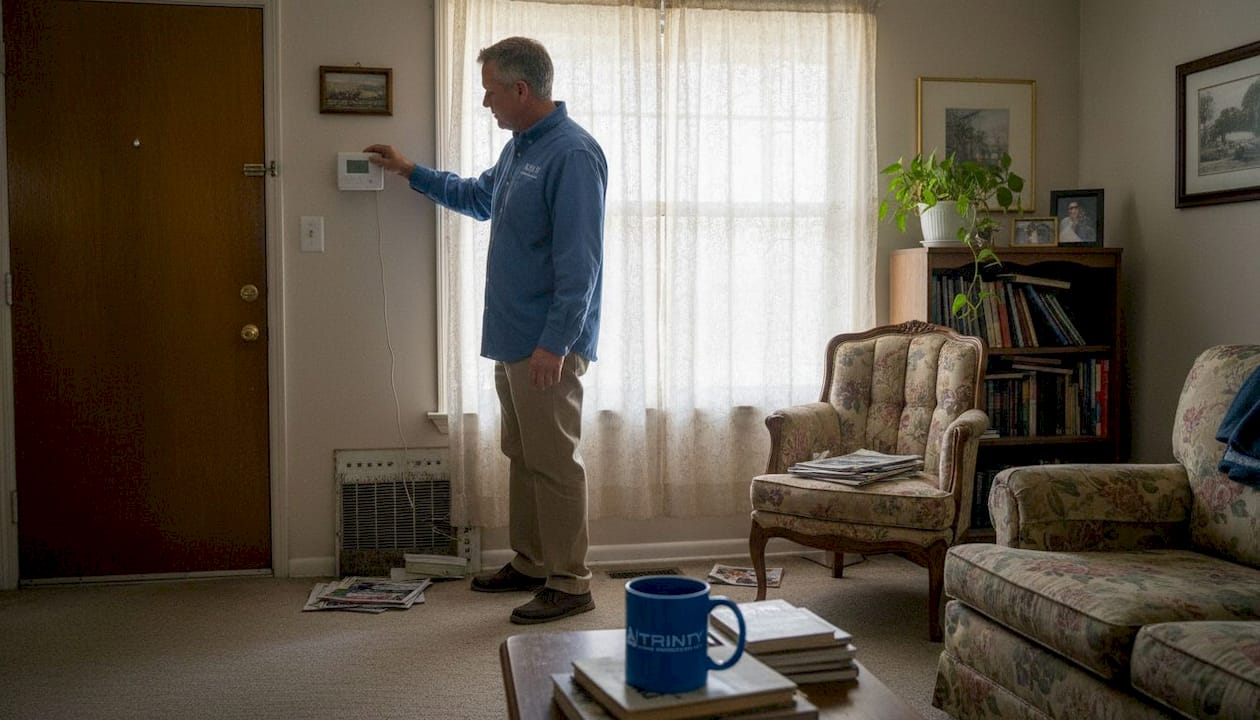
Most homes built before 1990 in this region followed a compartmentalized floor plan. Separate rooms with solid doors and narrow hallways were the norm, not the open concept layouts common in newer construction. That design made the homes feel private and cool-looking on paper, but it created real problems for airflow. When you close a bedroom door in one of these homes, you essentially trap the air that the supply vent pushed in. The system keeps trying to pull air back through the return, but there is nowhere near enough pathway for it to travel. This creates positive pressure in the closed room and negative pressure throughout the rest of the house, and that imbalance is felt as stuffiness, temperature swings, and uneven cooling.
The Gulf Coast climate makes this worse in ways that might surprise you. When indoor air pressure drops in the main living areas, the home draws in outside air through every crack it can find. In Mobile or Daphne in July, that outside air can be 95 degrees with humidity levels above 85%. Your system is then working overtime to cool and dehumidify air it was never designed to handle in those quantities. Even a modest pressure imbalance can add meaningful strain on the equipment and noticeably raise your energy costs.
Here are the most common return air mistakes found in pre-1990 Gulf Coast homes:
Single central return only, typically in a hallway, covering the entire house regardless of square footage or room count
Undersized return grilles that restrict airflow and cause the system to “starve” for air
Returns placed too high on walls, reducing efficiency since warm air rises but cool air settles
Blocked or covered returns from furniture placement or previous renovations
No returns in bedrooms, which is extremely common and causes the pressure imbalances described above
Deteriorated or disconnected duct connections that allow return air to pull from unconditioned spaces like crawlspaces or attics
Older Gulf Coast homes with closed floor plans and a single central return are essentially asking one drain to handle a flood. The pressure imbalances get worse every summer, and the humidity does the rest.
If you want to understand how these setups affect your energy costs specifically, the breakdown of energy-efficient returns in older homes goes deeper into the numbers. And for Gulf Coast-specific humidity control tips, the regional climate factors are laid out clearly. The structural issues and the climate combine to make return air a genuine priority, not a minor detail, in any older home here.
How return air design impacts comfort, efficiency, and safety
Understanding the sources of poor return air leads us to the everyday consequences.
The ACCA (Air Conditioning Contractors of America) publishes a standard called Manual D specifically to govern duct sizing. That standard, which relies on room-by-room load calculations from Manual J, requires return ducts to be sized at least equal to supply ducts and often 20 to 30 percent larger at the grille face. Systems should move roughly 400 CFM (cubic feet per minute) per ton of cooling capacity, with a friction rate of about 0.08 to 0.10 inches of water column per 100 feet of duct. Older homes almost never meet these standards, and the consequences show up in very specific, recognizable ways.
When returns are undersized or poorly placed, here is what happens in sequence:
Uneven temperatures throughout the home. Rooms without returns feel hotter and stuffier, especially bedrooms with closed doors. The thermostat in the hallway reads 74 degrees while the back bedroom is sitting at 80.
Increased dust and airborne particles. When the system can’t pull air back properly, it draws from whatever gaps it can find, including unconditioned attic or crawlspace air loaded with dust, insulation fibers, and sometimes mold spores.
Higher energy bills. A system starved for return air works harder to maintain temperature. The blower motor strains, the compressor cycles longer, and efficiency drops measurably. Studies show HVAC systems with restricted return airflow can lose 15 to 20 percent of their rated efficiency.
Accelerated equipment wear. Low return airflow reduces the cooling effect across the evaporator coil, which can cause the coil to freeze and force the system into damaging cycles.
Mold risk in the Gulf Coast climate. Pressure imbalances draw in humid outside air, and when that humid air meets cool surfaces like ducts and walls near supply vents, condensation forms. In Alabama’s climate, that moisture is a mold invitation.
Safety concerns from combustion appliances. Negative pressure from poor return setups can cause backdrafting in gas water heaters or furnaces, pulling combustion gases including carbon monoxide back into living spaces.
Pro Tip: If certain rooms in your home consistently feel warmer than others even when the AC is running, the first place to investigate is not the thermostat or the outdoor unit. Check whether those rooms have a return air grille and whether that grille is clear and unobstructed.
Understanding symptoms of poor return air early can save you from a costly equipment failure or a mold remediation bill. The not enough return air signs are often subtle at first, but they escalate quickly in our region’s climate. The role of HVAC in home comfort extends far beyond just temperature, and return air is the system’s foundation for doing that job well.
Solutions: Upgrading return air in old houses without major renovation
Now that we see the effects of poor return air, let’s look at smart retrofit solutions tailored to older homes.
The good news is that improving return air does not always require tearing out walls or rebuilding your entire duct system. There are targeted solutions that range from simple and inexpensive to more involved retrofits, and the right choice depends on your home’s layout, existing ductwork, and budget.
Here is a comparison of the most practical options for older Gulf Coast homes:
Solution | Best for | Disruption level | Approximate cost range | Key trade-offs |
Transfer grilles | Rooms with solid interior doors | Very low | $50 to $200 per room | Passes sound between rooms |
Jump ducts | Bedrooms needing pressure relief | Low to moderate | $200 to $500 per room | Requires attic access |
Additional return runs | Homes with accessible ductwork | Moderate | $500 to $1,500 per return | Most effective long-term fix |
Mini-duct high-velocity systems | Homes with no existing ductwork | Moderate | $8,000 to $15,000+ | Preserves walls, small vents |
Ductless mini-splits | Homes requiring zoned cooling | Moderate to high | $2,000 to $5,000 per zone | No central filtration |
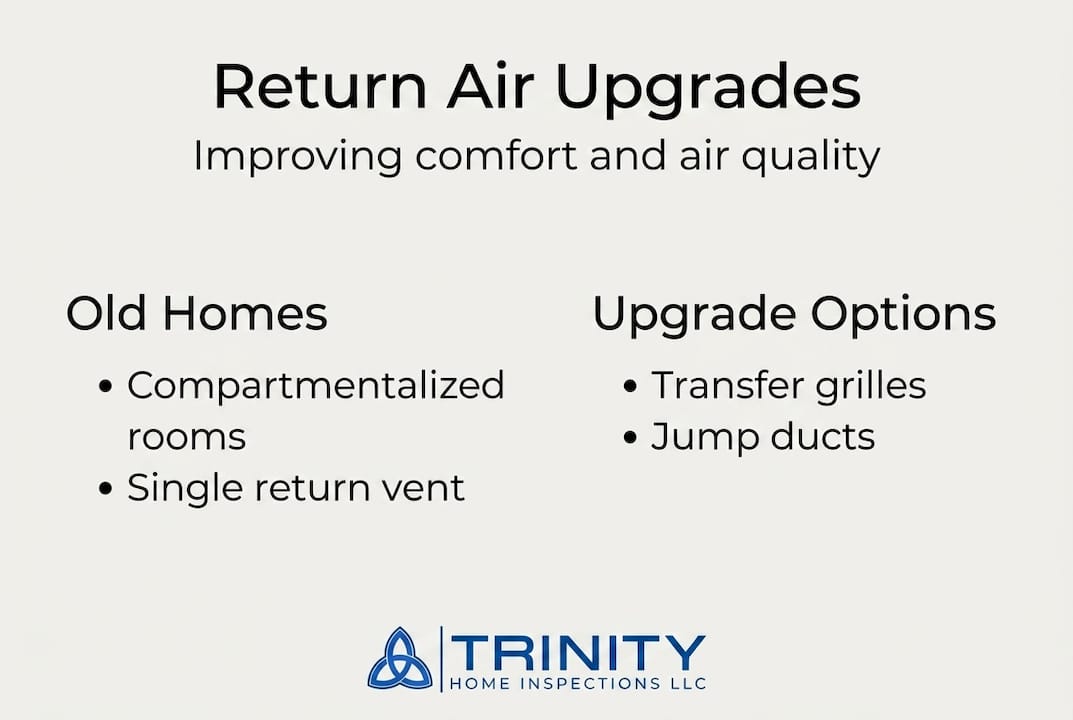
Transfer grilles and jump ducts are the most accessible starting points. A transfer grille is simply a grille installed in the wall or door between a room and the hallway, allowing air to pass through without a full duct run. A jump duct goes through the attic above the room and connects to the hallway ceiling, accomplishing the same goal with slightly better performance. Both options relieve the pressure imbalance in bedrooms without major construction.
Adding dedicated return runs is the gold standard fix for homes with accessible ductwork, typically those with attic-based systems. A qualified HVAC contractor can run new return ducts to problem rooms, connect them to a larger return plenum, and rebalance the entire system to meet Manual D standards. This approach costs more upfront but delivers lasting results in comfort and efficiency.
For historic homes in areas like downtown Mobile or older neighborhoods in Fairhope where ductwork simply does not exist, mini-duct high-velocity systems offer a less invasive alternative. These use small flexible ducts that snake through existing wall cavities and ceiling spaces, requiring only small circular vents rather than traditional large grilles. Ductless mini-splits are another option, though they eliminate central returns entirely and with them the ability to filter all your home’s air through one system.
Pro Tip: Before investing in any return air upgrade, have a qualified HVAC contractor perform a duct leakage test and a Manual J load calculation. Without those numbers, you’re guessing at the right solution. Many contractors skip this step, but it is the only way to know exactly what your system needs.
For guidance on broader HVAC ductwork improvements you can handle yourself, or to understand how cold air returns work mechanically, those resources give you practical detail. Professional duct repair services are worth evaluating once you know what your specific system requires.
Return air and indoor air quality: Boosting filtration and reducing humidity
Optimizing your return air isn’t just about comfort—it’s key to healthy air and moisture control.
The connection between return air design and indoor air quality is one of the most underappreciated aspects of home HVAC. Every cubic foot of air that passes through your return travels through your air filter before being reconditioned and redistributed. If your return is undersized, air bypasses that filter by sneaking through gaps and cracks in the building envelope. You end up with particulates, allergens, and humidity entering your living space without any filtration at all.
There is genuine debate among HVAC professionals about the ideal approach. Some experts strongly advocate for room-by-room return grilles for maximum indoor air quality and system efficiency. Others argue that a well-sized central return designed to Manual D specifications can serve an open or semi-open layout effectively. What most agree on is that older homes with closed floor plans benefit most from multiple returns, and that ductless systems, while comfortable, sacrifice centralized filtration entirely.
Here is how different return configurations perform across key indoor air quality factors in Gulf Coast climates:
Factor | Single central return | Multiple room returns | Ductless mini-split |
Whole-house filtration | Poor in closed layouts | Excellent | None centrally |
Humidity control | Inconsistent | Consistent | Zone-level only |
Allergen reduction | Limited | High | Room-level only |
Mold risk | Higher | Lower | Varies by zone |
System pressure balance | Often unbalanced | Balanced | Not applicable |
For Gulf Coast homeowners, humidity control is not optional. Indoor relative humidity consistently above 60 percent creates conditions where mold colonies can establish within 24 to 48 hours on organic materials like drywall, wood framing, and upholstery. A balanced return system actively pulls humid air back through the filter and across the evaporator coil, where moisture condenses and drains away. An imbalanced system allows humid outside air to infiltrate and bypass that process entirely.
Here are the most impactful steps you can take to improve both return air performance and indoor air quality together:
Upgrade to a MERV 8 to MERV 11 filter on your return. Higher MERV ratings capture finer particles including mold spores and dust mite debris, which are especially problematic in the Gulf Coast region.
Seal return duct connections with mastic sealant or metal-backed tape, not regular duct tape, to prevent the system from drawing in unconditioned air from attics or crawlspaces.
Install transfer grilles in bedroom doors as an immediate, low-cost step to relieve pressure imbalances that drive infiltration.
Schedule a professional duct leakage test to identify exactly where your system is drawing in outside air unintentionally.
Consider a whole-home dehumidifier integrated with the return duct system if your home’s humidity runs consistently high even with a properly functioning AC.
Proper fresh air code compliance for older homes is also worth reviewing, since older homes sometimes lack the mechanical fresh air intake required by modern standards. And if your garage connects to the living space, addressing garage humidity and ventilation is a related step that directly affects your whole-home air quality. Regular attention to these systems, as outlined in guidance on HVAC maintenance for homeowners, keeps your filtration working as designed and extends equipment life significantly.
Our take: What most homeowners miss about return air in old houses
Here is the truth that most articles on this topic gloss over: copying what works in a new construction home almost never works in an older Gulf Coast house. We see this pattern regularly during inspections. A homeowner reads that adding a return to every bedroom is the modern standard, hires a contractor who does exactly that, and then wonders why the system still doesn’t feel right. The problem is that the duct system, the air handler capacity, and the existing return plenum were all sized for the original single-return configuration. Adding returns without recalculating the full system can actually cause new problems, including high return velocity, excessive noise, and uneven pressure across zones.
The Manual D standard exists for exactly this reason. It requires that every change to a duct system be modeled against the actual room-by-room loads, the duct lengths, the friction rates, and the equipment capacity. An older Gulf Coast home with 9-foot ceilings, jalousie windows, and an east-west orientation has completely different load characteristics than a new construction home of the same square footage. Generic fixes treat them the same, and that is where the real money gets wasted.
What actually pays off is a customized approach that starts with understanding your specific home. Layout matters. Ceiling height matters. The direction your home faces matters. The condition of your existing ductwork matters enormously, because leaking ducts in a humid climate are not just an efficiency problem but a moisture and mold delivery system. We believe that a thorough inspection of your existing HVAC setup, including the return air configuration, before any upgrades are made is the single most valuable step you can take. Review the Gulf Coast HVAC energy tips to understand the full picture of what a well-functioning system should look like in this climate. Start with knowledge, not guesswork.
Inspecting and upgrading your old home’s air: Why expert help matters
Ready to tackle your home’s return air the right way? Here’s how Trinity Inspections makes it easy.
Before you invest in upgrades or sign a purchase agreement on an older Gulf Coast home, knowing the actual state of the return air system is your best defense against expensive surprises. At Trinity Home Inspections, we evaluate HVAC ductwork, return configurations, and visible air quality indicators as part of every standard inspection. We include free thermal imaging to spot hidden moisture issues that poor return setups often create, and we document everything with clear photos and video in a same-day report.
[

If mold or air quality concerns come up during the inspection, our mold inspection services include certified lab testing with chain-of-custody documentation, so you have real data to work with. We can also run a home permit search to verify whether prior HVAC work was properly permitted. As an InterNACHI-certified, locally owned team serving Mobile, Baldwin, and surrounding counties, we give you the honest, detailed information you need to make a smart decision about any home.
Frequently asked questions
Why do old houses often have poor return air setups?
Older homes were designed before modern load calculations like Manual J and Manual D were standard practice, which led to undersized, poorly placed, or missing return ducts and grilles that don’t meet current standards. The result is systems that were never properly balanced from the start.
Can I improve return air without tearing up walls?
Yes, options like jump ducts, transfer grilles, and upgraded return grilles can meaningfully improve airflow with minimal disruption, and mini-duct systems can serve historic homes without existing ductwork without invasive construction. The right choice depends on your specific layout and budget.
Do I really need a return in every room?
Not always, because a properly sized central return can work well in open floor plans, but room-by-room returns deliver the best results in older closed-off homes, especially in Gulf Coast climates where humidity makes pressure imbalances more damaging. The answer depends on your specific layout.
How can return air impact humidity control in the Gulf Coast?
Balanced return air keeps the system pulling conditioned interior air consistently across the evaporator coil, which removes moisture effectively, while pressure imbalances from undersized returns draw in humid outside air that the system then struggles to manage. In Gulf Coast summers, that difference directly affects mold risk and comfort.
Recommended