
Return Air Ducts in Crawl Spaces: What Homeowners Need to Know

TL;DR:
Return air ducts can be installed in crawl spaces if properly sealed and insulated.
In Gulf Coast Alabama, moisture control and encapsulation are critical for duct longevity and air quality.
Regular inspection and maintenance are essential to prevent mold, rust, and energy loss.
Most homeowners assume return air ducts simply don’t belong in crawl spaces. It sounds risky, even wrong. But here’s the surprising truth: return air ducts can be placed in crawl spaces, and authoritative sources including the U.S. Department of Energy confirm this is a legitimate HVAC design approach when done correctly. For homeowners across Gulf Coast Alabama, where crawl space homes are common and humidity is relentless, understanding what the codes actually say, what the real risks are, and how to protect your home and your family’s health is genuinely important knowledge. This guide walks you through every piece of that picture clearly and honestly.
Key Takeaways
Point | Details |
Permitting and codes | Return air ducts are allowed in crawl spaces by Alabama code if sealing and insulation standards are met. |
Moisture risks | High Gulf Coast humidity requires extra moisture protection for any return ducts in crawl spaces. |
Professional installation | Expert sealing, insulation, and encapsulation are strongly recommended for reliable system performance. |
Regular maintenance | Inspect crawl space ducts often to catch leaks or moisture issues early and ensure efficiency. |
Are return air ducts allowed in crawl spaces?
A lot of people get this question wrong, and it causes real confusion during home purchases, renovations, and HVAC replacements. The short answer is yes, return air ducts are allowed in crawl spaces. But that permission comes with specific conditions you need to understand before moving forward with any installation or accepting an existing setup in a home you are buying.
Alabama follows a modified version of the 2015 International Residential Code, known as the IRC. Under Alabama’s residential code board regulations, ducts located in crawl spaces are permitted as long as they meet the sealing and insulation requirements outlined in IRC Section M1601. There is no blanket prohibition on putting return air ducts in a crawl space. What the code does require is that those ducts are installed properly so they don’t become a source of energy loss, moisture intrusion, or air quality problems inside your home.
The U.S. Department of Energy is equally clear on this point. Return air ducts and plenums are explicitly permitted in crawl spaces under accepted HVAC design guidelines. The DOE’s guidance focuses on ensuring those ducts are sealed tightly at every joint and insulated to prevent energy waste. This isn’t a technicality or a loophole. It’s an intentional design option, especially useful for homes where running ducts through attic spaces would be inefficient or structurally difficult.
“Ducts that are in unconditioned spaces such as attics, crawl spaces, unheated basements, or garages, typically need more insulation and sealing to prevent energy loss.” — U.S. Department of Energy
Understanding HVAC state code basics and how they apply to your specific home is the foundation of making smart decisions. If you’re buying a home with existing return ducts in the crawl space, or if an HVAC contractor is proposing this type of installation, you now know it’s legally permissible, provided the work meets code.
Here’s a quick summary of the must-follow requirements under Alabama’s adopted IRC:
All duct joints and seams must be sealed with approved materials, typically mastic sealant or metal tape
Ducts must be insulated to meet the minimum R-value requirements for your climate zone
No unsealed gaps, holes, or open connections are permitted
Ducts cannot draw air from spaces that could introduce contaminants, such as areas with standing water or mold
Fresh air intake code requirements still apply to the broader HVAC system design
Statistic to know: Studies show that leaky ducts in unconditioned spaces like crawl spaces can waste 20 to 30 percent of the energy a typical HVAC system produces. That’s a meaningful monthly cost if the installation is done poorly or has degraded over time.
One area many homeowners overlook is the relationship between vapor barriers in crawlspaces and the longevity of duct systems placed there. A properly installed vapor barrier is not just a code requirement in many situations; it’s a protective layer that directly affects how your ducts perform over time.
Benefits and risks of crawl space return ducts in Gulf Coast Alabama
Now that you know it’s legal, let’s talk about whether it’s actually a good idea for your specific situation. The Gulf Coast Alabama region, including areas like Daphne, Fairhope, Foley, Gulf Shores, and Mobile, presents a unique set of conditions that make this question more loaded than it might be in a drier climate. The combination of heat, humidity, and proximity to coastal air creates challenges that don’t exist in most of the country.
The genuine benefits
Running return air ducts through the crawl space instead of the attic does offer real advantages in certain situations:
Shorter duct runs: In homes where the HVAC system is centrally located, a crawl space route can be shorter and more direct than attic routing, which reduces friction loss and improves airflow.
Lower attic heat exposure: In Alabama summers, attic temperatures regularly exceed 130 degrees Fahrenheit. Ducts running through that heat lose significant cooling energy. A crawl space, while humid, is typically cooler than an attic in peak summer heat.
Retrofit flexibility: Older homes with limited attic access or complex roof structures often benefit from routing ducts through the crawl space during HVAC upgrades.
Easier access for future repairs: Crawl spaces, when properly maintained and accessible, can make duct inspection and repair more straightforward than navigating a finished attic.
The serious risks
However, for Gulf Coast Alabama homeowners, the risks of return ducts in crawl spaces are real and deserve serious attention. Crawl space moisture control is one of the most challenging aspects of homeownership in this region, and return ducts add another layer of vulnerability.
Moisture and condensation: When cooled air moves through a duct surrounded by humid crawl space air, condensation can form on the outside of the duct. Over time, this leads to rust, mold, and duct failure.
Mold growth: Humid crawl spaces are already prone to mold. Adding duct work that can develop leaks or condensation accelerates that risk dramatically.
Air quality problems: A leaky return air duct in a crawl space doesn’t just lose energy. It pulls crawl space air, which can contain mold spores, radon, pest debris, and chemical off-gassing, directly into your living areas.
Energy loss: Even minor gaps in duct sealing can allow conditioned air to escape into the crawl space, raising your utility bills significantly.
Common crawlspace issues in coastal Alabama include wood rot, pest damage, moisture intrusion, and mold, all of which become more dangerous when an HVAC return duct is present in the same space.
“For homeowners in Gulf Coast Alabama, return air ducts in crawl spaces are feasible but high-risk without encapsulation, sealing, and insulation due to extreme humidity.” — U.S. Department of Energy guidance
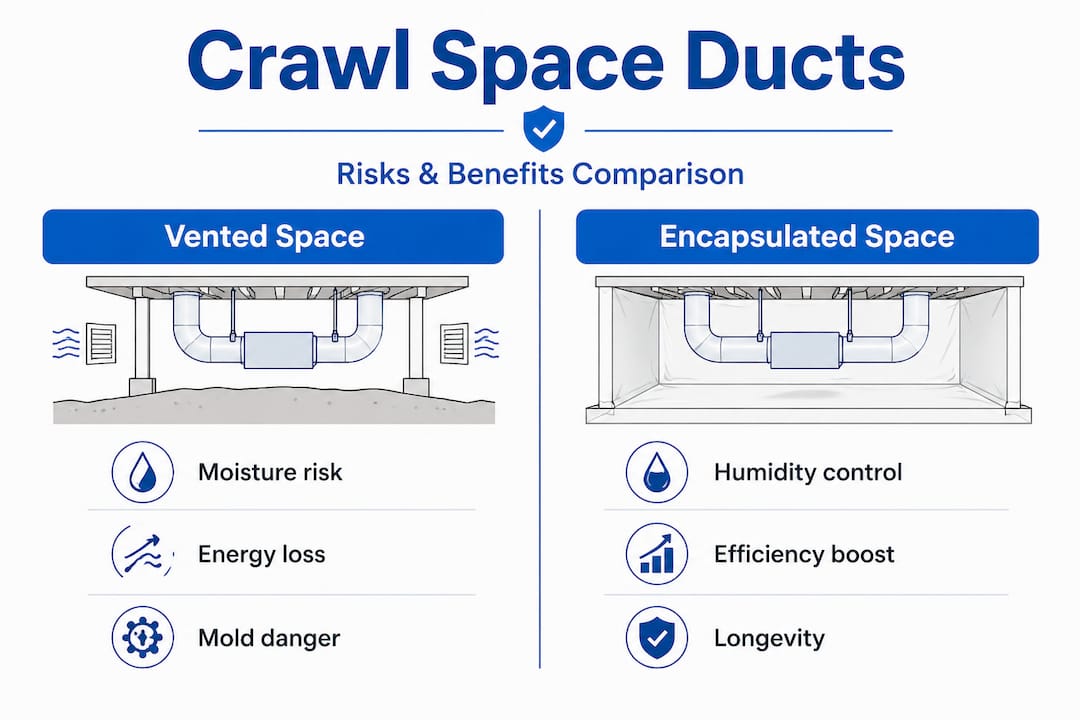
Here is a straightforward comparison to help you weigh your options:
Factor | Vented crawl space (no encapsulation) | Encapsulated or conditioned crawl space |
Moisture risk | Very high | Low to moderate |
Mold risk | High | Low |
Energy efficiency | Poor | Good |
Duct longevity | Short (5 to 10 years) | Long (15 to 20+ years) |
Code permissible | Yes, with sealing/insulation | Yes, and preferred |
Recommended for Gulf Coast AL | Not without major upgrades | Yes |
Pro Tip: If you’re buying a home with return ducts in the crawl space, ask whether the crawl space is encapsulated or conditioned. If it isn’t, budget for that upgrade before the HVAC system causes indoor air quality issues. It’s one of the most impactful investments you can make in a Gulf Coast Alabama home.
The bottom line is this: return ducts in crawl spaces can work well, but only when the crawl space itself is properly managed. In Gulf Coast Alabama’s climate, that almost always means encapsulation, dehumidification, and professional duct sealing. Skipping any of those steps is where homeowners run into expensive problems.
Key code requirements for safe, efficient installations
Understanding the risks makes the next step clear: if you’re going to have return ducts in a crawl space, every requirement needs to be met, and preferably exceeded. Let’s walk through what Alabama’s adopted IRC and DOE guidance actually require.
Ducts in unconditioned crawl spaces must be both sealed and insulated to prevent energy loss and moisture infiltration. The DOE recommends professional sealing using mastic sealant or metal foil tape at all duct joints, and insulation wrapped consistently along the duct’s entire length. Under Alabama’s code requirements, the minimum insulation R-value for ducts in unconditioned spaces is R-6, though best practice in Gulf Coast conditions pushes toward R-8 or higher.
Here are the numbered steps that represent a compliant, properly executed return duct installation in a crawl space:
Assess the crawl space first. Before any duct work is installed or inspected, the crawl space itself must be evaluated for moisture levels, existing mold, pest activity, and structural condition.
Install or verify a vapor barrier. A continuous vapor barrier covering the ground surface is required in most crawl space applications. It must extend up foundation walls and be properly secured.
Seal all duct joints with approved materials. Mastic sealant is the industry preferred option. Metal foil tape is also acceptable. Duct tape, despite its name, is not approved for permanent duct sealing under code.
Insulate the full length of the duct. Every inch of the return duct exposed to the unconditioned crawl space must be insulated. No gaps, tears, or compressed sections are permitted.
Support ducts properly. Ducts must be supported at regular intervals so they don’t sag, which can cause joints to separate over time.
Verify airflow design. The return air system must be sized correctly for the HVAC unit it serves. Undersized return ducts restrict airflow and reduce system efficiency significantly.
Requirement | Code minimum | Best practice for Gulf Coast AL |
Duct sealing material | Mastic or metal foil tape | Mastic sealant at all joints |
Duct insulation (R-value) | R-6 | R-8 or higher |
Vapor barrier | Required in most configurations | Fully encapsulated with sealed seams |
Dehumidification | Not specifically required by code | Strongly recommended |
Duct support spacing | Per manufacturer specs | Every 4 feet maximum |
Crawl space humidity target | Not specified by code | Below 60% relative humidity |
Crawlspace dehumidification is one of those areas where code minimums simply aren’t enough for Gulf Coast conditions. The code doesn’t require a dehumidifier, but in practice, a crawl space in Mobile or Baldwin County without active humidity control will regularly hit 80 to 90 percent relative humidity during summer months. At that level, mold begins to grow on most organic materials within 24 to 48 hours.
Managing humidity control year round is not optional in this region. It’s a core part of protecting both your home and the people living in it.
Pro Tip: When evaluating an existing crawl space duct installation, look for any sections where insulation has fallen away or compressed. Those unprotected sections are exactly where condensation forms first and where mold and rust start their damage. A thermal imaging camera can reveal these problems even when they’re not visible to the naked eye.
Smart strategies: Moisture control and maintenance
Beyond the initial installation, long-term maintenance is what separates a return duct system that serves your home well for two decades from one that causes mold problems in three years. This is especially true in Gulf Coast Alabama, where seasonal humidity swings are extreme and properties near water face additional moisture pressure.
Sealed and insulated ducts are the starting point, but regular maintenance keeps them performing the way they should. Here’s a practical process for inspecting and maintaining your crawl space return ducts:
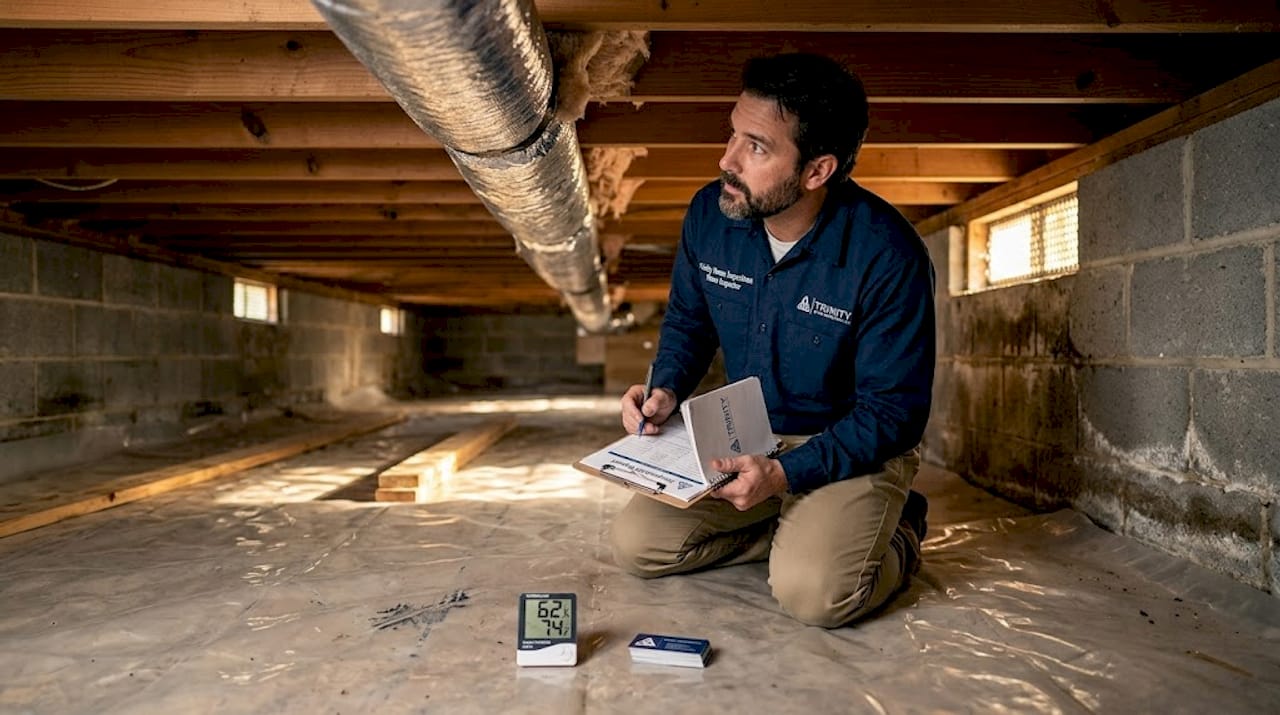
Inspect at least twice per year. Early spring before cooling season and late fall before heating season are the best times. Bring a flashlight, a moisture meter, and a phone camera.
Look for visible condensation or rust. Any rust on metal duct sections or water staining on insulation is a red flag that moisture is getting in where it shouldn’t.
Check insulation continuity. Walk or crawl the full length of the duct run and look for sections where the insulation jacket has torn, slipped, or been compressed by debris or pests.
Test joint connections. Gently press on duct joints and seams. Any movement or airflow you can feel means a seal has failed and needs resealing.
Monitor crawl space humidity. A simple digital hygrometer left in the crawl space gives you ongoing readings. If you see levels above 60 percent consistently, your dehumidification strategy needs adjustment.
Look for pest activity. Rodents and insects are attracted to the warmth of ducts and can chew through insulation and even duct materials. Any evidence of nesting or chewing needs immediate attention.
HVAC maintenance tips that you can handle yourself go a long way toward catching small issues before they become expensive repairs. But some things require a professional eye, particularly when moisture damage or mold is suspected.
Recommended upgrades that make a measurable difference include:
Full crawl space encapsulation: A sealed, closed-cell foam or heavy-duty polyethylene barrier that covers walls and floor completely, reducing humidity infiltration dramatically
Dedicated crawl space dehumidifier: A unit rated for your crawl space square footage, connected to a drain or condensate pump, running continuously during humid months
Duct cleaning and resealing: A professional duct cleaning every five to seven years removes debris accumulation and gives a trained technician the opportunity to identify and reseal any failed joints
Air quality testing: If you’ve had moisture issues in the crawl space, testing indoor air quality gives you confirmation of whether contaminants are reaching your living spaces
Crawlspace ventilation strategies vary depending on whether your crawl space is vented or sealed, and those two approaches require very different maintenance routines. Understanding which type you have is the starting point for building the right maintenance plan.
Pro Tip: Add a crawl space humidity reading to your home maintenance calendar, just like changing HVAC filters. A $15 hygrometer placed in the crawl space can give you readings that prevent thousands of dollars in duct and structural damage. It’s one of the highest return, lowest cost maintenance habits available to Gulf Coast homeowners.
What most guides miss about Gulf Coast crawl spaces
Here’s something that most online guides on this topic won’t tell you: following the code is not the same as protecting your home. In Gulf Coast Alabama, meeting the minimum code requirements for return ducts in crawl spaces is just the beginning of what you actually need to do.
We see this directly in our inspection work. Homes with duct systems that passed their original code inspection and were signed off years ago are showing early duct failure, mold contamination, and compromised indoor air quality today. Why? Because the code sets a floor, not a ceiling. And in a climate like ours, the floor is not high enough to guarantee long-term performance.
The uncomfortable reality is that a vented, unconditioned crawl space in Baldwin County or Mobile County is a genuinely hostile environment for HVAC equipment. The humidity doesn’t just cause condensation on cold surfaces in summer. In transitional seasons, when outdoor temperatures swing and the HVAC cycles less frequently, moisture levels in an unmanaged crawl space can remain dangerously high for weeks at a time. That extended exposure is what causes real damage.
Common crawlspace issues in coastal Alabama like wood rot and mold are not isolated problems. They share the same root cause as early duct failure: unmanaged moisture in a space that was never designed to handle Gulf Coast conditions without active intervention.
What we tell our clients is this: encapsulation and active dehumidification are not luxury upgrades in this region. For any home with return ducts in the crawl space, they are practically required for the system to perform safely and last as long as it should. Contractors who tell you otherwise may not be thinking about the full picture of what Gulf Coast humidity actually does to materials over time.
Smart homeowners in this area plan beyond code compliance. They treat their crawl space as part of the home’s living envelope, not as an ignored void beneath the floor. That mindset shift changes everything about how you evaluate, maintain, and protect your HVAC system and your indoor air quality.
Expert help for safe, efficient crawl space HVAC
If you’ve read this far, you understand that crawl space return ducts are a legitimate option, but one that requires real attention to detail and ongoing care. For Gulf Coast Alabama homeowners, the stakes are higher than in most parts of the country because our climate doesn’t forgive shortcuts.
[

At Trinity Home Inspections, we inspect crawl spaces as part of every standard home inspection, and we go further with tools like thermal imaging and moisture meters to identify problems that aren’t visible to the eye. If you’re buying a home with return ducts in the crawl space, our same-day reports give you the clear picture you need before closing. We also offer mold inspection and testing to give you lab-verified confidence about air quality when moisture history is a concern. Sellers benefit from our pre-sale home inspection services, which can identify crawl space and HVAC issues before they become negotiating surprises. Reach out to Trinity Home Inspections today and get the honest, thorough evaluation your home deserves.
Frequently asked questions
Are return air ducts in crawl spaces allowed by Alabama codes?
Yes, Alabama’s residential code allows return air ducts in crawl spaces as long as the ducts are properly sealed and insulated in accordance with IRC M1601 requirements, with no blanket prohibition in place.
Why is moisture control so important for return ducts in Gulf Coast crawl spaces?
The extreme humidity common to Gulf Coast crawl spaces creates conditions where condensation, mold, and duct material breakdown happen quickly, and without proper encapsulation and sealing, those problems migrate directly into your home’s air supply.
What should I look for when inspecting crawl space return ducts?
Check every duct joint and seam for tightness, confirm that insulation is intact and continuous along the full duct run, and look for any rust, water staining, or mold growth, because sealed and insulated ducts are essential to prevent both energy loss and contamination.
Can I install return ducts in a vented, unsealed crawl space?
It is technically permitted under code, but experts strongly advise against it in Gulf Coast Alabama unless the crawl space is first encapsulated or conditioned, because the moisture risks in an unsealed space will degrade duct performance and indoor air quality much faster than in a controlled environment.
Recommended