
Hiring a Home Inspector in Robertsdale, AL: A Buyer's Checklist

The right home inspector for a Robertsdale purchase is a state-licensed one whose written scope matches the house you are buying, who shows you a sample report before you book, and who can get into the property inside your contract’s inspection window. Trinity Home Inspections is a family-owned, InterNACHI-certified company serving Baldwin County, and this checklist is the same set of questions we would want a friend to ask before hiring anyone, including us.
A house on a slab inside town and a farmhouse on acreage with a private well and septic system are both “Robertsdale homes,” but they need different questions. We cover both below.
Start With the License, Not the Reviews
Alabama regulates home inspectors through the Division of Construction Management. Under the state’s home inspector registration rules, an inspector needs a current license, and that license is valid only for its calendar year. That gives you a simple first question: is your inspector licensed for this year?
The same rules tell you what stands behind a license:
Membership in a recognized inspector association (ASHI, InterNACHI and others are named), or equivalent certification and experience.
Either 120 hours of approved education plus 35 supervised inspections, or 35 hours plus 100 supervised inspections.
Passing the National Home Inspector Examination and the ASHI Standards and Ethics exam.
At least $250,000 in errors-and-omissions insurance.
15 hours of approved continuing education each year.
Every Trinity inspection is performed by an InterNACHI-certified inspector who has completed the National Home Inspectors Exam and the Standards of Practice and Code of Ethics exams, with continuing education every year. Trinity inspectors also carry FAA drone training and licensing, which matters when a roof is too steep, wet or fragile to walk. Our work is backed by the InterNACHI Honor Guarantee up to $25,000.
If something ever goes wrong with any inspector, the Division of Construction Management has a complaint form on its inspection page. Knowing that channel exists is part of hiring with confidence.
Read the Scope Before You Book
Before you pay a deposit, ask which standard of practice the inspector follows and ask to read the inspection agreement. Scope differs by property, inspector and agreement, as State Farm’s guidance on what inspectors check points out.
What a standard inspection looks at
Alabama’s Standards of Practice have inspectors examine readily accessible, installed systems and report components that are significantly deficient or near the end of their service life, with the reason and a recommended correction or follow-up. The Alabama REALTORS describe the typical walk-through this way:
Exterior and grounds: foundation, drainage, siding, gutters, shingles, chimneys.
Attic: insulation, vents, electrical splices.
Kitchen and bathrooms: plumbing fixtures and leaks.
Electrical: wiring and the service panel.
Heating and cooling.
Plumbing: water pressure, hot water temperature, leaks.
At Trinity, thermal imaging is included at no extra cost. It helps show insulation gaps, possible moisture issues and overheated electrical components. We also use moisture meters to confirm suspected leaks, a carbon monoxide detector, and a combustible gas detector for natural gas or propane.
What the standard report does not cover
The same standards leave out concealed or inaccessible conditions, environmental hazards, pest presence, underground items, recreational facilities, engineering, code compliance, and repair methods or costs. Fannie Mae’s buyer guide adds that a report does not determine the cause of a condition, insurability or how long a system will last.
That is why the add-ons in the section below exist. A good inspector tells you up front which ones fit your house.
Two Robertsdale Homes, Two Sets of Questions
We make no claims about every property in town. Houses vary by builder, age and lot. What follows is a way to match your questions to the kind of home you are considering.
The in-town slab home
A slab-on-grade house has no crawl space to enter, so the inspector’s attention shifts to what can be seen from the outside and the attic. Questions to ask:
How do you evaluate the foundation and drainage? Ask whether the report covers visible slab cracking, grading near the walls, and whether gutters and downspouts move water away from the house.
Will you use thermal imaging? On a slab home with plumbing in the walls and ceiling, a thermal camera paired with a moisture meter helps confirm whether a stain is active. Ours is included.
Is the home on municipal sewer? If so, ask about a sewer scope, a camera run through the main line. It looks at the one stretch of plumbing you cannot see. We offer sewer scope inspections for exactly this.
How will you look at the roof? Ask whether a drone is used when the pitch or the weather makes walking it unsafe.
What about the attic? Insulation depth, ventilation and electrical splices are all attic items worth confirming are part of the scope.
The rural home with a private well or septic
Outside town, the house may bring its own water and wastewater systems, and those are mostly underground. State Farm’s guidance lists underground sewer, septic and well systems among items that typically need separate specialists, and the Alabama standards exclude underground items from a general inspection.
Which systems does the property have? Ask the seller or agent early whether it has a well, a septic tank, or a grinder pump, so you can book the right services in time.
Does your company handle the well? Trinity offers private well inspections and grinder pump inspections as services alongside the general inspection.
Who evaluates the septic system? A septic tank is buried, so ask your inspector how it will be addressed and arrange a licensed septic specialist for the tank itself if it is not part of the scope.
How much land and how many buildings? Detached garages, barns and shops are often outside a standard scope. Ask whether they are included and whether there is an added fee.
Is there a pool or spa? Standards exclude recreational facilities from the general inspection, so confirm in writing whether it will be looked at. We offer pool inspections.
Is the house a manufactured home? We also provide mobile home inspections and a mobile home engineer certificate, which lenders sometimes ask about.
Question | In-town slab home | Rural home with well or septic |
Foundation access | Slab, viewed from outside and at floor level | Varies: slab, piers or crawl space |
Sewer | Ask about a sewer scope if on municipal sewer | Septic tank needs its own evaluation |
Water | Municipal supply, check pressure and plumbing | Private well, ask about a well inspection |
Extra structures | Often just a garage or shed | Barns, shops, detached buildings |
Time on site | Shorter, usually | Longer, so ask about scheduling |
Add-On Inspections Worth Asking About
These are the extras buyers around Baldwin County most often hear about:
4-point inspection. A focused look at roof, electrical, plumbing and HVAC. Houzeo’s 2026 Alabama buyer guide notes insurers commonly require one for older homes, so ask your insurer first. Our 4-point insurance inspection guide walks through it for Gulf Coast buyers.
Wind mitigation. This documents hurricane-resistant features that may lower coastal insurance costs, according to the same Houzeo guide. For a primer on how roof wind features are evaluated, see this piece on roof wind mitigation basics.
Mold and air quality testing. If you see staining, smell mustiness or a moisture meter flags damp areas, mold testing and indoor air quality testing give you data instead of guesses.
Wood-destroying organism (WDO) inspection. The Houzeo guide notes FHA and VA loans typically require one. Ask your lender.
Prices for these depend on the property, so request a quote for your specific house rather than relying on a per-square-foot rule.
Ask for a Sample Report
The report is the product you are really buying, so see one before you book. When you read a sample, look for:
Photos next to each finding. You should be able to see the problem without a long phone call to decode it.
Video where it helps. Moving footage, such as a sewer scope run, shows more than a still image.
Clear severity. The Alabama REALTORS advise buyers to focus on the severity of defects rather than their number, because most homes have a few small items. A report that separates safety concerns from routine maintenance makes that easy.
A list of what was not inspected and why. Alabama’s standards require inspectors to list required systems that were present but not inspected, with the reason.
Delivery time. Our reports are photo and video-rich and delivered the same day, which helps when you are working against a contract deadline.
Once you have a report in hand, our guide on how to interpret inspection reports shows how to sort what matters from what does not. For typical findings along the coast, see common home inspection findings in Gulf Coast Alabama.
Scheduling and Access
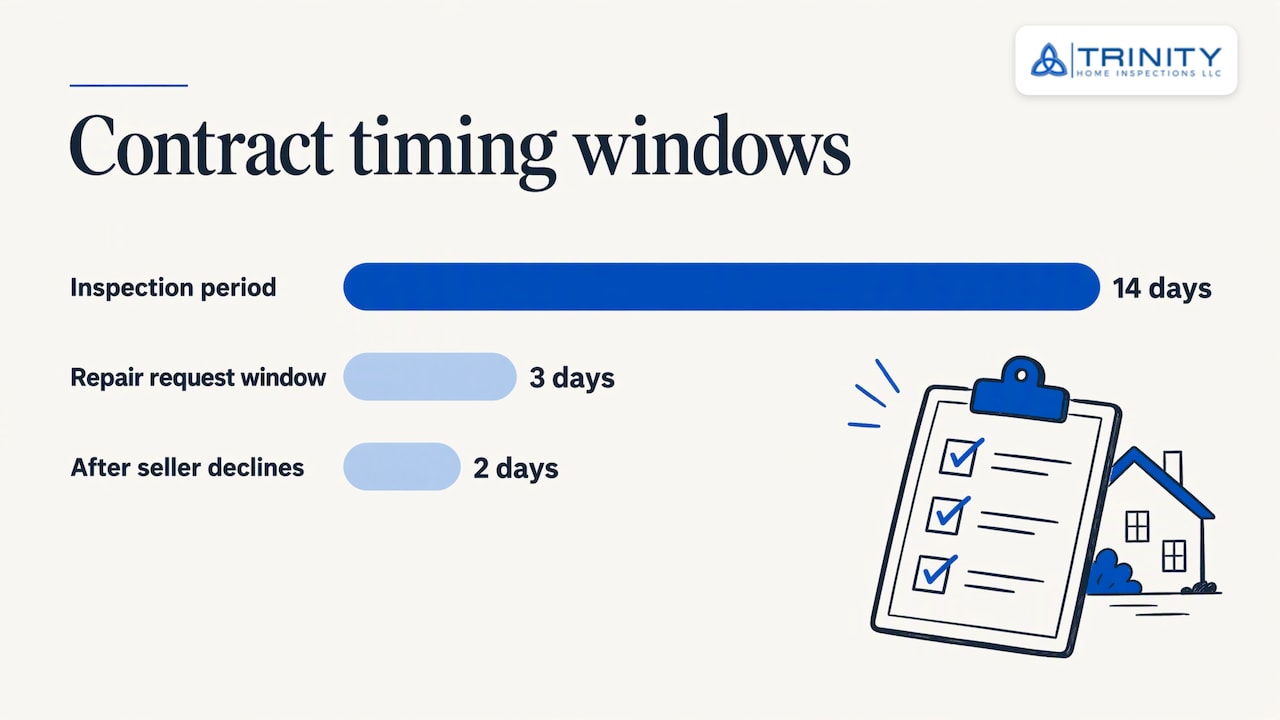
Timing is where good inspections get squeezed. Alabama is a buyer-beware state, which means you are responsible for determining the property’s condition. The 2025 Alabama REALTORS Residential Purchase Agreement sets the standard inspection period at 14 days from acceptance if the blank is left empty, with 3 days after that period to cancel or request repairs. If the seller declines your repair requests, you then have 2 days (if left blank) to decide your next move. Check your own contract for the exact numbers, since parties can change them.
With that clock running, these scheduling questions matter:
How soon can you inspect? Book as soon as the contract is signed, and book add-ons at the same time so they do not run past the window.
Will utilities be on? Power, water and gas need to be active so systems can be tested. The same agreement caps a seller’s re-inspection fee at $200 if utilities are off.
Is everything reachable? Attic hatches, the electrical panel, water heater and the garage should be clear. Standards cover readily accessible items, so a locked gate or stacked boxes can leave something un-inspected.
Who will attend? You schedule and pay for the inspection, as the Alabama REALTORS explain. Being there for the last part of the visit lets the inspector show you findings in person.
Who gets the key? Confirm how the inspector gets in and whether your agent will be present.
Is there a well, septic or pool? Tell the inspector ahead of time so the right equipment and time are set aside.
If you are a real estate agent reading this for clients, sending the inspector the property’s features (slab, well, septic, outbuildings) when you book prevents most scheduling surprises.
After the Inspection
The report is a snapshot of condition, not a verdict. Sort findings into safety concerns, items needing a licensed contractor, and routine maintenance. For larger repairs, Houzeo suggests getting two to three written estimates from licensed contractors before you negotiate. Your inspection contingency is what lets you ask for repairs or a price reduction, and our explainer on the home inspection contingency covers how it works.
When someone calls us about a Robertsdale house, the first thing we ask is what kind of property it is. A slab home on city utilities and a country home with a well and septic need different tools and a different amount of time, and we would rather plan that before the appointment than discover it during. We believe a report should tell you the truth, not what someone wants to hear. That is why we use thermal imaging, moisture meters, gas and carbon monoxide detectors and drones as part of the work, and why we deliver photo and video-rich reports the same day. You get the information while you can still use it. We are family owned and we treat your purchase the way we would treat our own family’s. Ask us anything before you book. We would rather you be comfortable than rushed. Matt
Our Perspective
What’s Included With a Trinity Inspection
Our general home inspection covers the home’s accessible structure, roof, exterior, interior, electrical, plumbing and heating and cooling systems, with free thermal imaging and a same-day photo and video report. When a property calls for more, we offer sewer scope inspections, mold testing, indoor air quality testing, pool inspections, private well inspections, grinder pump inspections, drone roof views, new construction and pre-drywall inspections, and 11-month warranty inspections. Sellers can order a pre-listing inspection, and investors and commercial buyers can use our commercial building inspections.
You can see how we work in Robertsdale on our Robertsdale home inspection page, or see all of our inspection services.
[
Ready to book? Call 251-210-7376 or visit TrinityInspectionsLLC.com.
FAQ
How much does a home inspection cost in Robertsdale?
Price depends on the home’s size, age, foundation type, number of systems and any outbuildings, so a flat per-square-foot figure is rarely accurate. Two houses of the same size can take very different amounts of time. Ask for a quote based on the specific address and list any add-ons you want.
What is not included in a standard home inspection?
Alabama’s Standards of Practice exclude concealed conditions, environmental hazards, pests, underground items, recreational facilities, engineering, code compliance and repair costs. Items like mold, a sewer line, a well or a pool can be added as separate services. Your inspection agreement lists exactly what applies.
How long do I have to inspect a house in Alabama?
Under the 2025 Alabama REALTORS purchase agreement, the default is 14 days from acceptance if the blank is left empty, plus 3 days afterward to cancel or request repairs. Your contract may differ, so confirm the dates with your agent and book as early as you can.
Should I be at the inspection?
It helps. Being present for the final walk-through lets the inspector show you what they found and answer questions on the spot, and the written report then makes more sense when you read it.
Sources
Recommended