
LVP vs Tile: Best Flooring for Gulf Coast Homes

Updated: Apr 17
TL;DR:
Proper installation and subfloor prep are crucial to prevent long-term flooring issues in Gulf Coast homes.
A hybrid approach using tile in wet areas and LVP in living spaces offers optimal durability and comfort.
Both materials handle humidity well if moisture barriers and maintenance guidelines are properly followed.
Choosing between LVP and tile flooring sounds straightforward until you factor in Gulf Coast Alabama’s humidity, slab-on-grade foundations, and what buyers actually respond to during showings. Most homeowners and sellers assume one option is universally better, but the real answer depends on the room, the subfloor, the budget, and how long you plan to stay. Get it right and you protect your investment. Get it wrong and you could be dealing with warped planks, cracked grout, or mold hiding under a floor that looked perfect on day one. This guide walks you through core differences, real-world performance, cost and ROI, installation specifics, and the hybrid strategy that consistently delivers results in Gulf Coast real estate transactions.
Key Takeaways
Point | Details |
No one-size-fits-all | The best flooring depends on your needs, room, and resale plan. |
Tile leads in humid areas | Porcelain tile offers unmatched durability and waterproofing—ideal for baths and kitchens. |
LVP maximizes comfort and value | LVP provides an affordable, comfortable, and quick update, especially for living spaces. |
Proper installation is crucial | Both LVP and tile require correct prep and install to prevent costly problems later. |
Hybrid approach often wins | Combining tile in wet zones and LVP elsewhere gives supreme balance for Gulf Coast homes. |
Core differences between LVP and tile flooring
Now that you understand the stakes, let’s break down what makes these two flooring options fundamentally different.
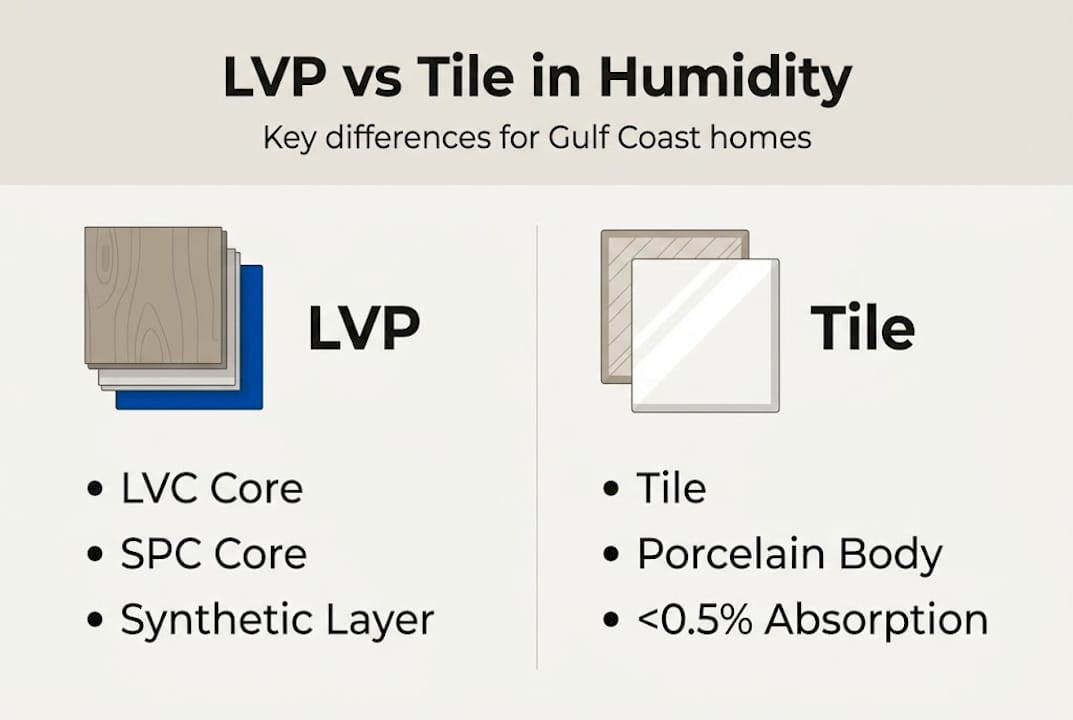
Luxury Vinyl Plank (LVP) is a multi-layer synthetic flooring product. The best versions use an SPC (Stone Plastic Composite) rigid core, which resists denting and flexing underfoot. On top sits a photographic layer that mimics wood or stone, protected by a wear layer measured in mils. A 12-mil wear layer suits light residential traffic; 20-mil or higher is what you want in high-traffic Gulf Coast homes where sand, pets, and humidity are daily realities.
Porcelain tile is fired at extremely high temperatures from dense clay, making it hard, heavy, and nearly impervious to moisture. Standard ceramic tile is softer and absorbs more water, so porcelain is the preferred choice in coastal climates. Both use thinset mortar and grout for installation, which adds labor time and cost compared to LVP’s click-lock floating system.
Humidity resistance is where these two materials truly diverge in ways that matter here. Porcelain tile absorbs less than 0.5% moisture, meaning flooding, condensation, and the sticky Gulf Coast summers have essentially zero effect on its structure. LVP resists humidity through its vinyl construction and SPC core, but it requires a proper vapor barrier underlayment on concrete slabs to prevent subfloor moisture from migrating up through the seams.
Quick comparison: LVP vs. porcelain tile
Feature | LVP (SPC Core) | Porcelain Tile |
Moisture resistance | Excellent (vinyl/SPC) | Superior (<0.5% absorption) |
Comfort underfoot | Warm, slightly cushioned | Hard, cold without rugs |
Typical lifespan | 15 to 25 years | 50 to 100+ years |
Installed cost | $3 to $8 per sq ft | $6 to $12 per sq ft |
Installation speed | Fast (click-lock) | Slow (thinset, grout, cure) |
Repair ease | Replace individual planks | Match and replace chips |
LVP is a strong fit when you need:
Whole-house uniformity at a reasonable cost
A warmer, quieter surface in bedrooms and living areas
Fast installation with minimal disruption
Easy individual plank replacement if damage occurs
Porcelain tile is the right call when you need:
Maximum waterproofing in showers, baths, or laundry rooms
A floor that outlasts the mortgage by decades
A material that holds up to heavy foot traffic in entryways
Perceived premium quality in high-visibility areas
Understanding these core differences gives you a foundation to make room-by-room decisions rather than blanket choices you might regret later.
Durability, comfort, and real-world performance
With the basics in mind, let’s see how LVP and tile actually perform in the unique climate and active lifestyles found across the Gulf Coast.
When it comes to lifespan, the gap is significant. Porcelain tile can last 50 to 100+ years with minimal degradation, resisting scratches, fading, and stains at a level that LVP simply cannot match long term. LVP, depending on the wear layer thickness, typically performs well for 15 to 25 years. A 20-mil or thicker wear layer extends that range considerably, which is why wear layer rating matters more than brand name when shopping LVP.
For waterproofing in wet areas, both LVP and tile are technically waterproof, but tile is the safer choice for showers and consistently wet zones. LVP seams, if not properly sealed or if the subfloor has moisture issues, can allow water to seep underneath and create conditions for mold or subfloor damage. Porcelain with epoxy grout is virtually impenetrable in wet areas. Track this carefully when evaluating a home you are buying or staging one you are selling.
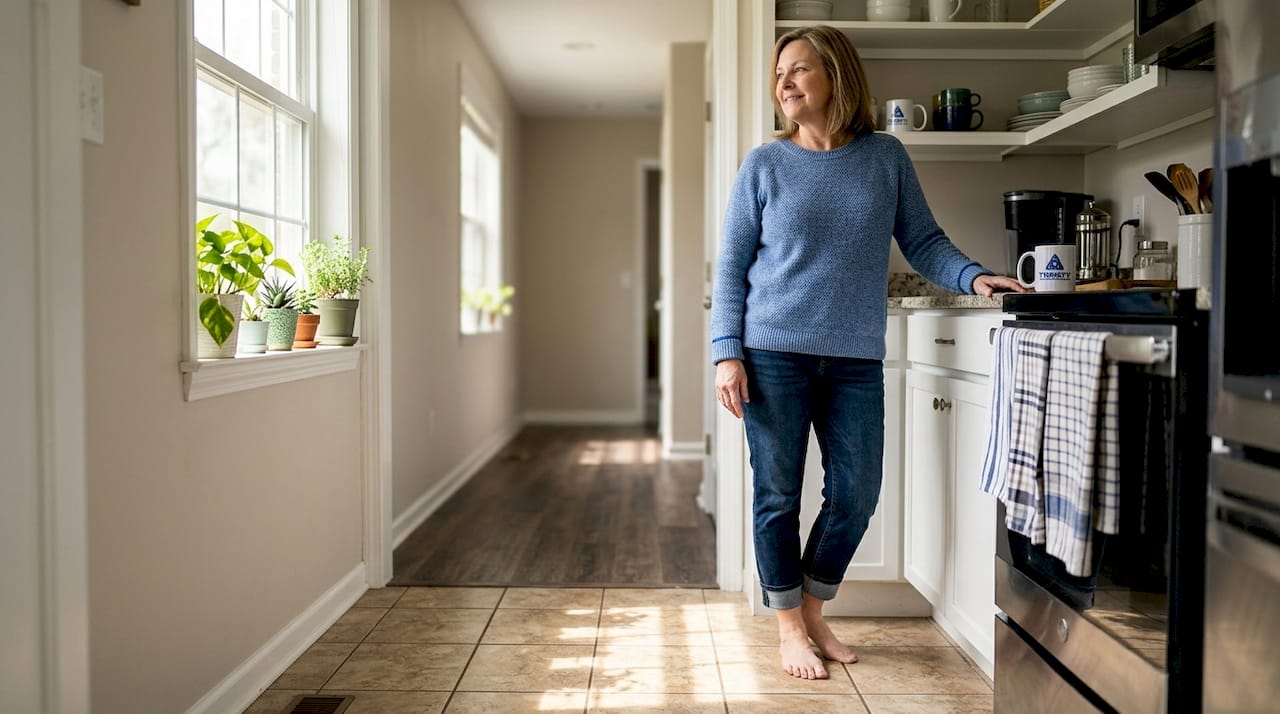
Comfort underfoot is where LVP wins the daily-living argument. Tile is hard and cold, which feels refreshing in July but unpleasant on bare feet during cooler months. LVP has a slight give and retains warmth, making it noticeably more comfortable in living rooms, hallways, and bedrooms. It also reduces impact noise better than tile, which matters in two-story homes or when kids or pets are in the picture.
For moisture control advice relevant to your specific subfloor situation, understanding what lies beneath your flooring is just as important as the material on top.
Performance comparison by category:
Category | LVP | Porcelain Tile |
Scratch resistance | Good (wear layer dependent) | Excellent |
Fade resistance | Good | Excellent |
Stain resistance | Very good | Excellent |
Impact resilience | Good | Poor (chips/cracks) |
Comfort underfoot | Warm, cushioned | Hard, cold |
Noise reduction | Better | Minimal |
Pet suitability | Very good | Very good |
Pets and kids: Both handle pet traffic well, but LVP is more forgiving for dropped toys or heavy impacts that might chip tile.
Prolonged moisture: Standing water left on LVP seams is a real risk; tile handles it without concern when grouted properly.
Temperature: Tile in a sun-drenched Gulf Shores entryway stays cool, which buyers in the summer months appreciate.
Pro Tip: The single most overlooked performance factor in Gulf Coast homes is subfloor flatness. Both LVP and tile require a level, clean subfloor surface. LVP over a wavy slab will creak and shift. Tile over an uneven surface will crack at grout lines within a year. Always inspect and correct the subfloor before installation, not after.
Cost breakdown and return on investment
Performance is vital, but budget and resale value often tip the scales. Here’s how the numbers stack up for LVP versus tile.
The installed cost difference between these two materials is one of the biggest practical factors for Gulf Coast buyers and sellers. LVP runs $3 to $8 per square foot installed, while porcelain tile lands between $6 and $12 per square foot. The gap exists primarily because tile installation is labor intensive. Installers must level the subfloor, apply thinset, set tiles precisely, and then wait for cure time before grouting. LVP’s click-lock floating system cuts installation time dramatically, which reduces labor cost.
For a 1,500-square-foot home, that difference could mean $4,500 to $6,000 in savings by choosing LVP over tile throughout. That is a meaningful number whether you are a buyer budgeting for updates or a seller calculating pre-listing renovation costs.
Return on investment (ROI) tells a more nuanced story. Tile delivers ROI of 60 to 70% and adds the most perceived value in kitchens and bathrooms, where buyers scrutinize surfaces closely. LVP ranges from 50 to 70% ROI but shines in whole-house scenarios where consistency and visual flow matter. A home with uniform LVP throughout the living spaces photographs well, shows well, and appeals to buyers who do not want to manage mismatched flooring.
Factors that influence your actual ROI:
Room type: Tile in wet zones, LVP in dry living areas maximizes both function and perceived value.
Neighborhood price range: In higher-end Gulf Coast markets like Fairhope or Orange Beach, tile in baths and kitchens is often expected.
Time horizon: Selling within two years favors LVP for its lower cost and faster install; long-term ownership favors tile for its durability.
Uniformity: A consistent LVP floor throughout bedrooms, living areas, and hallways increases perceived space and simplifies buyer decision-making.
Condition of existing flooring: Replacement cost matters. Ripping out old carpet and replacing with LVP is often the smartest pre-listing investment available.
Pro Tip: If you are selling a home and the bathrooms have outdated tile, do not panic. Sellers who upgrade just the kitchen backsplash and primary bath tile while using LVP in the living areas often see strong buyer response without overspending. Understanding vapor barrier installation costs ahead of time helps you budget realistically when planning any flooring renovation.
Installation and maintenance in Gulf Coast conditions
Even the right floor can backfire if the installation misses key prep steps. Here’s what every Gulf Coast homeowner should know.
LVP installation follows a clear sequence, but skipping any step creates problems that show up months or years later:
Test and prep the subfloor. Check for moisture in the slab using a calcium chloride test. Address any moisture readings before laying anything down.
Level the subfloor. Fill low spots with self-leveling compound. High spots need grinding. LVP tolerates no more than 3/16 inch variation per 10-foot span.
Install the vapor barrier. On concrete slabs, a 6-mil or thicker poly vapor barrier overlapped at seams and taped is non-negotiable in Gulf Coast homes. This single step prevents most LVP failures.
Acclimate the planks. Leave LVP in the room for 24 to 48 hours before installation so it adjusts to temperature and humidity.
Click and lock with expansion gaps. Leave a 1/4-inch gap at walls to allow for thermal movement in Alabama’s temperature swings.
Tile installation adds complexity. Thinset application, tile placement, spacer use, 24-hour cure, and then grouting all require skill and patience. Epoxy grout in wet areas adds another layer of labor but pays off in long-term waterproofing.
“Both LVP and tile are low maintenance, but tile requires periodic grout sealing to stay stain and moisture resistant, while LVP only needs regular sweeping and damp mopping. Individual LVP planks can be replaced if damaged; tile repairs require finding a matching tile and chip-filling or full replacement.”
Foundation moisture risks tied to poor drainage are a direct threat to both flooring types, and ventilation in coastal homes plays a supporting role in keeping subfloor conditions stable year-round.
Pro Tip: Before buying a Gulf Coast home with LVP already installed, use a moisture meter along the perimeter baseboards and near exterior walls. Elevated readings in those spots often signal that the original installer skipped or improperly installed the vapor barrier. That small check can save you thousands.
Common maintenance mistakes that cause flooring performance issues include leaving standing water on LVP seams, using steam mops on either surface, and neglecting annual grout sealing on tile in bathrooms.
Hybrid solutions and room-by-room recommendations
So which flooring should you actually choose? The smartest Gulf Coast homes use both. Here’s how to create a winning combination.
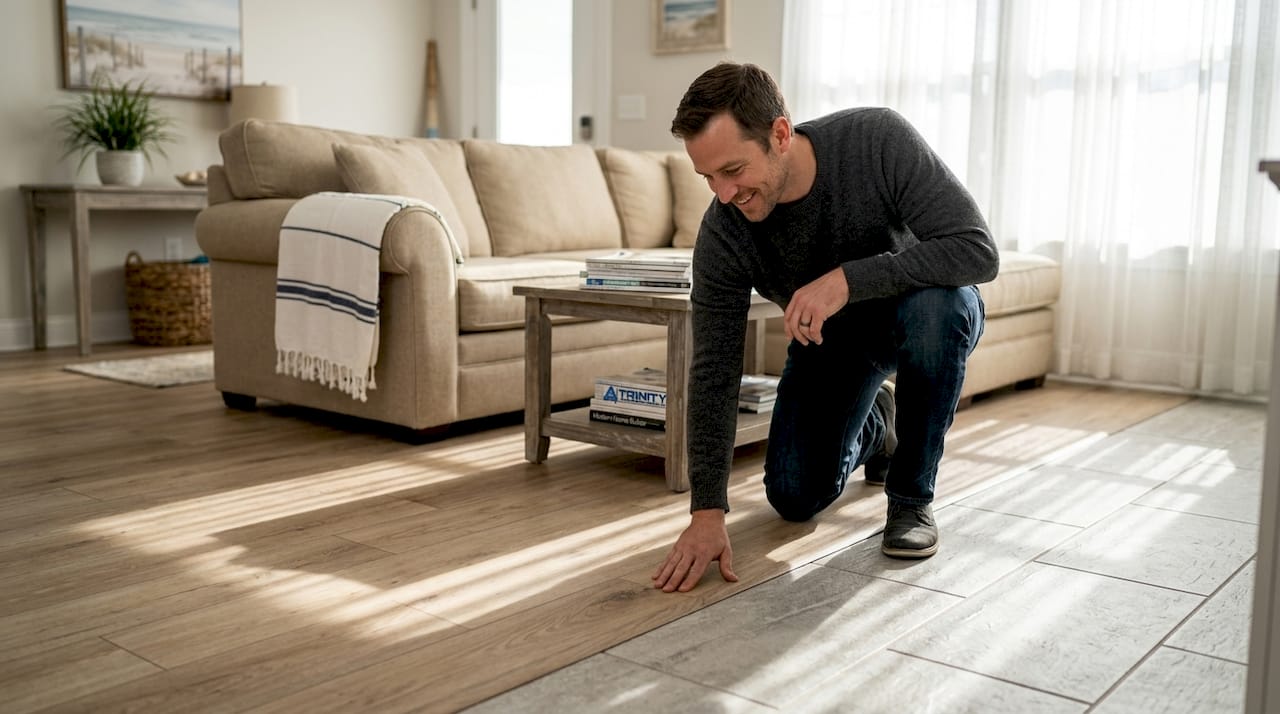
A hybrid approach pairing tile with LVP is the strategy that consistently performs best in Gulf Coast real estate. Porcelain tile in bathrooms, kitchens, showers, and entryways provides maximum durability and waterproofing where it matters most. LVP in living areas, hallways, and bedrooms delivers comfort, visual flow, and cost efficiency that buyers respond to immediately.
This combination works because it mirrors how people actually live in their homes. Nobody wants cold hard tile in the bedroom at 6 a.m. But nobody wants warped flooring under a bathroom vanity where a slow drip went unnoticed for six months either.
Room-by-room flooring guide for Gulf Coast homes:
Primary bath and guest baths: Porcelain tile, always. Epoxy grout in the shower area.
Kitchen floor: Porcelain tile for high traffic, spills, and resale appeal.
Entryway and mudroom: Porcelain tile to handle sand, mud, and wet shoes from beach days.
Living room and dining room: LVP for warmth, comfort, and visual continuity.
Bedrooms: LVP for softness underfoot and ease of replacement if furniture damage occurs.
Laundry room: Porcelain tile for water resistance near appliances.
Screened porch or sunroom: Porcelain tile for outdoor durability and easy cleaning.
For room design ideas that complement your flooring choices, or for space maximization strategies that tie together your renovation plan, thinking about flooring alongside other upgrades produces a more cohesive result.
For real estate transactions, LVP enables faster installations with less disruption, which matters when you are listing a home quickly. A uniform LVP run through all living areas increases perceived space and makes photography look cleaner. Tile in wet zones signals quality and longevity to buyers who know what to look for.
For sellers prepping for a quick listing, the hybrid approach lets you spend where it counts and save where buyers will not penalize you. Reviewing common home inspection findings before you begin renovations helps you prioritize flooring updates alongside other repairs that could affect your sale.
Our perspective: What most guides miss about Gulf Coast flooring
You’ve seen the evidence, but here’s what our years of inspecting Gulf Coast homes have taught us about the real stakes with LVP and tile.
Most flooring guides spend pages comparing materials and almost none discussing what actually causes flooring failures in this region. It is rarely the wrong product choice. It is almost always the wrong installation. We have walked through beautiful Gulf Shores homes where premium LVP was bubbling off the slab because no vapor barrier was installed. We have seen cracked tile grids in Daphne kitchens that failed not because the tile was cheap but because the subfloor was not leveled before installation.
The flooring material matters. But the prep behind it matters more.
Buyers who skip a home inspection and discover flooring issues after closing face a frustrating and expensive reality. What looks like a minor surface problem is often a symptom of deeper inspection findings involving moisture intrusion, subfloor rot, or drainage problems around the foundation. Those problems do not fix themselves when you lay new flooring on top.
The hybrid approach also reflects something true about how buyers value homes emotionally, not just financially. Tile in a bathroom communicates permanence and quality. LVP in the living room communicates warmth and livability. When both are done well and installed correctly, the result is a home that feels right from the moment someone walks through the door. That feeling translates directly into offers.
Our advice: choose your materials thoughtfully, budget for proper prep, and verify the subfloor condition before any flooring goes down. The cost of doing it right the first time is always less than fixing it later.
Expert help for smart flooring choices
If you want your flooring decision to maximize value and avoid hidden problems, a little expert help goes a long way.
Flooring improvements are one of the most impactful upgrades you can make before listing or after closing. But they only pay off when the subfloor, moisture conditions, and installation are all sound. That is where a professional home inspection becomes your best tool.
At Trinity Home Inspections, our InterNACHI-certified inspectors use thermal imaging and moisture meters to identify hidden moisture issues, vapor barrier problems, and subfloor conditions that could compromise any flooring investment. Our pre-listing inspections give sellers a clear picture of what needs attention before buyers find it. If moisture or air quality concerns surface, our mold testing services provide certified lab results you can act on. You can also use our property and permit search to verify that previous renovations were properly permitted. Serving Baldwin, Mobile, Escambia, and surrounding counties, we are here to help you make confident, informed decisions about your Gulf Coast home.
Frequently asked questions
Which is better for high humidity: LVP or tile?
Both handle Gulf Coast humidity well, but porcelain tile absorbs less than 0.5% moisture making it the top choice in flood-prone or very wet areas, while LVP performs excellently when a proper vapor barrier is installed on concrete slabs.
Does tile or LVP add more value to a home?
Tile delivers stronger ROI in kitchens and bathrooms, where tile ROI reaches 60 to 70% and buyers expect durable surfaces; LVP is the smarter investment for whole-house updates where affordability and visual uniformity matter most.
Is LVP or tile easier and cheaper to install in Gulf Coast homes?
LVP is significantly faster and more affordable because its click-lock floating system requires far less labor than tile’s thinset and grout process, with LVP installed costs at $3 to $8 per sq ft compared to $6 to $12 for porcelain tile.
Can LVP go in bathrooms and kitchens?
Yes, LVP works in bathrooms and kitchens, but because LVP seams may allow water seepage to reach the subfloor, tile remains the safer and more durable option in showers and consistently wet areas.
Recommended


