
Is an HVAC Drip Pan Required By Code? Gulf Coast Alabama

TL;DR:
Alabama code requires primary drain pans for all HVAC systems and secondary pans in attics.
Proper materials, sloped drain lines, and float switches are essential for code compliance.
Non-compliance can lead to inspection failures, costly water damage, and insurance issues.
If you’re buying or selling a home in Gulf Coast Alabama, the question of whether an HVAC drip pan is legally required probably hasn’t kept you up at night. It should. Misunderstanding this one code requirement leads to failed inspections, surprise repair bills, and in some cases, denied insurance claims after water damage. The rules aren’t complicated once you know what to look for, but the consequences of getting it wrong in a high-humidity climate like ours are very real. This guide breaks down exactly what Alabama building codes require, when each type of pan is mandatory, and what inspectors actually look for in Baldwin and Mobile County homes.
Key Takeaways
Point | Details |
Primary pan always required | All condensing HVAC units need a primary drain pan under IMC rules and Alabama codes. |
Secondary pan conditional | A secondary drain pan is a must if your HVAC unit is in the attic or above finished ceilings. |
IMC adopted statewide | Gulf Coast Alabama follows the International Mechanical Code without additional amendments for drip pans. |
Non-compliance hurts sales | Missing or faulty pans lead to failed home inspections and possible insurance problems. |
Routine inspection prevents damage | Annual checks catch clogs and condensation issues before they cause costly leaks or mold. |
What do Alabama building codes say about HVAC drip pans?
Alabama doesn’t write its own mechanical code from scratch. Instead, the state adopts the International Mechanical Code (IMC), primarily the 2021 edition, with select 2024 amendments for state buildings. Local jurisdictions across Gulf Coast Alabama, including Baldwin and Mobile Counties, adopt similar IMC versions through their local Authority Having Jurisdiction (AHJ). An AHJ is simply the local government body responsible for enforcing building codes in your area.
Here’s the practical takeaway: there are no major local amendments in Baldwin or Mobile County that change the core IMC requirements for HVAC drip pans. What the IMC says goes. That means the same rules that apply to a home in Birmingham apply to your beach house in Gulf Shores or your family home in Daphne.
What does change locally is enforcement emphasis. High humidity in Gulf Coast Alabama increases the volume of condensate your HVAC system produces, and Code Officials of Lower Alabama (COLA) are actively transitioning to the 2024 IMC with a strong focus on humidity control. Clogged pans and blocked drains are among the most common inspection findings in this region, often leading to mold growth and structural water damage. Local inspectors know this and look for it closely.
It’s also worth understanding how fresh air intake code rules interact with your overall HVAC setup, since the whole system works together.
County | Code Edition in Use | Enforcement Body |
Baldwin County | IMC 2021 (2024 amendments pending) | Baldwin County Building Department |
Mobile County | IMC 2021 (2024 amendments pending) | Mobile County Building Department |
Key points to remember:
Alabama follows the IMC without major local deviations for drip pan rules.
Local AHJs enforce the code during permitting and inspections.
Gulf Coast humidity makes condensate management a bigger deal here than in drier parts of the country.
COLA is moving toward stricter 2024 IMC standards, so newer construction faces tighter scrutiny.
Primary vs secondary drain pans: What’s required and when?
Understanding the general code is only part of the puzzle. Next, let’s look at the specific rules for primary versus secondary drain pans, because these are two very different requirements with different triggers.
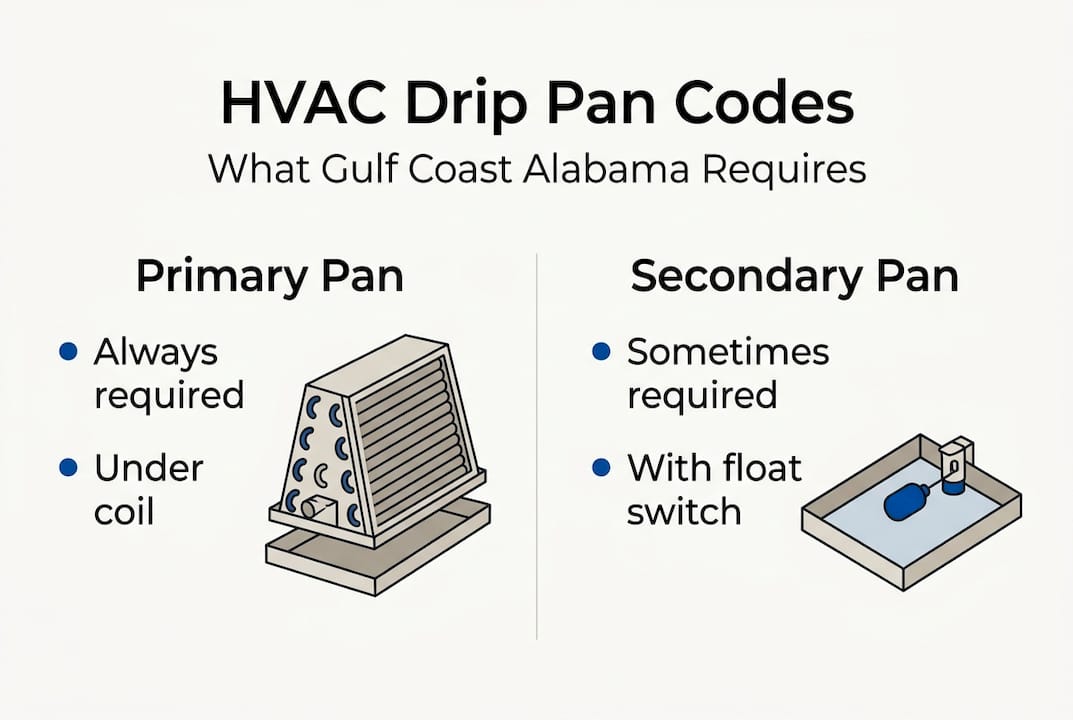
A primary drain pan sits directly under the evaporator coil of your HVAC system. The evaporator coil is the indoor component that cools the air and pulls moisture out of it. That moisture, called condensate, drips into the primary pan and flows out through a drain line. IMC Section 307 requires a primary drain pan for every HVAC unit that produces condensate. No exceptions. If your system cools air, it needs a primary pan.
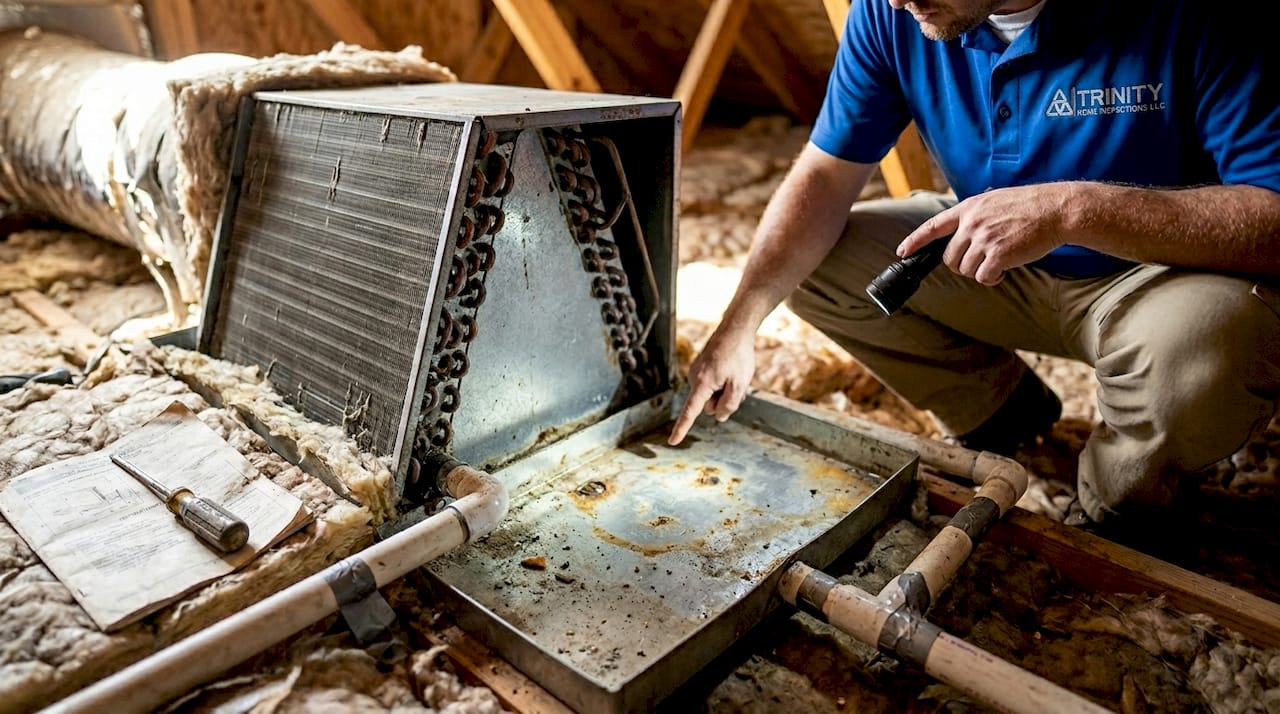
A secondary drain pan (also called an auxiliary pan) is a different story. IMC 307.2.3.1 requires secondary pans when the HVAC unit is located in an attic or above a finished ceiling where overflow from the primary pan could cause structural damage. In Gulf Coast Alabama, attic-mounted systems are extremely common. That means secondary pans are required far more often here than many homeowners realize.
Feature | Primary drain pan | Secondary drain pan |
Always required? | Yes, for all condensing equipment | Only for attic/above-ceiling installs |
Purpose | Catches normal condensate flow | Catches overflow if primary fails |
Code reference | IMC Section 307 | IMC 307.2.3.1 |
Drain required? | Yes, to approved location | Yes, independent drain or float switch |
Material | PVC, CPVC, or corrosion-resistant metal | Same approved materials |
How to determine if you need both pans:
Confirm your HVAC unit produces condensate (all central air systems do).
Identify where the air handler or evaporator coil is installed.
If it’s in an attic or above a finished ceiling, a secondary pan is required by code.
Check whether the secondary pan has its own independent drain line or a float switch that shuts the system off if water rises.
Verify both pans are properly sloped and draining to an approved location.
For a deeper look at keeping these systems working properly, our maintenance guide for homeowners covers the basics, and our guide on cleaning condensation drains walks you through the process step by step. You can also review common inspection findings to see how often pan issues show up in real Gulf Coast transactions.
Pro Tip: A float switch on your secondary pan is one of the smartest investments you can make in a Gulf Coast home. When the primary drain clogs and water rises in the secondary pan, the float switch cuts power to the system before overflow damages your ceiling. Some insurance carriers now ask about this during claims reviews.
Materials, installation, and best practices: What code and inspectors look for
Knowing the rules is vital, but understanding what passes or fails in the field keeps you out of trouble during inspections.
The IMC specifies approved materials for drain pans and condensate lines. PVC (polyvinyl chloride) and CPVC (chlorinated polyvinyl chloride) are the most common and widely accepted. Pans must be constructed of corrosion-resistant material and sized to collect all condensate that could overflow. Drain lines must slope at least 1/8 inch per foot toward the discharge point to prevent standing water, which is a breeding ground for algae and mold.
One often-overlooked requirement is the P-trap on condensate drain lines. A P-trap prevents air from being drawn back through the drain line and disrupting system pressure. Missing P-traps are a frequent condensate system failure that inspectors flag regularly. It’s a small fitting that causes big problems when absent.
Gulf Coast Alabama’s climate adds another layer of urgency here. The region’s extreme humidity means your AC system runs harder and longer than systems in drier climates, producing significantly more condensate volume than the national average. That higher volume increases the risk of clogs, overflows, and mold growth inside the pan itself.
Inspector red flags during real home sales:
Drain pan made of incorrect or deteriorating material
No visible slope in the drain line
Missing or improperly installed P-trap
Pan too small to catch overflow from the coil
Algae or standing water visible in the pan
Secondary pan absent on an attic-mounted unit
Drain line terminating in an unapproved location (like inside a wall cavity)
Rust staining or water marks on the pan exterior indicating past overflow
For guidance on protecting your drain line from moisture issues, our article on insulating condensation drains is worth reading. You can also find seasonal advice in our HVAC maintenance tips and coastal maintenance guidance for homes near the water. Additional homeowner maintenance tips can help you stay ahead of problems between professional inspections.
Pro Tip: Drop a few HVAC-safe UV algae-prevention tablets into your primary drain pan at the start of each cooling season. They dissolve slowly and keep algae from clogging the drain line. It costs a few dollars and takes two minutes. It can save you hundreds in service calls.
How code compliance impacts home sales, insurance, and repairs
With materials and installation standards in mind, let’s see how code compliance actually affects your property transaction or home ownership risks.
A missing or non-compliant drip pan isn’t just a technical code violation. It’s a real-world liability. No Alabama-specific amendments alter the IMC 307 requirements, so local AHJs in Baldwin and Mobile Counties enforce these rules as written. That means there’s no workaround, no local exception, and no gray area when an inspector flags a missing secondary pan on an attic unit.
“In Gulf Coast Alabama, we see water damage from condensate issues more than almost any other HVAC-related problem. A pan that looks fine from the outside can be hiding a slow leak that’s been soaking the ceiling below for months. By the time it’s visible, the damage is already significant.”
Top inspection deal-killers involving HVAC drip pans:
Missing secondary pan on an attic-mounted air handler
Cracked or deteriorated primary pan with visible staining
Drain line terminating improperly or not draining at all
No float switch or independent drain on secondary pan
Evidence of past overflow (water stains on ceiling below unit)
Mold growth inside the pan or on surrounding framing
Think about what these issues mean in a real transaction. A buyer’s inspector flags a missing secondary pan and signs of past water damage on the ceiling below the attic unit. The buyer requests repairs. The seller either fixes it before closing or negotiates a price reduction. If the seller refuses, the deal can fall apart. And if the damage was hidden and surfaces after closing, an insurance claim may be denied because the pan was non-compliant to begin with.
Water damage repairs from condensate overflow can range from a few hundred dollars for a simple drain flush to tens of thousands if drywall, insulation, and framing have been soaking for months. Our articles on inspection issues in Gulf Coast homes and thermal imaging for HVAC issues show how these problems are found before they become disasters. For context on related water-related HVAC concerns, furnace water leaks explained is a helpful reference.
A home inspector’s take: What most guides miss about HVAC drip pan codes
Most guides stop at the code language and call it done. Here’s what actually matters on the ground in Gulf Coast Alabama.
The biggest misconception we see is that homeowners treat secondary pans as optional upgrades. They’re not. If your air handler is in the attic, code gives you very little discretion. The secondary pan is required. Period. What we find in older homes is that secondary pans were sometimes installed without independent drains, meaning they just fill up and overflow anyway if the primary clogs. That’s not compliance. That’s a false sense of security.
Even in cases where a secondary pan technically isn’t required by code, installing one with a float switch is one of the most practical things you can do in this climate. We’ve seen inspection findings where a $40 float switch would have prevented $15,000 in ceiling and insulation damage. The code sets the floor. Smart homeownership goes a little higher.
Older homes in Mobile and Baldwin Counties deserve extra attention here. Systems installed 15 to 20 years ago may predate current code requirements or were installed under less stringent enforcement. Annual maintenance and a professional eye on the drain system are your best tools for staying ahead of problems before they show up on an inspection report.
Get expert help with HVAC code and home inspections
If you want true peace of mind with your HVAC system, professional support is the surest path.

At Trinity Home Inspections, we verify HVAC drip pan compliance as part of every inspection we perform across Baldwin, Mobile, and surrounding Gulf Coast Alabama counties. We use thermal imaging at no extra charge to spot hidden moisture issues that a visual check alone can miss. Whether you’re a buyer wanting clarity before closing or a seller who wants fewer surprises, we give you a same-day report with clear, actionable findings. You can also start with a permit search for Baldwin and Mobile County to understand what work has been permitted on the property. Ready to schedule? Our pre-sale home inspection service helps sellers get ahead of issues before they become deal-killers.
Frequently asked questions
Are HVAC drip pans always required in homes?
Yes. Primary drain pans are always required under evaporator coils for any condensing HVAC equipment. Secondary pans are additionally required when the unit is installed in an attic or above a finished ceiling.
Does Alabama have its own rules different from the International Mechanical Code?
No. There are no Alabama-specific amendments that change the IMC 307 drip pan requirements. Local AHJs in Baldwin and Mobile Counties enforce the standard IMC rules as adopted.
What happens if my home is missing a required drip pan?
A missing drip pan can result in a failed inspection, a delayed or canceled closing, or a denied insurance claim. High condensate volume in Gulf Coast Alabama makes the risk of water damage and mold especially serious when pans are absent or clogged.
How do I know if my HVAC setup needs a secondary pan?
If your air handler or evaporator coil is installed in an attic or above a finished ceiling, IMC 307.2.3.1 requires a secondary pan with an independent drain line or a float switch that shuts the system off when water rises.
Recommended

