
Spot Fast Food Building Inspection Issues Before They Cost You

Updated: Apr 29
TL;DR:
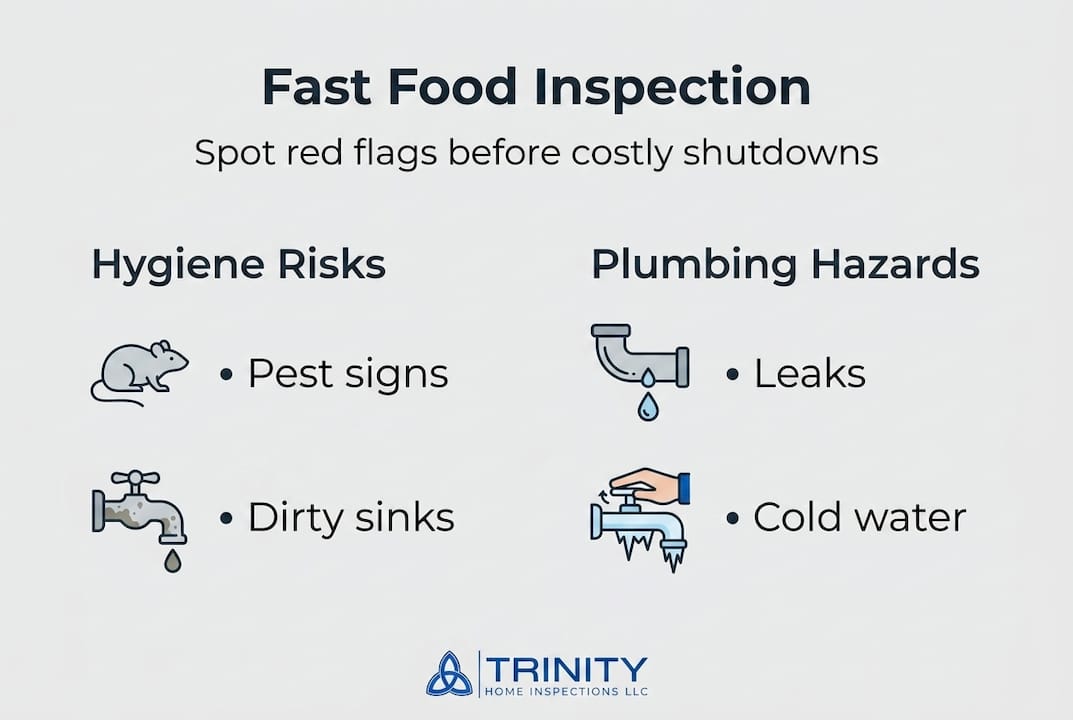
Pest control and hygiene violations frequently lead to restaurant closures and reputational damage.
Plumbing failures and grease trap issues often signal deferred maintenance causing operational shutdowns.
Regular proactive inspections and documentation help investors protect property value and ensure compliance.
A single unsecured grease trap cover. A hand sink without soap. These sound like minor details, but in Alabama’s fast food industry, they are the kinds of findings that trigger immediate closures, generate negative headlines, and create serious financial consequences for property owners and investors. If you own or are considering purchasing a fast food building in Alabama, understanding what inspectors actually find, and what those findings really mean for your bottom line, is one of the most important steps you can take. This article breaks down the most common fast food building inspection issues, how Alabama’s compliance system responds to them, and what you can do to stay ahead of the risks before they become costly crises.
Key Takeaways
Point | Details |
Pest and hygiene risks | Unchecked pest or cleanliness problems are the top cause of surprise closures and rapid re-inspections. |
Plumbing and fire hazards | Hidden plumbing, hot water, and fire suppression problems can force shutdowns and result in costly repairs. |
Alabama’s stiff compliance rules | Even a minor inspection score drop can trigger disruptive, costly follow-ups or closures under Alabama health law. |
Prevention pays off | Seasoned investors prioritize preventive maintenance and third-party checks to protect their property’s value. |
Structural flaws matter | Even small cracks or settlement signal bigger problems that impact cost, compliance, and pest risk for owners. |
Health code red flags: Pest control and hygiene failures
When it comes to fast food building inspections, pest control and hygiene violations are the most visible and most frequently cited problems. They are also the ones most likely to generate immediate regulatory action and reputational damage. For a property owner or investor, these are not just operational headaches. They are signals about how a building is being maintained and what ongoing costs may be hiding just beneath the surface.
Pest control lapses, including roach or rodent infestations, droppings, and entry points, rank among the top violations cited during restaurant health inspections. In fast food buildings specifically, the high volume of food handling, the presence of grease, and the frequent delivery traffic all create ideal conditions for pests to enter and thrive. Inspectors look closely at entry points around pipes and utility lines, gaps in door seals, and any evidence of nesting or droppings in storage and prep areas.
Hygiene violations are equally common and equally serious. Handwashing failures, including blocked or unstocked sinks, improper glove use, and lack of soap or paper towels, show up repeatedly in Alabama inspection records. These are not just paperwork problems. They represent real contamination risks that health departments take seriously.
Here are the most common pest and hygiene violations to watch for in a fast food building inspection:
Roach or rodent activity, including live insects, droppings, or nests in storage areas
Unsecured or poorly sealed entry points around plumbing, HVAC, and utility penetrations
Hand sinks blocked by equipment or supplies, making them inaccessible to staff
Missing soap, paper towels, or signage at required hand washing stations
Improper glove use, such as wearing gloves while handling raw product and then touching ready-to-eat food
Failure to maintain pest control logs or contracts with a licensed exterminator
For Alabama fast food operators, repeated sanitation lapses lead to compounding consequences. A first violation may generate a corrective action notice. Repeated citations in the same category can push a property into a higher-frequency inspection schedule, which means more disruption, more scrutiny, and more opportunity for additional violations to surface.
The long-term business impact is just as significant. A forced closure, even a temporary one, can generate media coverage that damages customer trust in ways that take months to rebuild. Some Alabama locations have faced mandatory closure after pest-related violations, with the resulting publicity causing lasting drops in customer volume.
“Pest activity in a food service environment is not just a health risk. It is a business continuity risk. One inspection finding can unravel years of brand equity overnight.”
Prevention is straightforward but requires consistent commitment. Establish a monthly third-party pest control contract, review entry point seals on a quarterly basis, and train staff on proper hand sink access and hygiene protocols. Document every service visit and keep records on site.
Pro Tip: Do not wait for a health inspector to find pest evidence. Hire a licensed pest management professional to conduct a pre-inspection walkthrough at least twice per year. A fresh set of expert eyes will catch issues your staff may have stopped noticing because they see the space every day.
Follow best practices for restaurant pest control to establish a documented, proactive program that satisfies inspectors and protects your investment year-round.
Plumbing and hot water: Hidden failures that shut down fast food sites
If pest violations are the most visible inspection problems, plumbing failures are the most underestimated. Property investors often focus on surface-level condition during due diligence and overlook the plumbing system entirely. That is a costly mistake. Plumbing deficiencies in fast food buildings can force an immediate shutdown, and they often signal years of deferred maintenance that will require significant capital to correct.
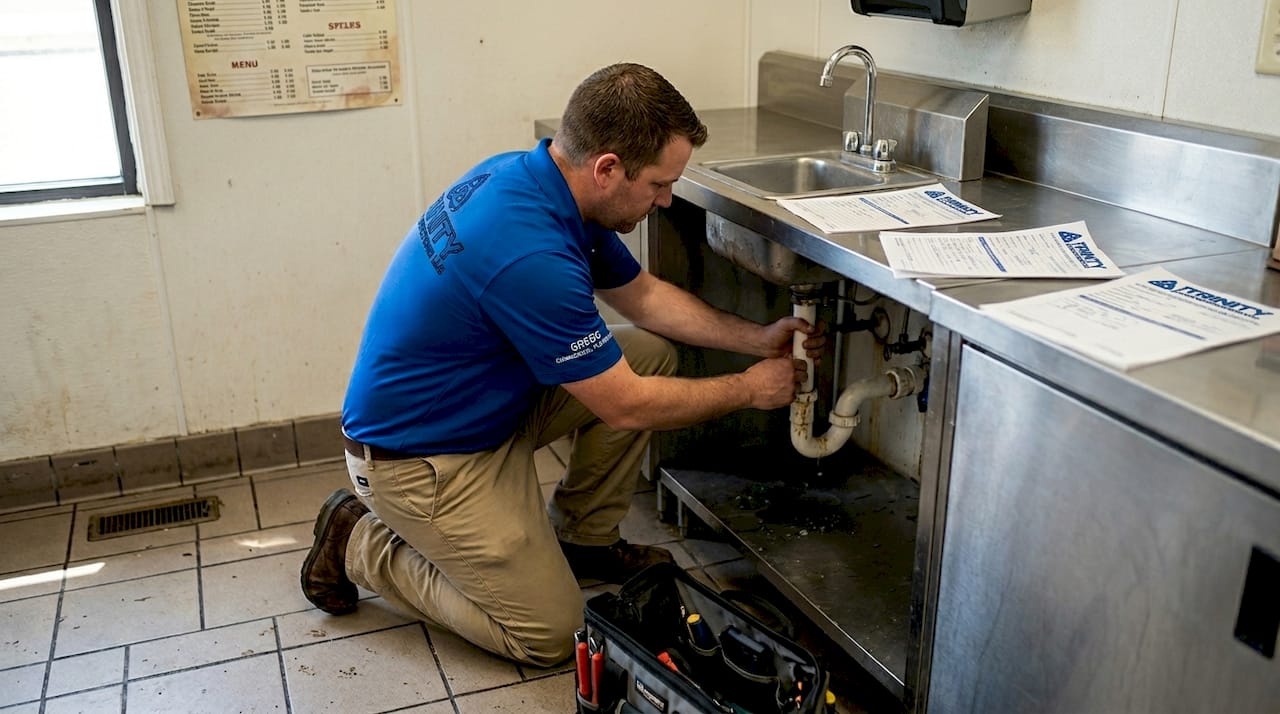
Plumbing and hot water deficiencies, such as a complete lack of hot water, active leaks, backflow risks, and sewage backups, have led to closures at Alabama fast food locations including McDonald’s and Sonic. These are not isolated incidents. They reflect a pattern seen repeatedly in the state’s inspection records. When a restaurant cannot supply hot water to hand sinks or food prep areas, it fails the most basic sanitation requirements and must close until the problem is resolved.
Grease trap issues are another major concern. Unsecured grease trap manhole covers have been cited in multiple Alabama fast food closures, including Olive Garden, Sonic, and Whataburger. An unsecured cover is both a sanitation violation and a safety hazard, capable of injuring employees or creating a confined space gas risk. These citations often come as a surprise to ownership groups who assumed routine maintenance was being handled.
For property owners and investors, plumbing failures almost always point to one thing: deferred maintenance. When you see a backflow preventer that has never been tested, a grease trap that has not been pumped on schedule, or supply lines showing signs of corrosion, you are looking at a capital expenditure timeline that ownership pushed back, often for years.
Our guide to commercial inspections covers how to evaluate these systems during due diligence, but here is a quick list of the top plumbing red flags to check before any fast food building purchase:
No hot water or inconsistent water temperatures at hand sinks or dish stations
Active leaks under sinks or at supply connections, especially in kitchen prep areas
Backflow prevention devices that are not tested annually or are missing entirely
Sewage odors or slow drains that suggest blockages or failing line conditions
Grease traps that are overdue for pumping or show signs of overflow
Unsecured or damaged manhole covers over grease interceptors in parking lots or service areas
Statistic to note: Plumbing-related violations are among the top five reasons fast food locations receive urgent corrective action orders in Alabama health inspections, and the repair costs can range from a few hundred dollars for a minor fix to well over $50,000 for a sewer line replacement or full grease interceptor installation.
Gas line inspections matter here too, because commercial kitchens depend on gas supply to function, and any compromise in line integrity creates both safety and compliance exposure.
Pro Tip: During purchase due diligence, always include a sewer scope inspection as a required line item. A camera run through the main line will reveal root intrusion, offset joints, grease buildup, and line collapse before they become your problem to fix after closing.
Fire safety and grease management: The hidden risks that lead to shutdowns
Grease and fire are two words that no property owner wants associated with their building, but in fast food environments, they are constant companions. The kitchen exhaust system, hood, duct, and suppression components work together to contain the fire risk that high-volume cooking creates every single day. When any part of that system falls behind on maintenance, the consequences can be severe and swift.
Grease buildup in kitchen exhaust hoods, ducts, and traps is one of the leading fire code violations cited in restaurant inspections, and it accounts for a significant share of commercial kitchen fires nationwide. Grease is highly flammable. When it accumulates inside a duct system, a single flare-up can spread a fire through the entire exhaust pathway in seconds.
Fire suppression system issues, including missed semi-annual inspections, misaligned nozzles, blocked manual pull stations, and expired suppression agents, are cited regularly during fast food inspection items for fast food restaurants reviews. A suppression system that has not been serviced in over a year may look functional but fail completely in an actual fire event.
Here is how fire safety inspection requirements compare to the violations most commonly found:
Requirement | Inspection standard | Common violation found |
Hood and duct cleaning | Quarterly for high-volume fryers | Skipped or performed annually only |
Fire suppression inspection | Semi-annually | Missed cycles, expired tags |
Manual pull station access | Clear and accessible at all times | Blocked by equipment or supplies |
Suppression nozzle alignment | Aimed at cooking surfaces | Misaligned after equipment moves |
Ansul system agent recharge | After any discharge or expiration | Expired cartridges left in place |
Exhaust fan operation | Fully functional during cooking | Belts worn, fans running slowly |
The financial penalties for missing these requirements are not minor. Fines for fire code violations can reach $5,000 per incident in Alabama, and insurance carriers can deny claims or cancel policies if they determine that required maintenance was not performed on schedule. For a property investor, that is not just a fine. It is a potential gap in coverage during the period when a fire is most likely to occur.
Commercial kitchen fires involving cooking equipment account for a substantial portion of restaurant total losses each year. When you combine high-volume frying with a poorly maintained exhaust system, you have a situation where a small incident can turn into a total loss quickly.
“A fire suppression system that looks fine but has not been inspected in 18 months is essentially a false sense of security. The paper trail matters as much as the equipment itself.”
Consider a scenario where a fast food location changes operators, and the incoming tenant does not verify the prior maintenance history. The suppression system had not been inspected in 22 months. A fryer fire occurred within six months of the new operator taking over. The suppression system discharged but did not fully extinguish the fire because a nozzle had been misaligned during a fryer replacement. The resulting damage cost over $200,000 in repairs and lost revenue.
Pro Tip: When evaluating a fast food building, request the last three years of hood cleaning logs, suppression system inspection certificates, and Ansul service records. If those documents do not exist or are incomplete, treat the cost to bring the system into full compliance as part of your purchase negotiation.
Inspection scoring and compliance timelines in Alabama
Understanding how Alabama’s health inspection scoring system works is essential for any property owner or investor. The scores are not just numbers. Each band triggers a specific regulatory response, and the gap between a score of 85 and a score of 84 can mean the difference between routine operations and a 60-day reinspection cycle.
Alabama’s scoring system works as follows: scores below 85 trigger more frequent inspections every 60 days, scores between 70 and 84 require a formal follow-up within 60 days, scores between 60 and 69 demand immediate corrective action within 48 hours, and scores below 60 result in immediate closure. These thresholds create a compounding effect where one bad inspection finding can cascade into a cycle of increased oversight that is difficult and expensive to exit.
Here is a quick comparison of how each scoring band affects operations:
Score range | Inspection consequence | Action required | Timeline |
85 and above | Standard schedule | Routine compliance | None immediate |
70 to 84 | Increased frequency | Corrective action plan | Within 60 days |
60 to 69 | Urgent response required | Immediate corrective action | Within 48 hours |
Below 60 | Immediate closure | Full remediation before reopen | Until resolved |
Key statistic: A score drop below 60 triggers same-day closure with no grace period. For a fast food location generating $5,000 to $15,000 per day in revenue, even a three-day closure represents a significant financial loss, not counting the cost of reinspection and repairs.
For property owners and investors who receive notice of a low inspection score, here are the inspection failure consequences and the action steps to take:
Obtain a copy of the full inspection report immediately and review every cited violation by category.
Prioritize critical violations that affect food safety, pest control, and sanitation above all others.
Contact a licensed contractor or specialist for any plumbing, fire suppression, or structural issues within the first 24 hours.
Document all corrective actions with photos, receipts, and contractor sign-offs to present at reinspection.
Schedule a pre-reinspection walkthrough with your operations team to confirm every cited item has been addressed.
Review your maintenance schedule to identify what deferred maintenance contributed to the score drop and build a forward-looking corrective plan.
The implications for property value and sale timelines are real. A property with a pattern of low inspection scores or recent closures will face scrutiny from buyers, lenders, and insurers. Proactive documentation of corrective maintenance, regular third-party inspections, and clean inspection histories create measurable value when it is time to sell or refinance.
Structural defects: Ongoing maintenance risks for property investors
Structural issues in fast food buildings rarely announce themselves loudly. They tend to show up quietly, as a hairline crack in a foundation wall, a slightly uneven floor slab, or a gap where an exterior wall meets the roofline. For investors, these findings are easy to minimize. They should not be.
Structural defects such as cracks and gaps signal ongoing maintenance costs and pest risks, while plumbing or hot water failures indicate deferred capital expenditures that directly impact operations. These two categories of findings often travel together. A foundation crack creates a pest entry point. A roof leak creates conditions for mold and wood rot. A gap in the building envelope around a utility penetration invites both moisture and rodents.
In fast food buildings, the most commonly overlooked structural risks include:
Cracks in concrete slabs or foundation walls that allow water infiltration and pest entry
Roof membrane failures or ponding water near HVAC equipment or parapet walls
Settlement around drive-through lanes and parking lots that creates drainage problems near the building
Deteriorated door and window seals that allow conditioned air loss and pest access
Gaps at utility penetrations in exterior walls where conduit, pipe, and duct lines enter the building
Damaged or missing expansion joint covers in flooring that trap debris and moisture
From an Alabama investor’s perspective, these are not isolated repair items. They are indicators of how a building has been managed over time. A fast food property that shows multiple structural deficiencies is telling you that the prior ownership or operator deferred maintenance across the board. That pattern almost always extends to systems you cannot see without specialized equipment.
Understanding home inspection red flags translates directly to commercial settings. The instinct to look past cosmetic or surface issues applies equally when evaluating a commercial property. It is also worth conducting a permit search in Alabama to verify that past repairs and renovations were permitted and inspected properly. Unpermitted work on structural components can create code compliance problems that fall to the new owner to resolve.
“The most expensive building problems are the ones you do not find until after you own them. Structural defects are rarely emergencies on day one, but they are almost always cost drivers within the first two to three years of ownership.”
Reviewing common pre-drywall issues offers additional context on how structural and envelope problems develop from the construction phase forward, which is useful context for investors evaluating older fast food buildings that may have had multiple remodels or tenant improvements over the years.
Why experienced investors focus on prevention, not just fixes
Most investors approach commercial property inspections with a reactive mindset. They get the report, they identify the problems, and they either negotiate a price reduction or ask the seller to make repairs. That approach works well enough for obvious defects. But it consistently misses the bigger picture, and that gap is where the real money gets lost.
The conventional wisdom that you can simply fix what the inspector finds is built on a flawed assumption: that inspection reports capture everything. They do not. A standard inspection gives you a snapshot of visible conditions on a specific day. It does not reveal the grease trap that is six months overdue for pumping, the suppression system that was last certified during a previous ownership group, or the sewer line that is slowly collapsing under the drive-through lane.
Veteran investors use inspection findings differently. First, they treat every inspection report as a capital expenditure roadmap, not just a deficiency list. Each finding gets projected forward: what does this cost to ignore for two years, five years, ten years? That calculation often reveals that the true cost of a deferred maintenance pattern is three to five times higher than the repair cost would have been at the time of purchase.
Second, experienced investors build routine specialty inspections into their annual operating budgets. Sewer scope inspections, fire suppression certifications, grease trap service logs, and third-party pest control audits are not optional line items. They are the documentation that makes a property defensible to regulators, insurable at reasonable rates, and attractive to future buyers. Our full inspection guide outlines how to structure that kind of proactive approach for commercial assets.
We worked with an Alabama property owner who had purchased a fast food building without commissioning a sewer scope. Within 18 months, a root-impacted main line caused a sewage backup that forced a three-day closure, required emergency plumbing work, and generated a health inspection score in the 60s. The total cost, including repairs, lost revenue, and reinspection fees, exceeded $90,000. A $400 sewer scope during due diligence would have surfaced the problem and shifted negotiation leverage entirely. Prevention is not just good practice. It is the only reliable way to protect the value of a commercial asset over time.
Protect your investment with expert inspections in Alabama
Every risk described in this article, from pest entry points to fire suppression gaps to structural defects, is the kind of finding that a thorough, professional inspection can surface before it becomes your problem to manage. Knowing what is in the building before you own it gives you the negotiating power, the budget clarity, and the peace of mind to make a sound investment decision.
[
At Trinity Home Inspections, we serve commercial property owners and investors across Baldwin, Mobile, Escambia, and surrounding Gulf Coast Alabama counties. Our InterNACHI-certified team uses thermal imaging, moisture meters, combustible gas detectors, drone roof assessments, and sewer scope equipment to give you a complete picture of a building’s condition. A permit and deed search helps you verify the history behind any repairs or renovations. And our pre-listing inspection services help sellers reduce surprises and move transactions forward with confidence. Same-day reports, real findings, and straight answers. That is what you get with Trinity.
Frequently asked questions
What is the most common violation in Alabama fast food building inspections?
The most frequent issues include pest control lapses, including evidence of roaches or rodents, alongside hygiene failures such as blocked or unstocked hand sinks.
What health inspection score will close a fast food restaurant in Alabama?
A score below 60 results in immediate closure, while scores between 60 and 69 require immediate corrective action completed within 48 hours.
Why is grease trap maintenance critical for fast food properties?
Unsecured grease trap covers have triggered closures at multiple Alabama fast food locations, creating both sanitation violations and physical safety hazards for employees and visitors on the property.
How often should fire suppression and exhaust systems be inspected?
Fire suppression systems require semi-annual inspections, and hood cleaning frequency depends on cooking volume but is at minimum quarterly for high-output fast food kitchens using fryers or open flame equipment.
What structural defects commonly affect fast food commercial buildings?
Cracks, settlement, and building envelope gaps are the most common structural findings, and they typically signal ongoing maintenance costs, pest entry risks, and moisture intrusion that compounds over time if left unaddressed.
Recommended