
What Is a Grinder Pump? A Guide for Gulf Coast Homeowners

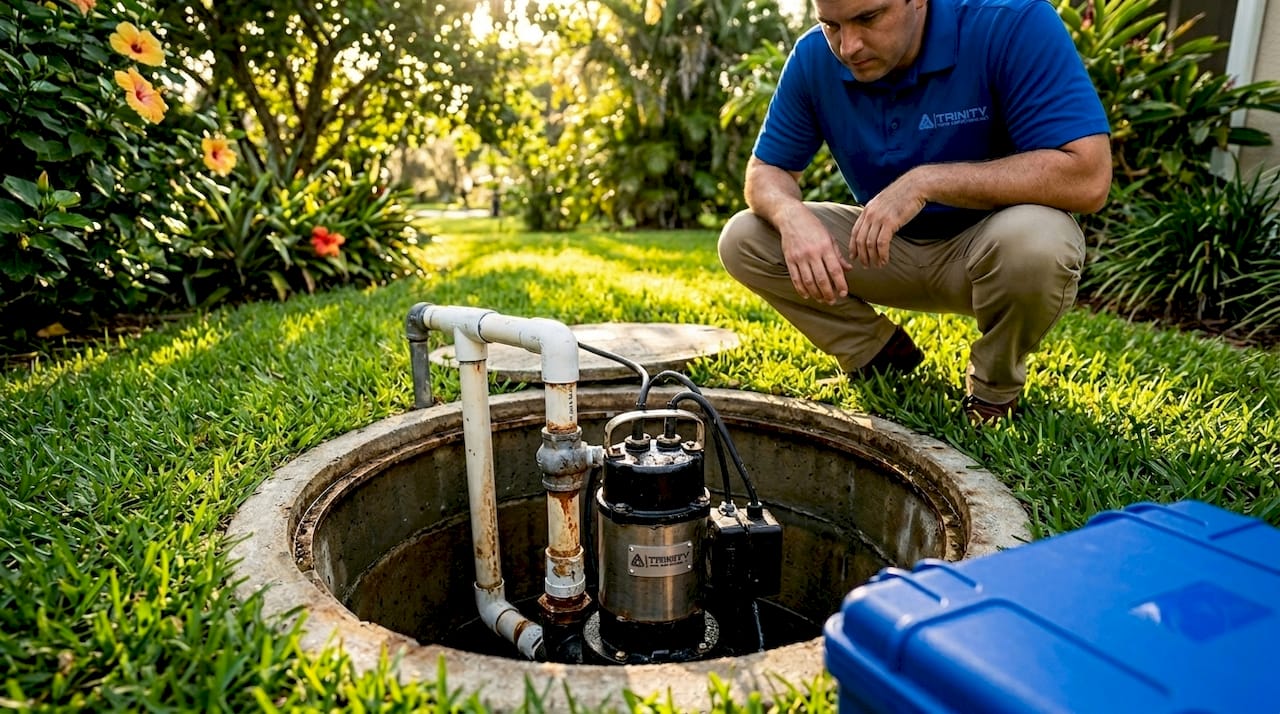
A grinder pump is a wastewater conveyance device that collects sewage in a buried basin, grinds solid waste into a fine slurry using stainless steel cutting blades, and then pumps that slurry through small-diameter pipes to the municipal sewer main. If you own or are buying a home in Gulf Coast Alabama, particularly in areas like Daphne, Foley, Spanish Fort, or Orange Beach where lots sit below the sewer line or at a distance from the main, a grinder pump is often the only practical solution for wastewater removal. Understanding how this system works, what it costs to maintain, and what warning signs to watch for can save you from a very unpleasant and expensive surprise. This article covers the grinder pump definition, how the system operates, its advantages over standard sewage ejector pumps, and what Gulf Coast homeowners need to know about installation and upkeep.
What is a grinder pump and how does it differ from other sewage systems?
A grinder pump is defined as a residential or light-commercial wastewater pump that uses mechanical grinding to reduce sewage solids into a slurry before forcing that slurry through pressurized pipes to the sewer system. The industry term you will see on spec sheets and permit documents is “grinder pump” or “sewage grinder pump,” and both refer to the same device. This is different from a gravity sewer system, where waste flows downhill on its own, and it is also different from a standard sewage ejector pump, which moves larger volumes of soft waste but cannot grind solids or push waste uphill through narrow pipes.
The typical residential grinder pump sits inside a sealed underground basin that is 24 to 36 inches in diameter. All household drains, toilets, and appliances feed into this basin by gravity. Once the waste level reaches a set point, the pump activates automatically and forces the ground slurry through a discharge pipe that is typically 1.25 to 2 inches in diameter. That pressurized pipe can run uphill, around obstacles, and over long distances to reach the nearest sewer connection.
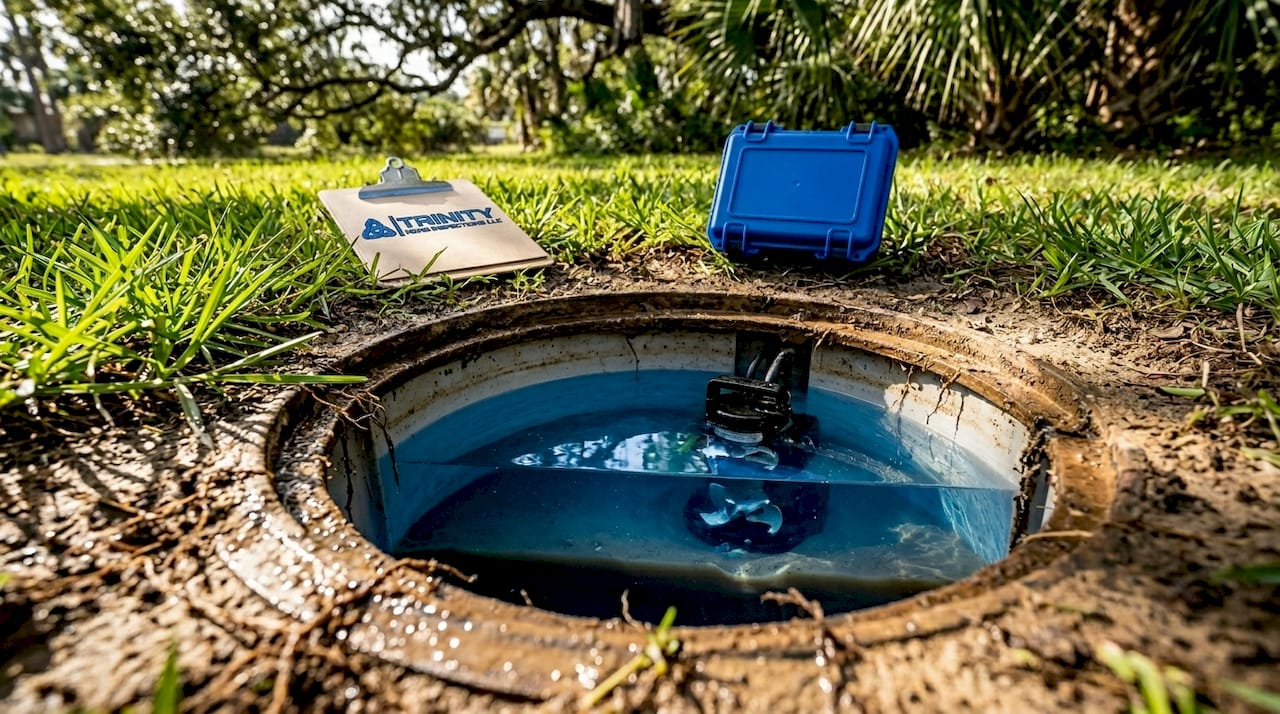
For homeowners in Baldwin County or Mobile County, this matters because the Gulf Coast terrain is flat in some areas and elevated in others, and many neighborhoods were developed without direct gravity sewer access. A grinder pump makes those properties livable and connectable to public sewer infrastructure without requiring expensive excavation of a gravity line.
How do grinder pumps work: collection, grinding, and discharge explained
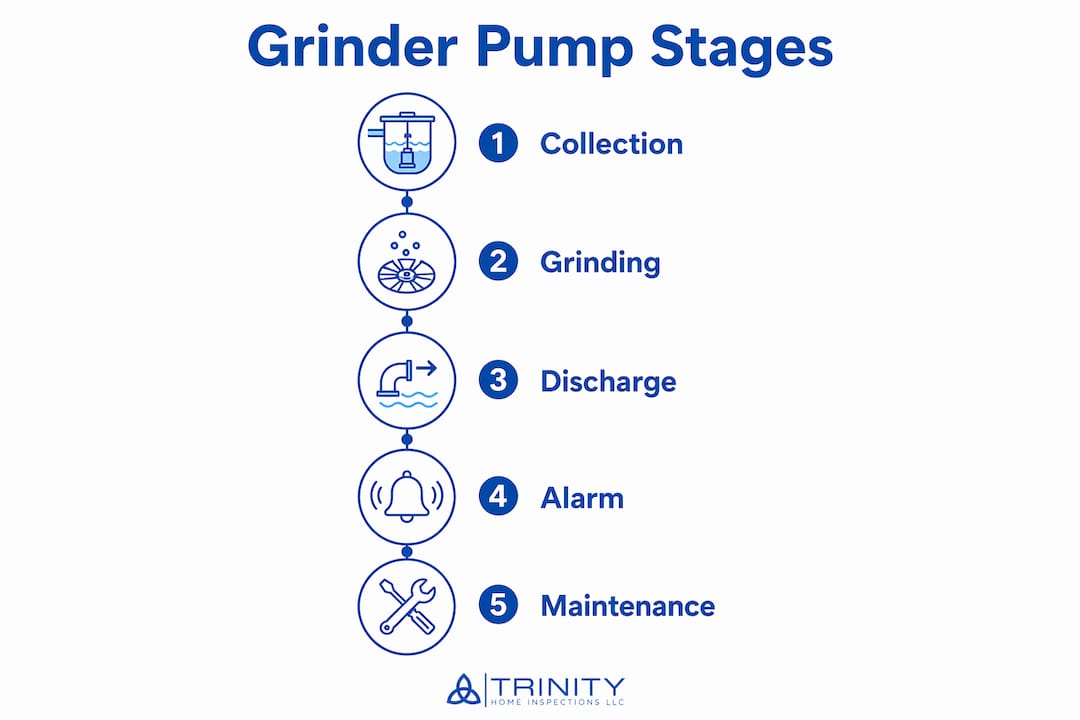
The grinder pump operates in three distinct stages: collection, grinding, and pressurized discharge. Each stage is automatic, and the entire cycle typically takes only a few minutes once triggered.
Stage 1: Collection
All wastewater from your home flows by gravity into the sealed underground basin. The basin is buried in your yard or, in some cases, in a basement or crawl space. It is airtight and vented to prevent odor from escaping into your yard or home. As waste accumulates, a float switch or electronic sensor monitors the level inside the basin.
Stage 2: Grinding
When the waste level reaches the activation point, the pump motor engages. Residential grinder pumps are typically rated at 1 to 2 HP, which is enough power to drive stainless steel cutting blades at high speed. Those blades macerate everything in the basin, including toilet paper, food particles, and fibrous materials, into a fine slurry. According to Aline Pumps, grinder pumps shred tough fibrous materials more effectively than standard cutter pumps, which means they are far less likely to clog when dealing with the kinds of waste that pass through a typical household.
A real-world example of this technology is the Zoeller EX841, which features a 2 HP motor with Tri-Slice cutter technology that cuts solids down to 1/8 inch. Its corrosion-resistant cast iron body and 1-year warranty make it a reliable choice for residential lift stations. Knowing the specifications of the pump installed at a property you are buying tells you a great deal about how long it will last and what maintenance it needs.
Stage 3: Pressurized discharge
Once the waste is ground into slurry, the pump forces it through the discharge pipe under pressure. That pipe, typically 1.25 to 2 inches wide, carries the slurry to the municipal sewer main. The grinding into slurry is what makes this possible. A standard sewage ejector pump cannot push solid waste through a pipe that narrow. The grinder pump’s ability to create a fine, uniform slurry is the key mechanical advantage that makes it work in challenging terrain.
Most residential systems also include an alarm panel, usually mounted inside the home or garage. If the pump fails or the basin fills beyond normal operating levels, the alarm sounds and a warning light activates. This gives you time to call a plumber before a backup occurs.
Pro Tip: If you hear your grinder pump alarm activate, stop all water use in the home immediately and call a licensed plumber. Running water into a full basin can cause sewage to back up into your drains within hours.
Grinder pump advantages vs. standard sewage ejector pumps
Choosing between a grinder pump and a sewage ejector pump is not a matter of preference. It is a matter of physics and property conditions. Understanding the difference protects you from buying the wrong system or inheriting a problem at closing.
The core distinction, as clarified by Zoeller Pump Company, is that grinder pumps prioritize vertical head, meaning lifting power, while sewage ejector pumps prioritize flow volume measured in gallons per minute. If your home sits below the sewer line or the sewer connection is hundreds of feet away, a grinder pump is the correct tool. An ejector pump simply does not generate enough pressure to move waste uphill through a small pipe over a long distance.
Feature | Grinder pump | Sewage ejector pump |
Solids handling | Grinds to fine slurry | Passes soft solids only |
Discharge pipe size | 1.25 to 2 inches | 2 to 4 inches |
Uphill pumping ability | Yes, high head pressure | Limited, low head pressure |
Fibrous material handling | Excellent | Poor to moderate |
Typical motor size | 1 to 2 HP | 0.5 to 1 HP |
Best application | Below-grade or distant properties | Basement bathrooms, short runs |
Standard sewage ejector pumps move larger volumes and handle soft solids, but they lack the grinding mechanism needed to create slurry, which limits their ability to push waste uphill through narrow pressurized pipes. This is a critical distinction for Gulf Coast homeowners evaluating a property with a pump-out system already installed.
The smaller discharge pipe is also a practical advantage during installation. Running a 1.5-inch pipe through a yard or under a driveway is far less disruptive and less expensive than trenching for a 3 or 4-inch gravity line. For properties in Gulf Shores or Orange Beach where landscaping and hardscaping are significant investments, this matters.
Pro Tip: Before closing on any Gulf Coast property with a grinder pump, ask the seller for the pump’s make, model, and installation date. A pump older than 10 years with no service records is a negotiating point worth addressing before you sign.
Installation and maintenance considerations for Gulf Coast homeowners
Grinder pump installation is not a DIY project. It requires excavation, electrical work, plumbing connections, and local code compliance. In Baldwin County and Mobile County, permits are required for new pump installations, and the work must be performed by a licensed plumber or contractor. The basin is typically buried in the front or side yard, close enough to the home’s main drain line to allow gravity feed into the basin, but positioned to allow access for future service.
Here is what to expect during a standard residential grinder pump installation:
Site assessment: A plumber evaluates the elevation difference between your home’s drain outlet and the sewer connection point to confirm a grinder pump is the right solution.
Excavation: A hole is dug for the basin, typically 3 to 5 feet deep depending on the frost line and local soil conditions.
Basin placement: The 24 to 36-inch diameter basin is set in the hole, leveled, and connected to the home’s drain line and the pressurized discharge pipe.
Electrical connection: The pump requires a dedicated electrical circuit, typically 120V or 240V depending on the motor size. The alarm panel is wired separately.
Backfill and restoration: The excavation is filled and the yard is restored. The access lid remains visible at or just above grade for future service.
Maintenance is where many homeowners fall short. The most common and overlooked issue involves float switch grease buildup, which causes false alarms or pump failures. The float switch is a small device inside the basin that rises and falls with the waste level to trigger the pump. Over time, grease from kitchen drains coats the float and prevents it from moving freely. The fix is simple: periodically hosing down the float switch during routine service visits keeps it operating correctly.
Additional maintenance tasks that protect your system include:
Annual pump inspection: A licensed plumber checks the cutting blades, motor, seals, and electrical connections.
Avoiding harmful materials: Never flush wipes labeled “flushable,” paper towels, feminine hygiene products, or cooking grease. These materials accelerate blade wear and can cause jams even in high-performance grinder pumps.
Alarm testing: Test the alarm panel annually to confirm it activates correctly. A silent alarm is no alarm at all.
Checking for odors: A persistent sewage smell near the basin lid can indicate a failed vent or a cracked basin, both of which need prompt attention.
For early warning signs that your pump may be struggling, the guidance on spotting pump trouble early applies directly to grinder pump systems as well. Slow drains, gurgling sounds, and frequent alarm activations are the three most common indicators that service is needed before a full failure occurs.
Pro Tip: Schedule a sewer line inspection every two to three years if your home relies on a grinder pump. The pressurized discharge line can develop small leaks at fittings over time, and catching those early prevents soil contamination and costly repairs.
What Gulf Coast homeowners should know about grinder pump costs and smart systems
Residential grinder pump systems vary in cost depending on the pump model, basin size, excavation requirements, and local labor rates. A basic residential unit with installation typically runs between $3,000 and $6,000 in the Gulf Coast Alabama market. Higher-end units with corrosion-resistant components, like the Zoeller EX841 with its cast iron body and Tri-Slice cutter technology, sit at the upper end of that range but offer longer service life and better performance with tough solids.
At the commercial and municipal scale, the technology has advanced considerably. The global integrated smart sewage pumping station market reached 43,730 units in 2024, with large-scale systems priced around $120,000. That figure reflects industrial-grade installations, not residential units, but the technology filtering down from those systems is directly relevant to homeowners.
System type | Approximate cost | Key technology | Best for |
Basic residential grinder pump | $3,000 to $6,000 installed | Float switch, manual alarm | Standard residential use |
Mid-range residential unit | $5,000 to $8,000 installed | Electronic sensors, audible alarm | Homes with higher usage |
Smart residential pump system | $8,000 to $12,000 installed | IoT monitoring, remote alerts | Tech-forward homeowners |
Commercial pumping station | $50,000 and up | Full IoT, predictive maintenance | Multi-unit or municipal use |
Smart sewage pumping stations use IoT sensors, remote monitoring, and predictive maintenance algorithms to flag problems before they become failures. For a Gulf Coast homeowner, this means a system that sends a text alert to your phone when the basin level is abnormally high, when the motor draws more current than normal, or when the alarm panel detects a fault. Several manufacturers now offer residential-scale smart pump controllers that retrofit onto existing systems for a few hundred dollars.
The practical benefit for Alabama homeowners is significant. If you are away for the weekend at a property in Gulf Shores or Orange Beach and the pump fails, a smart monitoring system alerts you in real time rather than letting the basin overflow. That kind of early warning is worth the investment, particularly for vacation properties or rental homes where the system may run unattended for days at a time.
Key takeaways
A grinder pump is the correct wastewater solution when gravity drainage is not possible, and proper maintenance, especially float switch cleaning, is what determines whether it lasts 10 years or 20.
Point | Details |
Grinder pump definition | A wastewater device that grinds solids into slurry and pumps it uphill through small-diameter pipes. |
How it differs from ejector pumps | Grinder pumps prioritize head pressure for uphill transport; ejector pumps prioritize flow volume for short, level runs. |
Key maintenance task | Clean float switches regularly to prevent grease buildup that causes false alarms or pump failure. |
Installation requires professionals | Permits, excavation, and licensed electrical work are required in Baldwin and Mobile counties. |
Smart systems add real value | IoT-enabled pump controllers provide remote alerts that protect unattended or vacation properties. |
What I’ve learned inspecting grinder pump systems on the Gulf Coast
I have walked through hundreds of homes across Baldwin and Mobile counties, and grinder pump systems are one of the most misunderstood components I encounter. Buyers often do not know one exists until I point out the access lid in the yard. Sellers sometimes cannot tell me the last time it was serviced. That gap in knowledge is where problems start.
The most consistent mistake I see is homeowners treating a grinder pump like a set-it-and-forget-it appliance. It is not. The cutting blades wear down. The float switch collects grease. The discharge line fittings age. None of these failures announce themselves loudly until the system backs up, and by then the repair bill is far larger than a routine service call would have been.
I also want to address something I hear often: “The pump has never given me trouble, so I don’t need to inspect it.” That logic works right up until it does not. A pump that has run without service for eight years is not a healthy pump. It is a pump that has not failed yet. There is a real difference.
On the technology side, I am genuinely encouraged by the direction smart pump controllers are heading. For vacation properties along the coast, remote monitoring is not a luxury. It is practical protection. A $300 smart controller that texts you when something is wrong is a far better investment than a $4,000 emergency pump replacement on a holiday weekend.
If you are buying a home with a grinder pump, ask for the service history. If none exists, budget for an inspection and a service call before closing. If you already own a home with one, schedule a professional inspection this year. The peace of mind is worth every dollar.
— Matt
Schedule a grinder pump inspection with Trinity Home Inspections

If you are buying or selling a home in Gulf Shores, Daphne, Foley, Mobile, or anywhere across the Gulf Coast Alabama region, and the property has a grinder pump, you need a professional eye on that system before the transaction closes. Trinity Home Inspections provides InterNACHI-certified inspections that include sewage system evaluation, with same-day photo and video reports delivered the day of your inspection. Our sewer scope inspection service uses a camera to check the condition of your pressurized discharge line and basin, giving you documented evidence of the system’s condition. For sellers, a pre-listing inspection that includes the grinder pump removes uncertainty and strengthens your position at the table. Call us at 251-210-7376 or visit TrinityInspectionsLLC.com to schedule today.
FAQ
What is a grinder pump used for in a home?
A grinder pump collects household sewage in a buried basin, grinds solids into a fine slurry, and pumps that slurry through small-diameter pressurized pipes to the municipal sewer main. It is used when a home’s plumbing sits below the sewer line or too far away for gravity drainage to work.
How long does a residential grinder pump last?
A well-maintained residential grinder pump typically lasts 10 to 15 years. Regular service, including float switch cleaning and annual blade inspection, extends that lifespan and prevents unexpected failures.
What should you never put down a drain with a grinder pump?
Never flush wipes labeled “flushable,” paper towels, feminine hygiene products, or pour cooking grease down any drain connected to a grinder pump. These materials accelerate blade wear and can cause jams even in high-performance units like the Zoeller EX841.
How is a grinder pump different from a sewage ejector pump?
Grinder pumps prioritize head pressure to move waste uphill through narrow pipes, while sewage ejector pumps prioritize flow volume for short, level runs. Grinder pumps are the correct choice when a property sits below the sewer line or requires a long discharge run.
Do I need a permit to install a grinder pump in Alabama?
Yes. In Baldwin County and Mobile County, grinder pump installation requires a permit and must be performed by a licensed plumber or contractor. Always verify local code requirements with your county building department before any installation work begins.
Recommended

