
Spot Well Pump Trouble Early: Key Signs Homeowners Must Know


TL;DR:
Gulf Coast Alabama wells have shorter pump lifespans due to sediment and regional conditions.
Early warning signs include fluctuating water pressure, unusual noises, and sandy or cloudy water.
Regular inspections, water tests, and sediment filters can prevent costly pump failures.
If you rely on a private well for your home’s water supply, you may assume the system will just keep working until it doesn’t. That assumption costs Gulf Coast Alabama homeowners thousands of dollars every year. Well pumps are mechanical systems with real lifespans, and they send warning signals long before they quit completely. The problem is that most people don’t know what to look for until they turn on the faucet and nothing comes out. This guide walks you through the parts of your well system, the early warning signs of pump trouble, and what the Gulf Coast’s unique soil and climate conditions mean for your maintenance priorities. By the end, you’ll know exactly what to watch for and when to act.
Key Takeaways
Point | Details |
Pressure and noise symptoms | Early signs like low water pressure or strange noises can warn of impending pump failure. |
Gulf Coast pump risks | Sediment and drought in Gulf soils dramatically shorten well pump lifespan and increase maintenance needs. |
Repair or replace decision | Fixing small issues early is cheaper; major failures and motor problems often mean full replacement. |
Professional inspection benefits | Home inspections catch well pump problems and prevent costly surprises for buyers and owners. |
Understanding your well system: Basic parts and Gulf Coast challenges
Before you can spot a problem, you need to understand what you’re working with. A private well system has several key components that all work together to deliver clean water to your taps.
The main parts of your well system include:
The pump itself: Usually a submersible pump sitting deep in the well casing, pushing water up to your home.
The pressure tank: Stores pressurized water so the pump doesn’t cycle on and off every time you open a faucet.
The pressure switch: Monitors tank pressure and tells the pump when to turn on and off.
Filtration components: Sediment filters, iron filters, or water softeners depending on your water quality.
Pipes and fittings: Connect everything from the well casing to your home’s plumbing.
Understanding where well water comes from helps you realize why each component matters. If one part fails, the whole system suffers.
Now here’s where Gulf Coast Alabama gets complicated. The region sits on a mix of sandy coastal soils and heavy clay formations, and both create specific hazards for well pumps. Sandy soils allow fine particles to enter the well casing more easily, causing constant abrasion against the pump’s internal impellers (the spinning parts that move water). Over time, this grinds down the pump from the inside. Clay soils, on the other hand, can compact around shallow wells and affect water yield, especially during dry spells.
These regional conditions are a big reason why Gulf Coast home issues often include well system problems that buyers and sellers don’t anticipate. The national average lifespan for a submersible pump is 8 to 15 years, but Gulf Coast pumps often last only 5 to 10 years because of sediment-heavy water conditions.
Well pump lifespan: Gulf Coast vs. national average
Factor | National Average | Gulf Coast Alabama |
Submersible pump lifespan | 8 to 15 years | 5 to 10 years |
Jet pump lifespan | 5 to 10 years | 4 to 8 years |
Primary failure cause | Age and wear | Sediment abrasion, drought |
Maintenance frequency | Every 3 to 5 years | Every 1 to 2 years |
Top reasons Gulf Coast pumps fail earlier:
Fine sandy soils introduce sediment that wears down impellers faster than in other regions.
Extended drought periods lower the water table, causing pumps to run dry and overheat.
High iron and mineral content in water accelerates corrosion on pump components.
Shallow wells in clay-heavy areas are more vulnerable to seasonal water level changes.
Humid coastal air can corrode above-ground electrical components like pressure switches.
Knowing these regional risks puts you ahead of most homeowners. You’re not just dealing with a standard pump aging out. You’re managing a system under conditions that push it harder than the manufacturer’s specs may anticipate.
Early warning signs your well pump is going out
Your well pump rarely fails without warning. It gives you signals, sometimes weeks or months in advance. The problem is that these signals are easy to dismiss or misread as minor inconveniences. Here’s what to actually pay attention to.
Checklist of early warning signs:
Noticeable drop in water pressure at faucets or shower heads
Pump running constantly or cycling on and off rapidly
Sputtering or air in the water lines
Cloudy, sandy, or discolored water coming from taps
Unexplained increase in your electric bill
Humming or grinding sounds near the well or pressure tank
Complete loss of water pressure
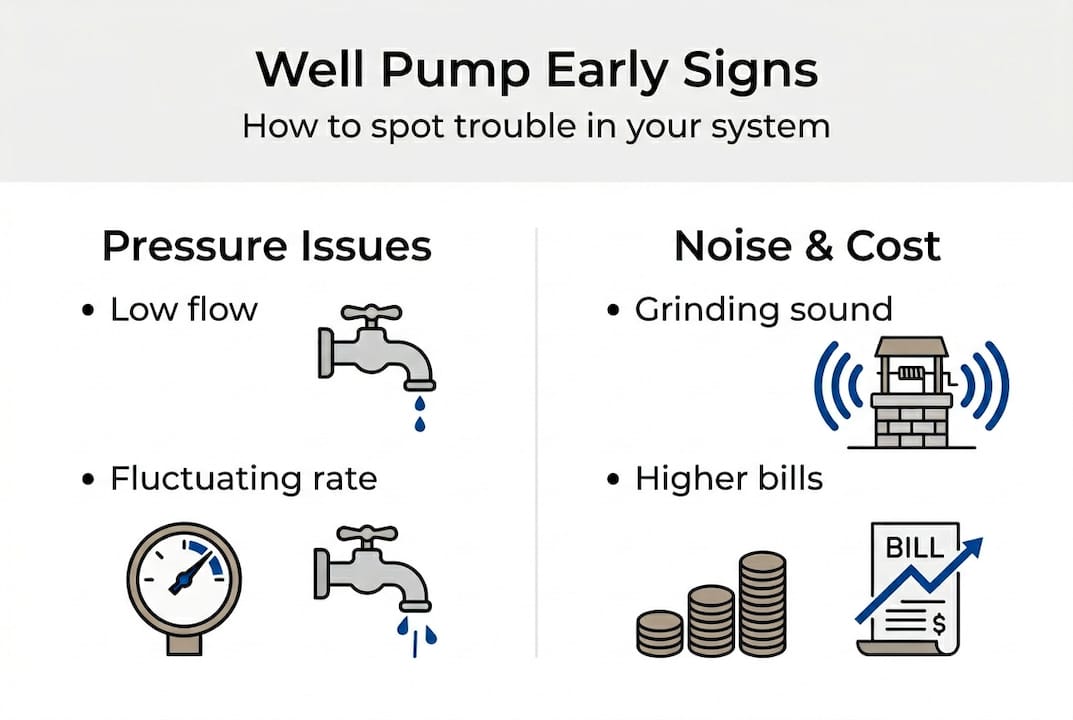
Low or fluctuating water pressure is one of the most common and earliest signs that your pump is struggling. You might notice it first in the shower or when running multiple fixtures at once. Don’t write it off as a plumbing quirk.
Unusual noises like grinding, rattling, or humming often point to bearing wear or cavitation (when the pump pulls in air instead of water). These sounds mean internal damage is already happening.
Short-cycling, which is when the pump turns on and off every minute or two, usually signals a waterlogged pressure tank, a faulty pressure switch, or a low water level in the well. Left unchecked, short-cycling burns out the pump motor fast.
Symptom, probable cause, and urgency level:
Symptom | Probable Cause | Urgency Level |
Low water pressure | Pump wear, clogged filter | Moderate, monitor closely |
Short-cycling | Waterlogged tank, bad switch | High, address within days |
Grinding or humming noise | Bearing failure, cavitation | High, call a pro soon |
Air in water lines | Low water table, pump intake issue | Moderate to high |
Cloudy or sandy water | Sediment intrusion, screen failure | High, test water quality |
Spike in electric bill | Pump running inefficiently | Moderate, investigate cause |
No water at all | Pump failure, tripped breaker | Urgent, check breaker first |
A 20 to 30 percent rise in your electric bill without any other explanation is often one of the first signs your pump is working harder than it should. Most homeowners don’t connect the two until a technician points it out.
Pro Tip: If your pump is humming but not moving water, or if it’s short-cycling more than twice a minute, don’t wait. These patterns almost always get worse before they get better, and a motor burnout means a full replacement instead of a simpler repair.
It also helps to know whether you’re dealing with a pump issue or a pressure tank issue. If you lose pressure suddenly and it returns quickly, the tank is the more likely culprit. If pressure drops gradually and the pump runs constantly, focus on the pump. You can also check inspection red flags that relate to plumbing and water systems to build a fuller picture of what to watch for.
If you’re buying a home in the region, understanding Baldwin County home issues can help you ask the right questions about the well system before you close.
Gulf Coast specifics: Sediment, drought, and pump failure risks
National well pump guides give you general advice. But Gulf Coast Alabama has conditions that change the game. If you live in Baldwin County, Mobile County, or any of the surrounding areas, these regional risks deserve your attention.
How Gulf Coast conditions create unique pump problems:
Sandy coastal soils allow fine sediment to infiltrate well casings, wearing down pump impellers through constant abrasion.
During droughts, the water table drops and pumps may run partially or fully dry, causing overheating and motor failure.
Clay-heavy soils in inland areas can compact over time, reducing water yield in shallow wells and stressing the pump.
High iron content in local groundwater causes rust buildup inside pumps and pipes, reducing flow and efficiency.
Seasonal flooding can introduce surface contaminants into poorly sealed well casings, affecting both pump function and water quality.
Sediment abrasion accelerates impeller wear, and drought or low-yield conditions can cause the pump to run dry, which is one of the fastest ways to destroy a submersible motor. These aren’t rare events in this region. They’re regular seasonal risks.
The sandy soil conditions here are similar to what’s seen further south. Florida’s sandy soil environment increases sediment risk and affects well depth requirements, and the same logic applies across the Gulf Coast. Testing for iron and acid levels in your water isn’t optional here. It’s basic maintenance.
“Gulf Coast homeowners dealing with sandy or clay-heavy soils need to treat well maintenance as a seasonal task, not a once-a-decade afterthought. The soil conditions here accelerate wear in ways that standard pump warranties simply don’t account for.”
Pro Tip: If your well is in a sandy area, install a sediment pre-filter before the pressure tank. This one step can add years to your pump’s life by catching abrasive particles before they reach the impellers. Also have your water tested for iron and pH levels annually. High iron and acidic water corrode pump components from the inside out.
What most Gulf Coast homeowners miss is the connection between their water quality and their pump’s health. They treat these as separate problems. They’re not. Addressing Gulf Coast inspection issues early, including water quality and well condition, is the most cost-effective approach. And don’t overlook how sediment-heavy water affects other systems. Your water heater maintenance schedule should also account for the sediment load in your water supply, since the same particles that wear your pump will settle in your water heater tank.
When to repair, replace, or call a pro: Costs and decision points
Once you’ve identified symptoms, the next question is what to do about them. Not every well pump problem requires an emergency call or a full replacement. Here’s how to think through your options.
Start with these basic checks before calling anyone:
Check the circuit breaker for the well pump. A tripped breaker is the simplest fix and costs nothing.
Look at the pressure switch near the pressure tank. A reset or replacement switch costs under $50 in most cases.
Check the pressure gauge on the tank. If it reads zero with the pump running, you likely have a tank or switch issue, not a failed pump.
Listen for the pump. If you hear it running but have no water, the problem may be a broken pipe or check valve rather than the pump itself.
Complete loss of water is a late-stage symptom, but it doesn’t always mean the pump is dead. Checking the breaker and switch first can save you hundreds of dollars in unnecessary service calls.
Deciding between repair and full replacement:
Check the pump’s age. If it’s under 7 years old and the issue is isolated (a bad capacitor or pressure switch), repair is usually the right call.
Get a repair estimate. If the repair cost exceeds 50 percent of the replacement cost, replacement is the smarter financial decision.
Assess the symptoms. Motor winding failure, physical impeller damage, or repeated breakdowns in a short period all point to replacement.
Consider the urgency. Emergency replacements cost significantly more than planned ones.
Factor in water quality. If sediment damage is severe, replacing the pump without addressing the root cause will just repeat the cycle.
Planned pump replacement typically costs between $1,500 and $4,000 depending on well depth, pump type, and local labor rates. Emergency replacements, especially those requiring after-hours service calls, can run 40 to 60 percent higher than a scheduled job. That cost difference alone makes proactive maintenance worth every dollar.
Repair vs. replace cost comparison:
Situation | Typical Cost Range | Recommended Action |
Pressure switch replacement | $50 to $200 | DIY or basic service call |
Pressure tank replacement | $500 to $1,200 | Professional repair |
Pump motor repair | $300 to $800 | Repair if pump is under 7 years |
Full pump replacement (planned) | $1,500 to $4,000 | Replace if pump is aging or damaged |
Emergency replacement (after hours) | $2,500 to $6,000 | Avoid with proactive maintenance |
One way to reduce long-term costs is to think about reducing energy costs across your whole water system. An efficient, well-maintained pump uses less electricity and lasts longer.
The reality most Gulf Coast homeowners miss about well pumps
Here’s the honest truth we see during inspections across Baldwin, Mobile, and surrounding counties: most well pump failures are not surprises. They’re the result of ignored signals and deferred maintenance. The “fix it when it breaks” mindset is understandable. Well pumps are out of sight, underground, and easy to forget. But that mindset is expensive.
What surprises homeowners most during inspections is not the pump itself. It’s the hidden damage that built up around it. Sediment-clogged screens that have been restricting flow for years. Pressure tanks that were waterlogged so long they burned through two pump motors. Corroded electrical connections at the pressure switch that were one humid summer away from causing a full system shutdown.
We’ve seen buyers walk away from homes with well systems that looked fine on the surface but had pressure readings that told a completely different story. And we’ve seen sellers lose negotiating power because a simple annual well inspection would have caught a failing pressure tank before it became a line item in a buyer’s repair request.
The home inspection findings we document most often in this region include water system issues that were preventable. An annual well inspection, a sediment filter, and a water quality test once a year are not luxury maintenance items in Gulf Coast Alabama. They’re the baseline for protecting a system that your entire household depends on. Don’t wait for no water to start paying attention.
Take the next step: Protect your home with trusted inspections
Knowing the warning signs is the first step. Acting on them is what protects your investment and your family’s access to clean water.

At Trinity Home Inspections, we inspect well systems, plumbing, water quality indicators, and more as part of our full-service home inspections across Baldwin, Mobile, Escambia, Washington, Monroe, and Clarke counties. Our InterNACHI-certified inspectors use thermal imaging, moisture meters, and detailed visual checks to catch what’s easy to miss. If you’re buying a home with a well, or if you’re a current homeowner who hasn’t had a system check in years, now is the time. We also offer real estate permit searches, mold inspection services, and sewer scope inspections so you get a complete picture of your home’s condition without scheduling multiple contractors.
Frequently asked questions
How long should a well pump last in Gulf Coast Alabama?
Most well pumps last 8 to 15 years nationally, but Gulf Coast sandy soils can shorten that lifespan to as little as 5 to 10 years due to sediment abrasion and regional water quality conditions.
Which symptoms mean I need to call a professional?
If you notice constant low pressure, loud noises, cloudy or sandy water, or a complete loss of water, those are clear signals to call a licensed well pump professional rather than waiting to see if the issue resolves on its own.
How do I know if my pressure tank or pump is the actual problem?
Short-cycling usually points to a waterlogged pressure tank, while continuous running or a pump that won’t start at all typically indicates a pump motor issue. A professional can test both components to confirm the source.
Can sediment filters extend well pump life?
Yes. Installing a sediment pre-filter helps prevent impeller abrasion from sand and fine particles, which is especially important for Gulf Coast wells where sandy soils make sediment intrusion a constant risk.
Recommended

