
Insulation R-value guide for Gulf Coast Alabama homes


Most homeowners shopping for insulation fixate on one number: the R-value printed on the bag or the spec sheet. The assumption is simple — the higher that number, the lower your energy bills and the more valuable your home. But that assumption leads thousands of Gulf Coast Alabama homeowners to spend money on insulation upgrades that barely move the needle on their utility bills. The truth is that a perfectly installed R-30 attic almost always outperforms a poorly installed R-60 attic, and the reason comes down to factors most contractors never explain clearly.
Key Takeaways
Point | Details |
R-value isn’t everything | Installation quality and air sealing matter as much as the insulation’s R-value. |
Local code is your baseline | Choose R-value levels that meet or slightly exceed Gulf Coast code minimums for best results. |
Diminishing returns exist | Going far beyond minimum R-value offers little benefit if air leaks remain unaddressed. |
Balanced upgrades maximize value | Combining insulation improvements with air sealing gives the strongest boost to energy efficiency and property value. |
Understanding insulation R-value: What it means and why it matters
R-value measures a material’s resistance to heat flow. The “R” stands for resistance, and a higher number means the material slows heat transfer more effectively. Think of it as a numeric score for how hard insulation works to keep your conditioned air inside and the outdoor heat outside. For Gulf Coast Alabama homeowners, where summer temperatures regularly sit above 90 degrees Fahrenheit and humidity stays high for months on end, managing that heat transfer is directly tied to your monthly power bill and your family’s comfort.
Here is the part most people miss. R-value is measured under controlled laboratory conditions. A perfectly uniform, uninterrupted layer of insulation tested in a sealed chamber will perform exactly at its rated value. But your attic is not a sealed chamber. It has wiring penetrations, recessed lighting cans, HVAC ducts, gaps at the top plates of walls, and countless other spots where air can move freely. As InsulationRValues.com explains, the best R-value is not only about the insulation material’s labeled R-value because air sealing and installation quality strongly affect real-world performance.
Understanding this principle changes how you approach every insulation decision in your home.
Key factors that affect actual insulation performance:
Installation quality: Compressed batts, gaps between batts, and insulation that doesn’t fully contact surfaces all reduce effective R-value significantly
Air leaks: Even a small gap or crack allows air movement that bypasses insulation entirely, making the R-value on that section essentially irrelevant
Moisture: Gulf Coast humidity can cause insulation to absorb moisture, which drops its thermal resistance and invites mold growth
Thermal bridging: Wood framing, concrete blocks, and metal connectors conduct heat directly, creating weak spots in the thermal envelope regardless of insulation R-value
“The labeled R-value represents the best-case performance of the material itself. Real-world performance depends on how well your entire building assembly manages both heat conduction and air movement.” — InsulationRValues.com
Here is a quick reference for common insulation materials and their R-values per inch:
Insulation type | R-value per inch | Best application |
Fiberglass batt | R-2.9 to R-3.8 | Walls, attic floors |
Blown fiberglass | R-2.2 to R-4.3 | Attic floors, hard to reach spaces |
Blown cellulose | R-3.2 to R-3.8 | Attic floors, walls (dense pack) |
Open cell spray foam | R-3.5 to R-3.7 | Walls, unvented attics |
Closed cell spray foam | R-6.0 to R-7.0 | Crawl spaces, rooflines |
Rigid foam board | R-3.8 to R-6.5 | Exterior walls, basements |
The air sealing benefits for your HVAC system are significant. When conditioned air leaks out through gaps and cracks, your system runs longer cycles trying to maintain your set temperature. That translates directly to higher energy costs and more wear on your equipment, regardless of how much insulation you have sitting above those leaks.
How Gulf Coast climate influences the best insulation R-value
With a clear understanding of R-value, let’s see how local climate and codes shape what “best” really means on the Gulf Coast. Alabama’s coastal counties fall into Climate Zone 2 and Zone 3 as defined by the U.S. Department of Energy. These zones are characterized by hot, humid summers, mild winters, and year-round moisture challenges. This climate profile is fundamentally different from the northern half of the country, where insulation decisions are driven by brutal cold. Here, your insulation strategy must address summer heat gain just as seriously as it handles winter heat loss.
The numbers that matter for Gulf Coast homeowners are the minimum R-value requirements for different parts of the home. These minimums represent the floor, not the ideal. Meeting them gets you code compliance; exceeding them thoughtfully gets you real energy savings.
Recommended R-values by location for Gulf Coast Alabama:
Attic insulation: R-30 minimum, with R-38 being the sweet spot for energy savings without overspending
Cathedral ceilings and roof decks: R-19 to R-38 depending on the assembly type and whether the space is vented or unvented
Exterior walls: R-13 in stud cavities is the code minimum, with R-15 or continuous exterior insulation improving performance noticeably
Crawl space walls or floors: R-13 in the floor or R-19 on crawl space walls if conditioned; consult a professional for your specific situation
Garage walls adjacent to conditioned space: R-11 minimum, though R-13 or R-15 batts are standard and cost little more
As the U.S. Department of Energy notes, for property value and comfort goals, the best single R-value number is usually the one that meets or slightly exceeds local code minimums for your specific climate zone and is implemented with adequate air sealing. That guidance is important because it frames the conversation correctly. You are not looking for the absolute maximum; you are looking for the right balance.
Comparison: R-value minimums versus over-insulation in Gulf Coast Zone 2/3
Location | Code minimum | Recommended target | Over-insulation threshold |
Attic floor | R-30 | R-38 | Above R-49 |
Walls | R-13 | R-15 to R-20 | Above R-25 |
Crawl space | R-13 | R-19 | Above R-25 |
Slab edge | R-0 to R-10 | R-10 | Above R-20 |
Statistic to keep in mind: Homes that are properly insulated and air sealed can reduce heating and cooling energy use by 15 to 20 percent compared to homes that meet only minimum code requirements, according to energy modeling studies for hot-humid climate zones.
Pro Tip: If you’re considering garage insulation in Gulf Coast Alabama, don’t forget the door between your garage and living space. That single door is often completely uninsulated and can account for significant heat gain in summer months, making it one of the most cost-effective upgrades you can make.
Don’t overlook windows either. Even with excellent attic and wall insulation, single-pane windows create dramatic heat gain in direct summer sun. Learning about window insulation for climate control is a natural next step once your primary insulation decisions are made.
Installation quality and air sealing: The missing link in R-value performance
Choosing the right material and R-value is not enough. Let’s explore why installation and sealing are the silent factors in your real energy savings. This is where many well-meaning homeowners and even experienced contractors fall short. They focus almost entirely on what insulation goes in and how thick it is, then skip the foundational work that determines whether any of that insulation performs the way it should.
Consider a real scenario. A homeowner in Fairhope replaces blown fiberglass attic insulation with fresh blown cellulose at R-38. The contractor does solid work blowing in the material. But nobody seals the gap around the 12 recessed light cans in the ceiling below, the open top plates in the master bedroom wall, or the area where the HVAC supply trunk passes through the ceiling. Six months later, the homeowner notices their cooling bills barely changed. The insulation is there, but air is moving freely around it, pulling conditioned air out and drawing humid outdoor air in.
As InsulationRValues.com confirms, real-world performance falls short when gaps and leaks remain, even when the field-installed R-value matches the design spec perfectly.
Common installation mistakes that reduce effective R-value:
Compressed batts: Fiberglass batts need to fill the full cavity depth to achieve their rated R-value. Stuffing a thicker batt into a narrow cavity compresses it and cuts the actual R-value significantly.
Gaps at edges and ends: Batts that don’t extend fully to the edges of cavities leave thermal bypasses at every stud bay.
Missing insulation above interior walls: The gap between the top of interior wall partitions and the attic floor is one of the most common air leakage points in Alabama homes.
Recessed lighting cans: Traditional cans are essentially holes in your ceiling. Without sealed covers or air-tight rated fixtures, they are direct conduits for heat and moisture exchange.
HVAC penetrations: Every pipe, wire, and duct that passes through an insulated assembly creates a potential air leak if the penetration isn’t sealed with appropriate materials.
“Installing more insulation over an unaddressed air leakage problem is like putting on a thicker sweater while leaving the door open. The sweater is real, but the air movement overrides the benefit.”
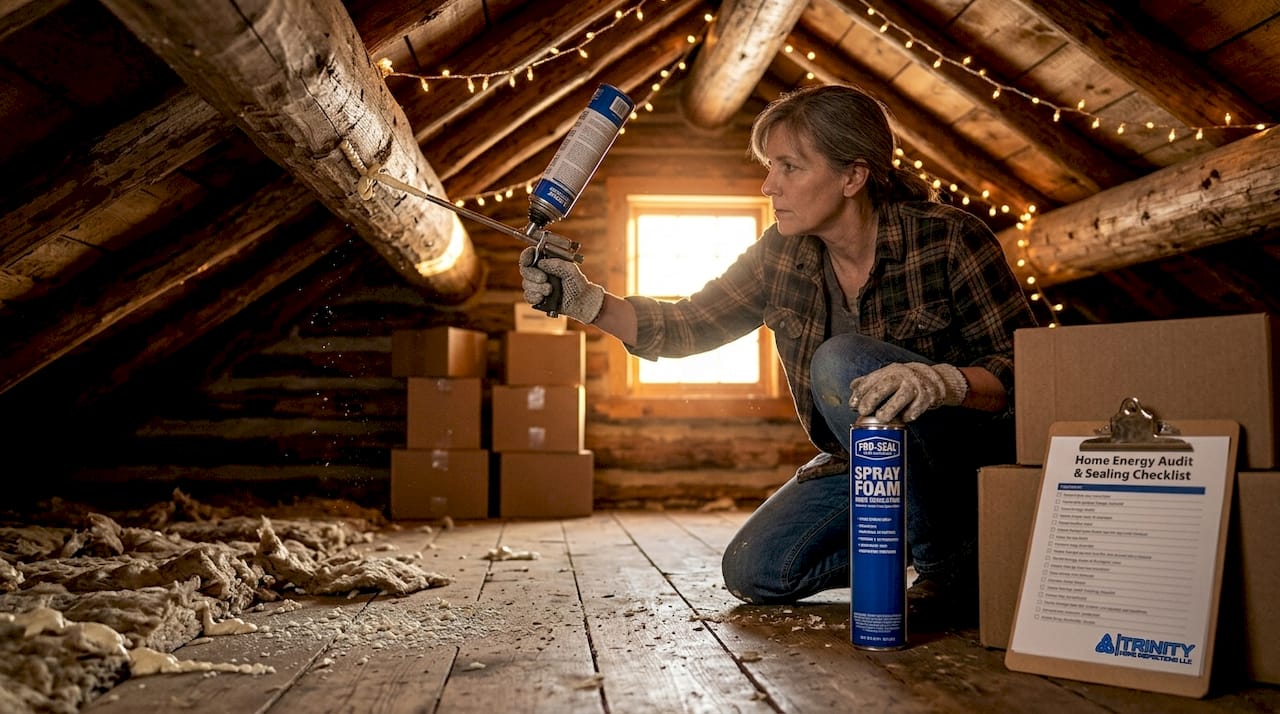
Pro Tip: Before adding any new insulation to your attic, invest in air sealing first. Caulk, spray foam, and rigid blocking at penetrations, top plates, and light fixtures will cost a fraction of what new insulation costs and will often deliver more measurable energy improvement than simply adding insulation depth.
The evidence for this shows up clearly in thermal imaging. Our inspections at Trinity Home Inspections include free thermal imaging, and we regularly find attics with visually adequate insulation depth that still show significant heat transfer through unaddressed gaps and bypasses. The thermal camera doesn’t lie. You can see exactly where heat is moving even when the insulation looks fine from the attic hatch.
Learning about air sealing shiplap ceilings is particularly relevant for older Gulf Coast homes, where tongue and groove wood ceilings are common and create unique air sealing challenges. Similarly, insulation installation errors in new construction are more common than most buyers realize, and a thorough inspection with thermal imaging can catch them before you close.
Balancing cost, energy savings, and property value: Practical R-value choices
Now, let’s bring it all together with practical steps to maximize efficiency, comfort, and property value without overspending. The question of how much insulation is “enough” has a financial dimension that matters just as much as the technical one. Insulation upgrades follow a clear curve of diminishing returns. The jump from R-11 to R-22 produces dramatic energy savings. The jump from R-38 to R-60 produces very little additional savings for the same type of climate zone, especially if air sealing hasn’t been addressed first.
Statistic to note: Department of Energy modeling suggests that for Climate Zone 2 homes, upgrading attic insulation from R-11 to R-30 can reduce attic-related heat gain by roughly 70 percent. Moving from R-30 to R-60 reduces it by only an additional 15 to 20 percent, at significantly higher material and labor cost.
Smart insulation decision checklist for Gulf Coast Alabama homeowners:
Assess what you have first. Pull back attic access and measure actual depth and coverage. Look for gaps, compression, or missing sections before spending money on new material.
Air seal before you insulate. Address all penetrations, top plates, and bypasses before adding or replacing insulation. This step alone can improve energy efficiency noticeably.
Match material to application. Blown cellulose or blown fiberglass work well for attic floors. Closed cell spray foam makes more sense for crawl space walls or rim joists where moisture resistance matters.
Target R-38 for attic floors. In the Gulf Coast climate zone, R-38 offers a solid balance of performance and cost. Going beyond R-49 rarely pays back within a reasonable time frame.
Don’t skip the small stuff. Insulating the band joists at your floor framing, the attic hatch, and HVAC duct runs in unconditioned spaces all contribute meaningfully to whole-home efficiency.
Get it verified. After installation, a thermal imaging inspection confirms coverage gaps and air leakage that visual inspections miss entirely.
As the Department of Energy notes, insulation R-value has diminishing returns if the building envelope is leaky or improperly assembled. Spending more on R-value without addressing the assembly is one of the most common ways homeowners waste money on energy upgrades.
Return on investment reference table for Gulf Coast Alabama:
Upgrade | Approximate cost | Estimated annual savings | Simple payback period |
Attic air sealing only | $300 to $700 | $100 to $200 | 3 to 5 years |
Upgrade attic to R-38 | $800 to $2,000 | $150 to $300 | 5 to 8 years |
Crawl space insulation | $1,500 to $3,500 | $200 to $400 | 7 to 10 years |
Wall cavity upgrade | $2,000 to $5,000 | $100 to $250 | 12 to 20 years |
Pro Tip: Before budgeting for insulation, review crawl space insulation cost estimates for Gulf Coast conditions. Crawl space moisture in our region often degrades insulation prematurely, so choosing the right material for that environment is critical to getting the return you expect.
For homeowners thinking long term about property value, pairing insulation upgrades with an energy efficient roofing upgrade can compound your savings. A metal roof with a proper radiant barrier and attic air sealing creates a system-level improvement that buyers notice and appraisers increasingly recognize.
Why “the best R-value” advice often misses the point in Gulf Coast homes
After considering all the evidence and practical tips, here’s what most guides miss about R-values in our region. We’ve looked at dozens of homes across Baldwin and Mobile counties where homeowners spent real money on insulation upgrades that delivered frustrating results. The pattern is almost always the same. Someone got a generic R-value recommendation, paid a contractor to install it, and assumed the problem was solved. It rarely was.
The advice you read in most national articles treats R-value as a universal prescription. “Install R-49 in your attic” sounds authoritative. But that recommendation was written for a national audience spanning Climate Zone 1 through Zone 7. Gulf Coast Alabama sits at the warm end of that scale. An R-49 attic that costs thousands more than an R-38 attic will not produce thousands more in energy savings here. The math simply doesn’t support it in Zone 2 or Zone 3 conditions.
What we’ve seen in practice is that the homes with the most dramatic efficiency improvements are not the ones with the highest R-values. They are the ones where someone thought carefully about the entire assembly. Air sealing was done first. Insulation was chosen for the specific application, not just the price per bag. The crawl space and band joists got attention, not just the attic. And a verification step confirmed the work actually performed as expected.
The Gulf Coast adds a layer of complexity that most generic guides ignore entirely: moisture. Insulation strategies that work perfectly in Phoenix or Minneapolis fail in Mobile. Vapor management, moisture-resistant materials, and proper ventilation strategies matter here in ways they simply don’t in drier or colder climates. Installing kraft-faced batts in a Gulf Coast crawl space, for example, creates the perfect conditions for mold growth because vapor moves from the exterior in summer and has nowhere to go.
Our perspective, grounded in what we see during inspections every week, is this: stop chasing R-value numbers and start thinking about building science. The goal is a well-sealed, properly insulated thermal envelope where every component works together. The sealing for efficiency step is not optional or secondary. It is foundational. When air sealing is done right, even modest R-values perform well. When it is skipped, even impressive R-values disappoint.
The single question worth asking before any insulation project is not “what R-value should I use?” It is “where is air currently moving through my home, and what will I do about it before I add insulation?” Answer that question first, and the R-value decision becomes much clearer.
Ready to make your Gulf Coast home more efficient and valuable?
You’ve learned how R-value truly impacts your home, and more importantly, why the installation quality and air sealing beneath that number determine your actual results. Taking action on that knowledge is the next step. Whether you’re buying a home in Daphne, selling in Foley, or simply trying to understand what’s happening in your attic in Orange Beach, having verified, documented information about your home’s insulation puts you in a much stronger position.
[

At Trinity Home Inspections, we include free thermal imaging with every inspection, which means we can show you exactly where your insulation is performing and where it is falling short. Our same-day reports document every finding with photos and video so you have a clear record to share with contractors. Before you invest in any insulation upgrade, consider checking a property permit search to verify what insulation work was permitted and inspected on your property. If you’re preparing to list your home, a pre-sale home inspection can surface insulation deficiencies before buyers discover them, keeping your transaction on track.
Frequently asked questions
What R-value is recommended for attic insulation in Gulf Coast Alabama homes?
For most Gulf Coast Alabama homes, R-30 to R-38 attic insulation meets code minimums and delivers solid comfort and efficiency, since the best R-value meets or slightly exceeds local code minimums for your specific climate zone rather than simply maximizing thickness.
Is a higher R-value always better for property value?
Exceeding minimum R-value can help, but poor installation or air leaks erase the benefits, because real-world performance depends on air sealing and installation quality just as much as the material’s labeled R-value.
How does air sealing affect insulation R-value performance?
Air sealing prevents leaks and drafts, allowing insulation to perform at its rated R-value and improving energy efficiency, since field-installed performance can significantly underachieve if gaps and leaks remain after insulation is installed.
What is the risk of installing more insulation without addressing air leaks?
Adding insulation atop a leaky structure results in less real-world benefit and wasted money, because diminishing returns become severe when the building envelope still allows air movement that bypasses even the thickest insulation layer.
Recommended